
We may earn a commission if you buy through links on this page. It never changes a score or a ranking. How we make money
The bottom line
Zero Hash covers many financial flows through APIs, but buyers need to validate integration and commercial details.
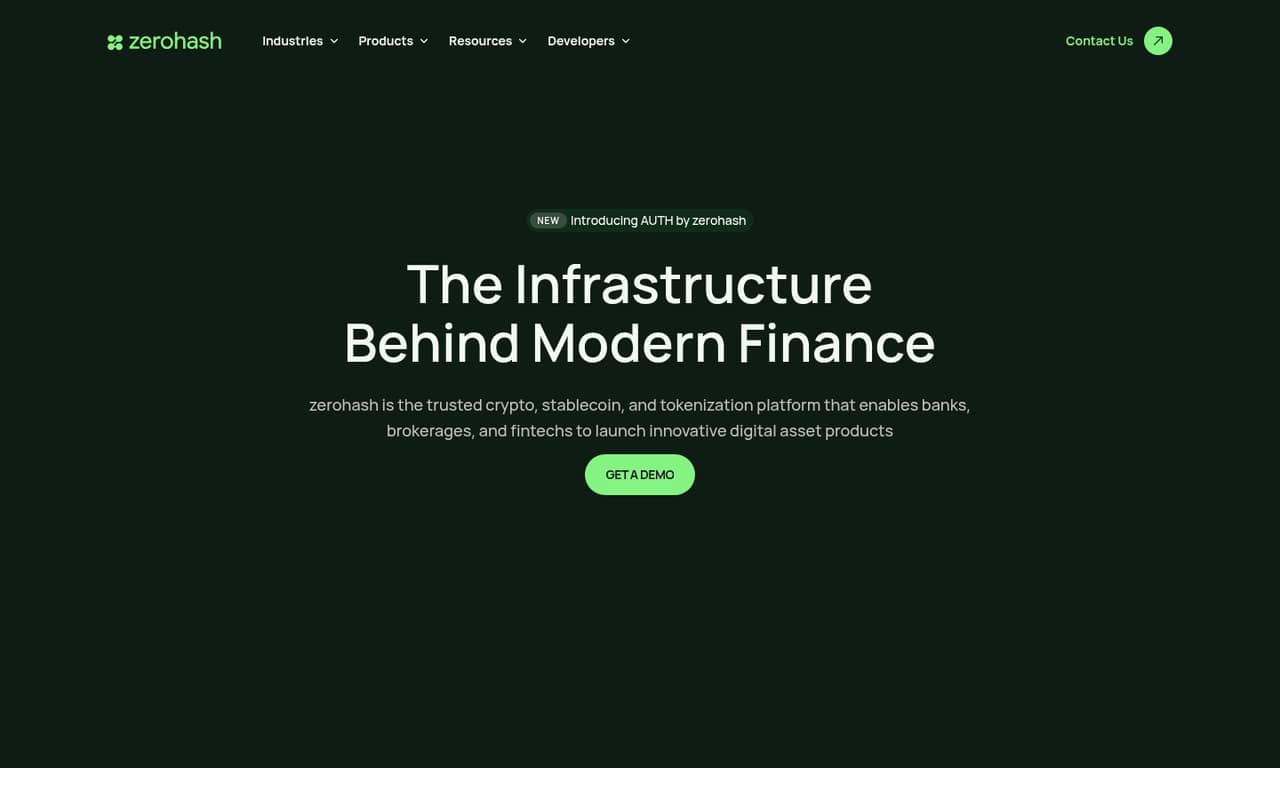
Zero Hash is API-based financial infrastructure for businesses adding digital-asset trading, staking, custody, payments, payouts and tokenization. It could reduce the number of separate capabilities a platform has to build, but the vendor’s public materials leave key implementation details to confirm with its team.
Pricing is custom, with no free plan or published usage limits. Before committing, ask for API and SDK specifics, production limits, service commitments, data-export terms and a complete cost model for your expected transaction mix.
Good fit if
- Platforms adding crypto trading
- Businesses building digital-asset payments
- Teams needing custody and payouts
Skip it if
- Developers seeking a free tier
- Teams requiring self-hosted infrastructure
- Buyers needing public rate limits
ScoresHow it rates
What works
- One API-oriented offering spans multiple financial capabilities
- Supports trading, staking and qualified custody
- Includes payins, payouts and remittances
- Offers tokenization payment rails and an engine
- Targets businesses adding financial capabilities to platforms
What doesn't
- Custom pricing requires a sales conversation
- No free plan or trial is listed
- Usage limits and overage rates are not published
- SDK languages and API conventions need confirmation
- License, self-hosting and data-export terms need confirmation
01What Zero Hash is, technically
Zero Hash is a financial infrastructure provider that exposes capabilities through APIs. It sits between a business’s application and the financial operations behind digital assets: trading, staking, custody, payments, payouts, remittances and tokenization. The intended customer is a platform adding those capabilities without building each underlying service itself.
The product is not presented as a developer library, CLI or self-hosted server. Its homepage describes API-based infrastructure and products such as embeddable crypto trading, qualified custody and a lending stack. That makes Zero Hash a potential integration layer in a fintech, brokerage, marketplace, payments or gaming stack—not a ready-made consumer crypto app. The vendor also lists on- and off-ramps and account funding among its product areas. Buyers should map each required flow to a specific API and confirm which parts of the transaction, compliance and operational lifecycle Zero Hash handles.
02Zero Hash API, SDKs and docs
The stated integration surface is the Zero Hash API. The homepage presents API-backed products for buying and selling crypto, staking, qualified custody, payins, payouts, remittances and tokenization, and includes a Developers entry point. That positions the product for integration into an existing platform rather than use as a standalone developer tool.
The homepage does not name API conventions, SDKs, programming languages, webhooks, a CLI or plugins. Confirm SDK availability and language support in the vendor’s developer documentation before choosing an implementation path. Also ask for examples of authentication, environment setup, idempotency, transaction state changes, error handling and webhook delivery if those are relevant to your architecture. The homepage names product categories, but not their precise integration boundaries; get a flow-by-flow API map and confirm which capabilities are generally available to your business and region.
03Zero Hash pricing for developers
The pricing page lists custom pricing for organizations seeking commercial terms. It does not list a starting price, monthly or annual rate, free plan, free trial, seat limit or usage allowance. The pricing check dated November 10, 2026, records pricing confidence as low; buyers should confirm current terms directly with sales.
There is no published price table to use for estimating costs as traffic grows. The vendor does not publish usage rates, transaction fees, overage charges or add-on prices in the published pricing information. That leaves teams without a public way to calculate a monthly bill from request volume, transaction count, custody needs or payment flows. Ask for a written quote based on expected volumes and the specific products in scope. Get the billing unit, minimum commitments, included usage, fees by transaction type, overages, implementation charges and any separate custody or settlement costs in writing. Without those terms, a cost comparison against other payment APIs is incomplete.
04Zero Hash: open source, self-hosting and lock-in
Zero Hash is presented as API-based financial infrastructure, not as software to install in your own environment. The homepage does not publish a source-code license or describe a self-hosted deployment option. Ask the vendor whether any components are available under an open-source license and whether the service can run in a customer-controlled environment before treating either as an option.
The homepage also does not describe data-export tools or a migration path. Because the product can sit across trading, custody and payment flows, replacing it may involve more than changing an API endpoint: your team will need to understand how transaction records, asset positions and operational workflows can move to another provider. Request export formats, retention terms, access during termination and a transition plan. Build internal abstractions around provider-specific calls where practical, and keep your own ledger and reconciliation records in formats your team can use independently.
05Zero Hash in production
Before putting Zero Hash on a critical path, get the production limits and operating commitments in writing. The vendor does not publish API rate limits, throughput figures or service-level terms in the published pricing and homepage information. Confirm authentication and key management, supported regions, incident communication, retry behavior, transaction reconciliation and how custody responsibilities are divided. The homepage uses the term “Qualified Custody,” but teams still need to review the applicable custody model and compliance obligations with the vendor and their own counsel.
A Reddit discussion comparing stablecoin infrastructure characterizes Zero Hash as leaning toward custody and compliance layers. That is one commenter’s assessment, not a technical specification or a guarantee of coverage. Another commenter emphasizes the importance of a provider that will build with a smaller customer, but does not report a specific Zero Hash support experience. Treat service responsiveness as a diligence question: ask for escalation paths, support coverage, incident history and references from customers with a similar transaction profile.
From the threadsWhat users say
The Reddit discussion is limited and mixed: one thread frames Zero Hash as a custody- and compliance-oriented option, while another raises practical diligence and provider-fit questions. The comments do not provide verified implementation or reliability reports.
As a crypto lawyer, you need to hire a crypto lawyer
we're small so we need providers that'll actually build with us not just serve us
Cybrid and Zero Hash lean more into custody and compliance layers
You can't even make contactless payments in Walmart. Lol
Questions people ask
What does Zero Hash do?
Zero Hash provides financial infrastructure through APIs for businesses adding digital-asset capabilities to their platforms. Its homepage lists crypto trading, staking, qualified custody, lending, payments, payouts, remittances and tokenization. It is aimed at businesses and platforms, rather than consumers looking for a standalone crypto app.
Does Zero Hash offer a free plan or trial?
The pricing information lists no free plan or free trial. Zero Hash uses custom pricing, and prospective customers are directed to contact sales. Ask whether evaluation access or a sandbox is available, and whether any fees or usage limits apply to it.
How much does Zero Hash cost?
Zero Hash does not publish a starting price or monthly or annual rates in the pricing information. Pricing is custom, so request a quote based on your products, expected transaction volumes and regions. Ask for usage units, minimum commitments, overages and any separate fees.
Which programming languages and SDKs does Zero Hash support?
The homepage identifies an API and a Developers entry point, but does not name supported SDKs or programming languages. Check the vendor’s developer documentation and ask which SDKs are maintained, what API conventions they use, and whether they support your team’s language and deployment environment.
Can Zero Hash be self-hosted?
Zero Hash is presented as API-based financial infrastructure, not as a self-hosted server or library. The homepage does not publish a self-hosting option or source-code license. Ask the vendor about deployment choices, source availability, data exports and transition support before signing a contract.
Sources
- Zero Hash homepage
- Zero Hash pricing, compiled via web search from zerohash.com
- Reddit: Which Service is Better for Launching Cryptocurrency Exchange with Regulatory Compliance: Prime Trust or Zero Hash?
- Reddit: What is stablecoin payment infrastructure, comparing cybrid bvnk bridge and zero hash
- Reddit: Zebec partnership with Zero Hash, zero hash infrastructure for crypto payments in Walmart