
We may earn a commission if you buy through links on this page. It never changes a score or a ranking. How we make money
The bottom line
A broad JSON SERP API with a free tier, but hosted-service limits need checking before scaling.
Zenserp is a hosted HTTP API that returns live Google search results and other SERP data as JSON. It covers standard results, ads, snippets, local results and specialized searches, with a request builder for generating code examples.
The free plan includes 50 searches per month; paid plans start at $49.99 monthly. The API fits applications that need structured search data without operating their own scraping infrastructure, but plan limits, concurrency and provider-specific response formats are production considerations.
Good fit if
- Apps that consume SERP data
- Prototypes with light search volume
- Teams needing varied SERP types
Skip it if
- Teams requiring self-hosted search
- Projects needing published overage rates
- Workloads above standard concurrency limits
ScoresHow it rates
What works
- 50 monthly searches on the free plan
- Google organic, paid and snippet data
- Bing, Yandex and DuckDuckGo on paid plans
- Image, Maps, News, Trends and Shopping data
- Request builder generates code snippets
What doesn't
- Standard plans are advised to stay below 400 concurrent connections
- Overage pricing is not published
- No source licence or self-hosting option is published
- API response formats can create provider-specific integration work
- One Reddit thread shows uncertainty around batch requests
01What Zenserp is, technically
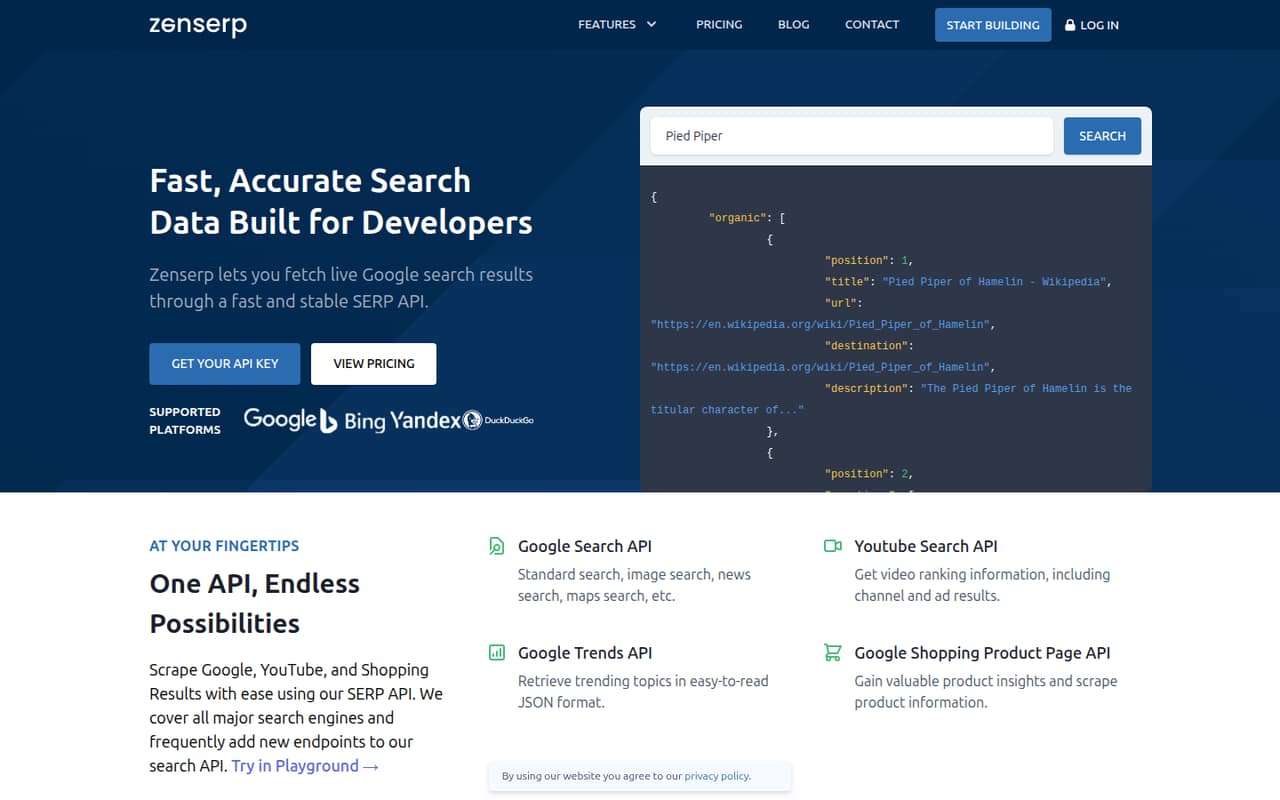
Zenserp is a hosted SERP API: your application sends an HTTP request to Zenserp, and the service returns search data in JSON. It is not presented as a library, CLI or self-hosted server. The homepage shows a Google search request using a GET endpoint at https://app.zenserp.com/api/v2/search, with a query and engine passed as parameters.
The service sits between your application and search-result pages. Instead of building and maintaining your own search-results collection pipeline, you request structured results such as organic and paid listings, related questions, answer boxes, knowledge graphs, videos, local results and Maps data. The listed coverage also includes Google Images, News, Shopping and Trends, plus Bing, Yandex and DuckDuckGo search on paid plans.
This architecture keeps collection infrastructure outside your codebase, but makes your application dependent on Zenserp’s availability, pricing and response schema. Your code still needs to handle authentication, request failures, usage tracking and mapping returned fields into your own data model.
02Zenserp API, SDKs and docs
The documented integration surface is an HTTP API that returns JSON. The homepage gives a GET example for /api/v2/search with q and engine parameters and says data can be retrieved with any HTTP client. It does not name particular SDKs, languages, CLI tools, webhooks or plugins; confirm SDK support in Zenserp’s documentation if your stack requires a maintained client.
Zenserp offers a Playground, documentation and examples, plus a request builder that generates production-ready code snippets from configured requests. The homepage says its Google search API supports setting parameters and filters. Its example response groups organic results and can include questions and videos within those results. The vendor also documents batch functionality, and the Medium plan includes a batch endpoint.
A Reddit thread about batch searches shows that at least one user was unsure how to submit multiple keywords, while a responder found the documentation clear. Before building a large ingestion job, verify the batch request shape and error handling in the current docs, then test the returned JSON against your own parser.
03Zenserp pricing for developers
The Free plan includes 50 searches per month, Google Search, all SERP types and email support. The Small plan costs $49.99 per month, or $39.99 per month on annual billing, and includes 25,000 searches monthly plus Google, Bing, Yandex and DuckDuckGo. The pricing page lists a 20% discount for annual subscriptions.
Medium is $149.99 monthly or $119.99 per month on annual billing for 100,000 searches; it adds a batch endpoint, keyword volume and CPC, personal support and an SLA. Large costs $299.99 monthly or $239.99 on annual billing for 250,000 searches. Premium costs $499.99 monthly or $399.99 on annual billing for 500,000. Enterprise costs $899 monthly or $719.20 on annual billing for 1,000,000 searches, with priority support. Higher volumes are available by custom quote.
AI Overview requests use three searches each, so they consume plan allowances faster. The vendor advises standard plans not to exceed 400 concurrent connections. Overage rates are not published; ask Zenserp about excess usage and higher concurrency before committing.
04Zenserp: open source, self-hosting and lock-in
Zenserp is presented as a hosted API. The vendor does not publish a source licence or self-hosting option, so teams should treat it as an external service rather than software they can deploy inside their own infrastructure. Ask Zenserp about data handling, retention and contractual terms if those affect your security or compliance requirements.
The API returns results as JSON, which gives your application data to store or transform, but the vendor does not publish a separate data-export facility on the vendor's site. Plan for provider-specific response fields: moving to another SERP API would likely require changing request construction and mapping its output into your internal schema. Keeping a normalized search-result model behind your own adapter can reduce that migration work. The service’s core dependency is the hosted collection and delivery layer; Zenserp does not document a self-hosted fallback.
05Zenserp in production
Zenserp says it returns live search results in real time, but the vendor does not publish a latency target or uptime figure on the vendor's site. The pricing page advises standard plans not to exceed 400 concurrent connections; contact Zenserp about a higher limit. Ask the vendor for rate limits, retry guidance, SLA terms for your selected plan, and details on authentication, data retention and security controls before making the API a critical dependency.
Usage is metered by searches, and AI Overview requests consume three searches each. Track that consumption in your application and decide how it should respond when the allowance runs out; overage pricing is not published. Zenserp’s Medium plan lists an SLA and personal support, while Enterprise lists priority support.
A Reddit thread records confusion about how to batch multiple keywords; one reply says the documentation is clear. That is limited evidence, not a general reliability signal. Validate batch behavior, concurrency and error responses against the current documentation before scaling.
From the threadsWhat users say
The available Reddit discussion is mixed and too limited to establish broad user sentiment. One user found batch-search guidance unclear, while a responder said the documentation was clear.
not very clear on how to use it
as i have looked into it its very clear
I wanted to batch search multiple keywords
the q parameter is ur query
Questions people ask
What does Zenserp return?
Zenserp returns live search data as JSON. Its listed Google coverage includes organic and paid results, snippets, related questions, answer boxes, knowledge graphs, videos, local results and Maps data. It also lists image, News, Shopping and Trends searches, along with Google Places data. The pricing page lists Bing, Yandex and DuckDuckGo on paid plans.
Does Zenserp have a free plan?
Yes. The Free plan includes 50 searches per month, Google Search, all SERP types and email support. It is a limited allowance for basic requests rather than a high-volume production plan. The pricing page does not list a separate free trial.
How much does Zenserp cost?
Paid plans start with Small at $49.99 per month, or $39.99 per month on annual billing, for 25,000 searches. Higher plans range from Medium at $149.99 monthly for 100,000 searches to Enterprise at $899 monthly for 1,000,000. The vendor offers custom quotes above that volume.
Can Zenserp search multiple keywords in a batch?
Zenserp has a batch endpoint, and the Medium plan lists batch access. A Reddit thread shows a user asking whether batch search can handle multiple keywords; the discussion does not settle the implementation details. Check the current batch documentation and confirm request format, limits and error handling before relying on it.
What are Zenserp’s production limits?
The pricing page advises standard plans not to exceed 400 concurrent connections and says to contact Zenserp about a higher limit. AI Overview requests use three searches each, which reduces the number of other searches covered by an allowance. Ask the vendor about rate limits, overages and SLA terms for your plan.