
We may earn a commission if you buy through links on this page. It never changes a score or a ranking. How we make money
The bottom line
A broad hosted Grok API with familiar SDK paths and metered costs.
xAI API is a hosted endpoint for Grok text, code, image, video, voice, and search features. Python, TypeScript, the OpenAI SDK, and cURL examples give developers several ways to connect, and every Console account includes a Playground.
The trade-offs are metered API charges, limited published production detail, and dependence on xAI’s hosted service. Subscription plans do not include a stated API usage allowance; check rate limits and enterprise requirements before building around it.
Good fit if
- Teams building Grok-powered applications
- Apps needing text and media APIs
- Developers using OpenAI SDK patterns
Skip it if
- Teams requiring self-hosted models
- Projects needing predictable fixed API costs
- Buyers requiring published rate limits
ScoresHow it rates
What works
- Text, code, image, video, voice, and search through one API
- Python, TypeScript, OpenAI SDK, and cURL examples
- Console Playground included with every account
- Files and collections support document search and reasoning
- Enterprise options include SSO and data residency
What doesn't
- API usage is billed separately from subscription plans
- Public rate-limit numbers are not listed
- The vendor does not publish self-hosting or licence details
- No API free usage allowance is stated
- General support and service reliability terms need confirmation
01What xAI API is, technically
xAI API is a hosted API service, not a library, CLI, or self-hosted model server. Applications send requests to xAI’s API endpoint and receive responses from Grok models. The service covers text and code generation, image and video generation, voice workflows, and real-time web and X search.
It sits behind an application or agent in a typical stack: your code handles user input, calls the API with an API key, then uses the response in the product. The Console provides a Playground for trying models and API keys for integrations. Files and collections let developers upload PDFs, spreadsheets, and presentations for search and reasoning. Enterprise options add controls such as SSO, audit logging, invoicing, and data residency. The API therefore combines model access with several application-level capabilities, while inference and service operation remain on xAI’s infrastructure.
02xAI API API, SDKs and docs
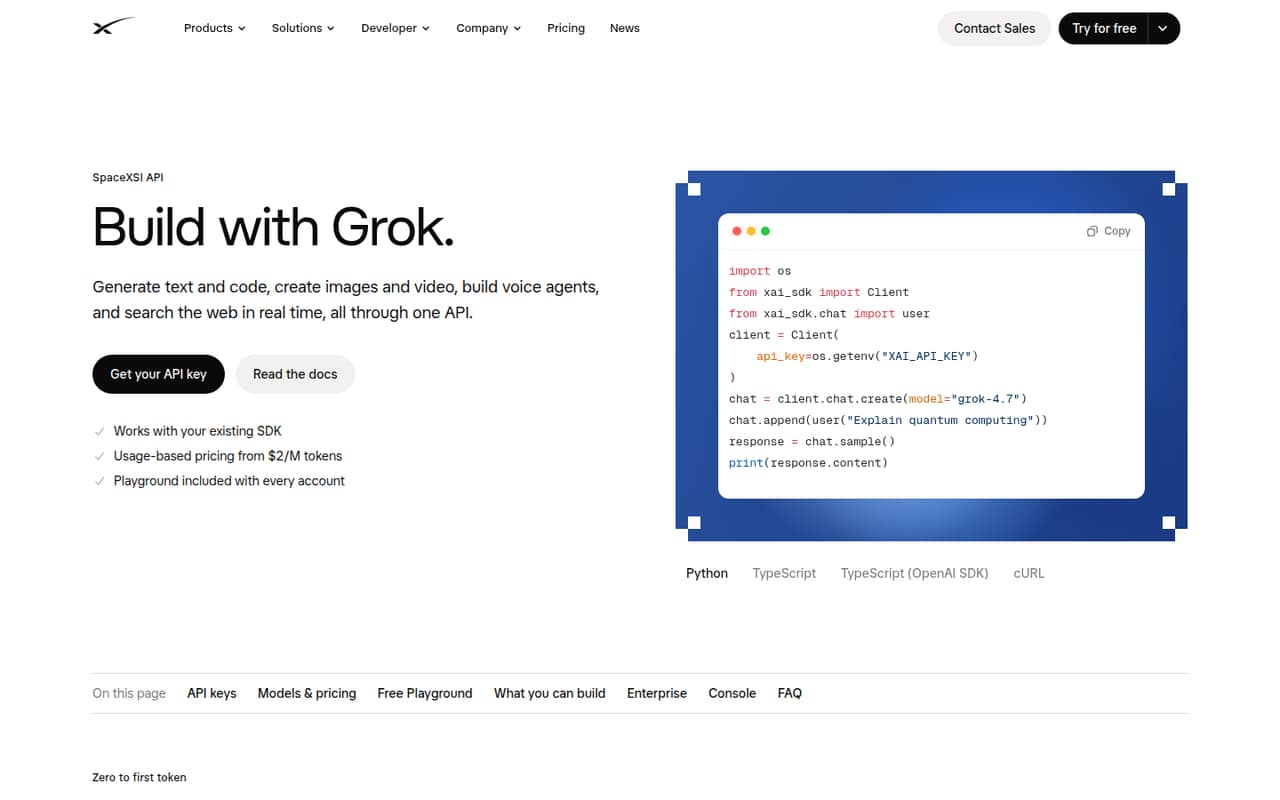
The API exposes an HTTP endpoint at https://api.x.ai/v1. The homepage shows Python with xai_sdk, TypeScript with @ai-sdk/xai, TypeScript with the OpenAI SDK pointed at xAI’s base URL, and a cURL request to /chat/completions. It describes compatibility with existing SDKs and links to a full quickstart and API documentation.
The documented setup is to create an account at console.x.ai, generate an API key, store it securely, set the base URL, and call a model such as grok-4.7. The Console Playground is available before integration work. The published examples do not show a CLI; cURL is the command-line integration surface. For other languages or SDKs, confirm current support in xAI’s docs. One Reddit thread reports Remote MCP Tools support, which it says connects Grok to external servers and custom or third-party functions; check current documentation before depending on that integration.
03xAI API pricing for developers
The API pricing is usage-based, not a flat monthly developer plan. The pricing page lists grok-4.7 at $2 per 1 million input tokens and $6 per 1 million output tokens, with a 500k context window. The Console Playground comes with every account, but API calls are billed separately; the Free subscription lists limited Chat and agent requests, not a stated API allowance. Plus is $8 per month and includes Grok API access, also billed separately. Premium is $30, Super $100, Ultra $200, and Teams starts at $30 per user per month. Enterprise pricing is custom.
Media and voice add separate meters: image output starts at $0.04 per image for grok-imagine-image-2.0; video output starts at $0.08 per second for grok-imagine-video-1.5; speech-to-speech is $0.08 per minute. Speech-to-text is $0.10 per hour for REST or $0.20 per hour for streaming. Prepaid credits and enterprise invoicing are available. Estimate tokens and media units separately; taxes and fees may apply.
04xAI API: open source, self-hosting and lock-in
The API is delivered as a hosted service. The vendor does not publish a software licence or self-hosting option in the published API materials, so teams should not assume they can run Grok or the API server in their own environment. The Console and API key are part of the service’s access path.
The vendor does not describe a data-export process here. Ask xAI what data, logs, files, and collection contents can be exported and how deletion works before sending sensitive material. Migration effort depends on how tightly an application uses xAI-specific models and features, including Imagine, Voice, search, and files and collections. The OpenAI SDK example and familiar HTTP request format can ease transport-layer changes, but they do not make model behavior or feature parity portable. Keep prompts, stored data, and provider-specific calls behind application interfaces if switching providers is a likely requirement.
05xAI API in production
Before depending on the API, confirm rate limits, availability commitments, retry behavior, and support response times with xAI. Public rate-limit numbers and service reliability terms are not listed in the API material; enterprise customers can request custom rate limits and dedicated support. Enterprise controls also include SSO, audit logging, and data residency, but teams should confirm which controls apply to their contract and deployment.
Production costs can vary across token, image, video, and voice usage, so budget each meter and set internal alerts. The API key is shown once at creation, according to the Console text; store it securely and manage access accordingly. One Reddit thread reports that Remote MCP Tools let developers connect Grok to external servers and custom tools. That is a useful integration signal, but verify its availability, permissions, and operational behavior in xAI’s documentation before making it part of a critical path.
From the threadsWhat users say
The available Reddit discussion is narrow and positive about adding connections to external tools. It does not offer much evidence about reliability, support, or production experience, so we treat user sentiment as provisional.
It now supports Remote MCP Tools
This lets developers connect Grok to external servers
You can now extend Grok with your own custom tools
or third-party functions
Questions people ask
Is xAI API a hosted service or a library?
It is a hosted API service. Applications call xAI’s endpoint at https://api.x.ai/v1 using an API key. The Console provides keys and a Playground; the API is not presented as a self-hosted server or a standalone library.
Which languages and SDKs can I use?
The API homepage shows Python with xai_sdk, TypeScript with @ai-sdk/xai, TypeScript with the OpenAI SDK, and cURL. The OpenAI SDK example uses https://api.x.ai/v1 as its base URL. Check xAI’s documentation for current support beyond these examples.
Does an xAI subscription include API usage?
The pricing information says API use is billed separately per token or media and voice unit. Plus lists Grok API access, but that access is billed separately. The Free subscription lists limited Chat and agent requests, not an API usage allowance.
What can I build with xAI API?
The API supports text and code generation, image and video generation, voice applications, web and X search, and search and reasoning over uploaded documents. The Imagine API handles image and video work; the Voice API supports speech-to-speech, text-to-speech, and speech-to-text.
Does xAI API publish rate limits?
The public API material does not list numeric rate limits. It says enterprise options include custom rate limits. Ask xAI for applicable limits, retry guidance, and service commitments before relying on the API in production.