
We may earn a commission if you buy through links on this page. It never changes a score or a ranking. How we make money
The bottom line
WEKA targets inference bottlenecks in storage and memory; pricing and integration details need buyer diligence.
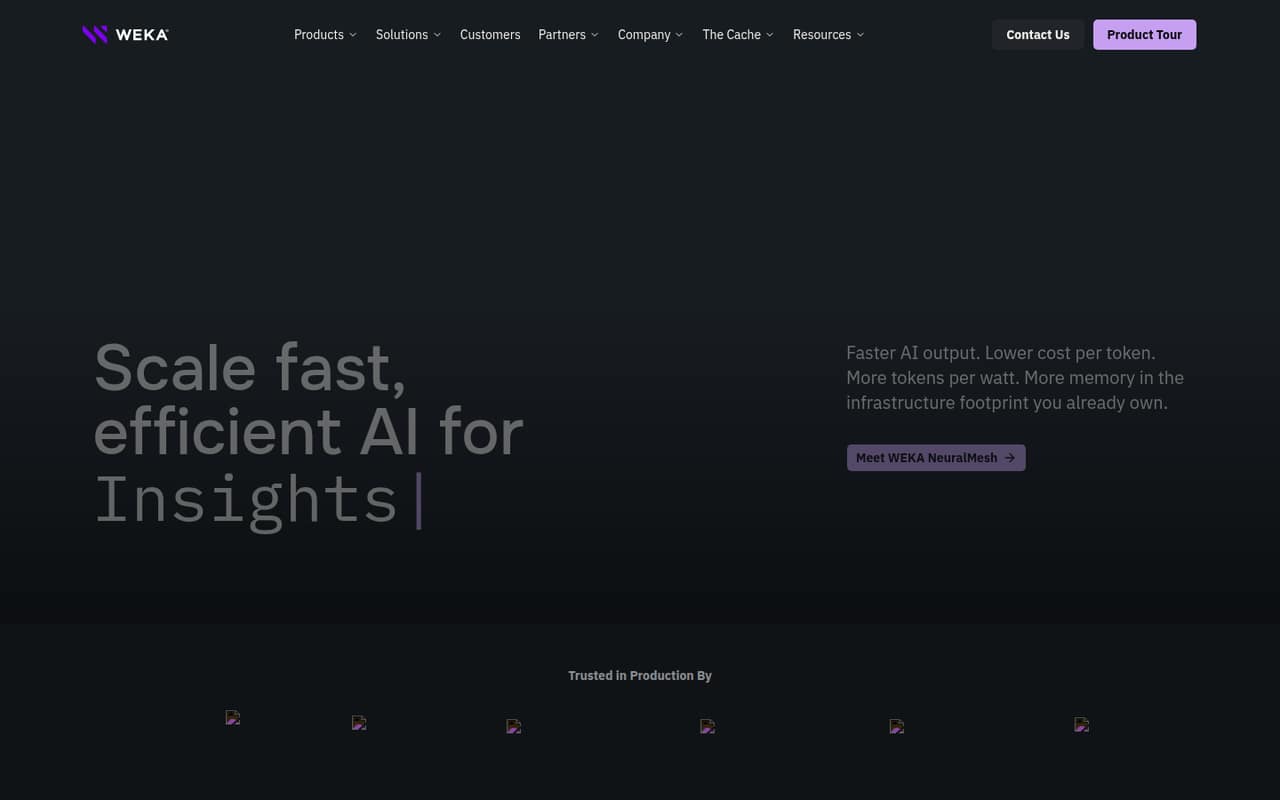
WEKA NeuralMesh combines storage and memory on one platform for AI workloads. The company says it keeps GPUs fed, makes memory persistent and can use infrastructure customers already own; its homepage claims 6.5x higher token throughput.
Pricing is custom quote, with no published starting price, free plan or trial. WEKA positions the platform around lower cost per token, but buyers will need deployment, performance and commercial details from the vendor to judge the economics.
Good fit if
- Teams optimizing AI inference infrastructure
- Organizations with existing GPU infrastructure
- Buyers evaluating persistent memory for AI
Skip it if
- Teams seeking a model-serving API
- Projects needing public self-service pricing
- Developers requiring documented SDKs
ScoresHow it rates
What works
- Combines storage and memory on one platform
- Designed to keep GPUs fed
- WEKA says memory persists
- Targets lower inference cost per token
- Can use infrastructure customers already own
What doesn't
- Pricing is custom quote
- No free plan or trial is listed
- API, SDK and language details need confirmation
- The 6.5x throughput claim needs workload context
- Deployment and data-export terms need clarification
01What WEKA Data Platform is, technically
WEKA Data Platform is AI infrastructure, not a model-serving API, general-purpose SDK or data-mining desktop application. Its NeuralMesh platform combines storage and memory for AI workloads, sitting beneath inference services as part of the data path that supplies GPUs and retains memory. WEKA says the platform keeps GPUs fed and that memory persists.
The company positions NeuralMesh as a way to improve inference throughput and cost per token, and says it can run on infrastructure customers already own. Its homepage claims 6.5x higher token throughput, but that figure needs context for a production decision: ask which workloads, configurations and comparison produce it. The product is therefore most relevant to teams tuning the infrastructure around inference, rather than developers looking for an endpoint to call or a library to add to an application. Confirm the deployment architecture and how NeuralMesh fits your storage, GPU and serving stack before planning a rollout.
02WEKA Data Platform API, SDKs and docs
The published integration surface is infrastructure: NeuralMesh combines storage and memory, and WEKA says it can use an existing infrastructure footprint. That is a different integration task from adding an inference API to an application. The homepage does not name a REST API, webhooks, CLI, plugins, SDKs or programming languages, so developers should confirm the available management and data-plane interfaces in WEKA's technical documentation before estimating implementation work.
Ask whether your team will configure the platform through a CLI, API or management UI; which SDKs and languages are supported; and how it connects to your GPU nodes and inference stack. Also request deployment guidance, compatibility requirements and operational documentation for your target configuration. The homepage points to a product tour and customer story, but those are not a substitute for interface references, integration examples or a supported-versions matrix. Treat the integration effort as unscoped until WEKA confirms those details for your environment.
03WEKA Data Platform pricing for developers
WEKA lists custom, quote-based pricing for organizations with custom requirements. There is no published starting price, free plan or free-trial offer in the pricing information available for this review. Monthly and annual billing terms are also not published, so buyers cannot compare a public subscription rate or estimate a standard entry-level deployment.
The pricing information does not give a per-token, per-request, per-seat or per-capacity rate, nor does it describe overages or add-ons. That makes it impossible to model how a bill grows with inference traffic from public figures alone. WEKA's lower-cost-per-token positioning is a product claim, not a published price schedule. Ask for a quote tied to your GPU count, storage and memory requirements, deployment model, support terms and expected workload. Request the assumptions behind the quote and how costs change as capacity or usage grows. Without those details, teams should not treat the throughput claim as proof of lower total cost.
04WEKA Data Platform: open source, self-hosting and lock-in
WEKA's homepage positions NeuralMesh as a platform that can use infrastructure customers already own. That does not, on its own, establish whether the software is self-hosted, published as a managed service or offered in multiple deployment models. The vendor does not publish the software licence, source availability, deployment options or data-export terms in the homepage information reviewed here; confirm each directly with WEKA before procurement.
If your architecture depends on NeuralMesh's storage and memory layer, migration could involve more than changing an application endpoint. Ask how data is stored, what formats and interfaces are available, and whether workloads can move to another storage or memory system without conversion or extended downtime. Include exit assistance, data retrieval and any associated fees in the contract review. Do not assume open-source access or portable data based only on the claim that the platform can use existing infrastructure.
05WEKA Data Platform in production
WEKA says NeuralMesh is designed to keep GPUs fed, persist memory and increase token throughput. Its homepage claims 6.5x higher token throughput, but that headline needs workload and configuration details before it can inform capacity planning. Ask WEKA for the tested baseline, supported scale, failure behavior and guidance for sizing storage, memory and GPU resources in your deployment.
The pricing information does not provide rate limits or usage caps, so production capacity and billing boundaries need to be confirmed in a quote. Before depending on the platform, review availability commitments, upgrade and rollback procedures, monitoring, backup and recovery, and support response terms. Also ask for security controls, data handling terms and compliance documentation relevant to your environment. The homepage's performance and persistent-memory claims are useful architectural signals, but production readiness depends on the operational guarantees and compatibility details WEKA can document for your specific stack.
Questions people ask
What does WEKA Data Platform do?
WEKA NeuralMesh combines storage and memory on one platform for AI workloads. WEKA says it keeps GPUs fed, supports persistent memory and targets faster inference at lower cost per token. The company also says NeuralMesh can use infrastructure customers already own.
How much does WEKA Data Platform cost?
WEKA lists custom, quote-based pricing for organizations with custom requirements. There is no published starting price or public per-usage rate in the pricing information reviewed here. Ask WEKA for a quote based on your deployment, capacity and expected workload.
Does WEKA Data Platform have an API or SDK?
WEKA's homepage describes NeuralMesh as an infrastructure platform but does not name an API, SDK, CLI or supported programming language. Ask the vendor which management and data-plane interfaces are available, and confirm language and integration support for your stack before estimating development work.
Can WEKA Data Platform use infrastructure we already own?
WEKA says NeuralMesh can use the infrastructure footprint customers already own. That claim does not establish compatibility with a particular GPU, storage system or deployment configuration. Confirm supported hardware, software versions and architecture requirements with WEKA for your environment.
What does WEKA's 6.5x higher token throughput claim mean?
WEKA's homepage claims 6.5x higher token throughput. The claim needs workload, hardware, configuration and comparison details to assess how it applies to a production system. Ask WEKA for the benchmark methodology and results that match your inference workloads before using it for capacity or cost planning.