
We may earn a commission if you buy through links on this page. It never changes a score or a ranking. How we make money
The bottom line
A low-friction hosted webhook inspector with useful workflows and a free tier capped at 50 requests.
Webhook.site is a hosted service for capturing HTTP requests, emails and DNS lookups at unique endpoints. Its no-signup tier is easy to use for debugging; paid plans add permanent URLs, workflows, a REST API and higher request-history limits.
It suits development and integration work where a temporary endpoint is enough, or where teams want to automate request handling without running a server. Check data handling, history retention and self-hosted feature parity before making it part of a production flow.
Good fit if
- Debugging inbound webhooks
- Testing email and DNS integrations
- Automating request forwarding and responses
Skip it if
- Teams requiring a published SLA
- Projects needing guaranteed self-hosted parity
- Workloads requiring published compliance terms
ScoresHow it rates
What works
- Capture requests without signup or setup
- Inspect headers, query strings and bodies in real time
- Capture email messages and DNS lookups
- Visual workflows can transform and forward requests
- CLI can forward requests to localhost or private networks
What doesn't
- Free URLs expire after one week
- Free tier retains up to 50 requests
- Paid request-history limits vary by plan
- SDK languages and support are not named on the homepage
- Self-hosted version may not match hosted features
01What Webhook.site is, technically
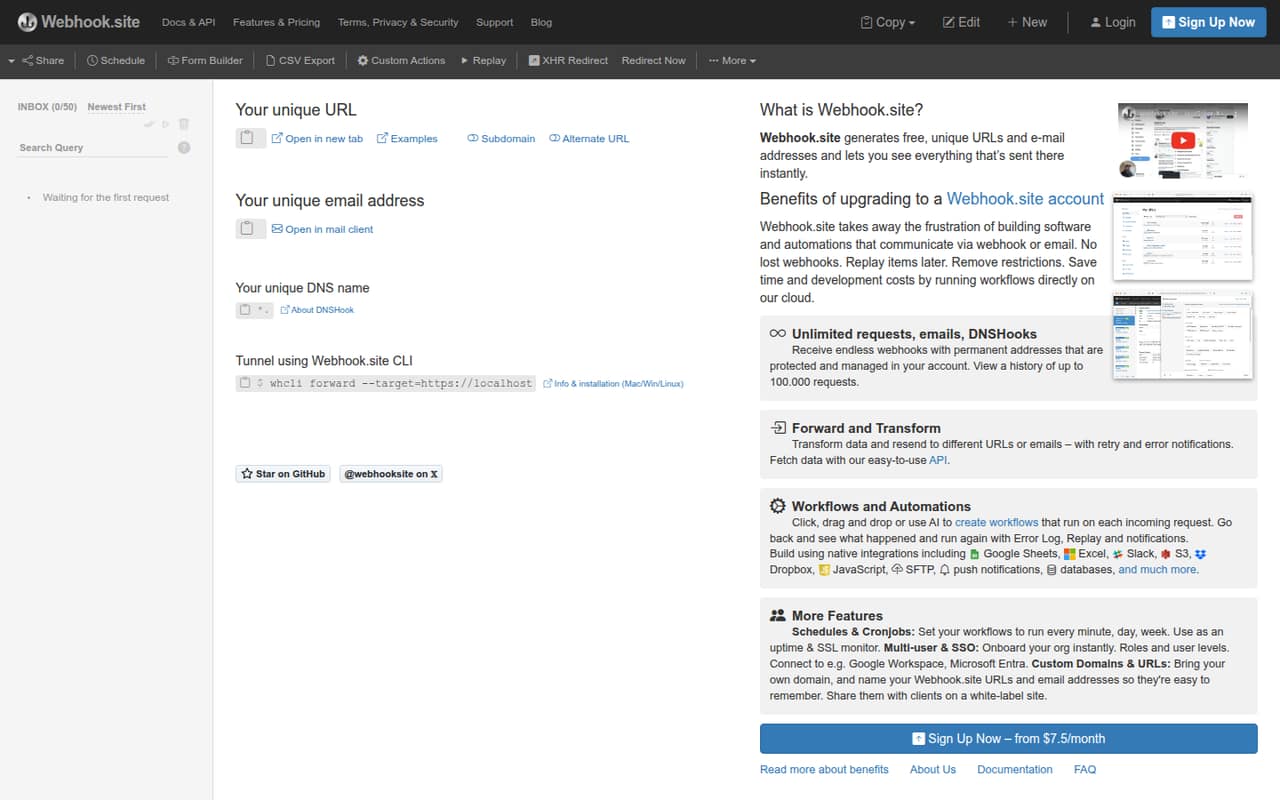
Webhook.site is a hosted SaaS application that creates unique HTTP URLs, email addresses and DNS names for capturing inbound traffic. It sits between a client or service that sends a request and the application you are debugging: point the sender at a Webhook.site endpoint, then inspect the captured headers, query string and body in a browser.
The free endpoint needs no signup, but expires after one week and stores up to 50 requests. An account removes those restrictions and adds workflows, custom domains and other features. The service also offers a CLI to forward captured requests to localhost or a private network, which helps when a webhook sender cannot reach a development machine directly. For ongoing processing, visual workflows can filter, transform, forward or respond to requests and emails. Schedules, databases and a REST API extend it beyond a temporary request bin into a hosted automation service.
02Webhook.site API, SDKs and docs
The main integration surface is an HTTP endpoint: Webhook.site captures any HTTP method and sub-path sent to its unique URL. The homepage also links to a REST API for managing the service programmatically, plus documentation, an API reference and guides for Custom Actions and the CLI. It does not name SDK languages, so confirm SDK support in the vendor’s docs before choosing a client library.
The Webhook.site CLI forwards captured requests to localhost or a private network; the homepage shows whcli forward --target=https://localhost and lists Mac, Windows and Linux installation. For automation, Custom Actions provide visual steps, while WebhookScript and JavaScript handle logic outside those steps. Named integrations include Google Sheets, Excel, Slack, S3, Dropbox, SFTP, databases and push notifications. The service also captures email and DNS traffic, so the integration surface includes more than HTTP webhooks.
03Webhook.site pricing for developers
The no-signup free tier costs nothing, but each URL expires after one week and stores up to 50 requests. Paid plans list unlimited incoming requests, while request history, URLs, schedules and users vary by tier. Basic costs $9 monthly or $90 annually ($7.50/month equivalent) and includes one URL, 1,000 request history, one schedule and one database. Pro costs $19 monthly or $190 annually ($15.83/month equivalent); it includes 50 URLs, 10,000 request history, five schedules and one database.
Enterprise costs $69 monthly or $699 annually ($58.25/month equivalent), with unlimited URLs, 100,000 request history, unlimited schedules and 10 users included. These tiers make the bill depend on the plan’s history, URL, schedule and seat allowances rather than a published per-request charge. The pricing lists no add-ons. Before production use, check whether your retention and team requirements fit the included caps; the vendor does not publish overage pricing.
04Webhook.site: open source, self-hosting and lock-in
A Reddit commenter points to an open-source version of Webhook.site on GitHub and says it can be hosted yourself. The license is not published in the homepage text, so check the repository’s current license and deployment requirements before using it. Do not assume the self-hosted version includes every hosted feature: commenters report missing multipart/form-data display and container deployment trouble in particular environments.
For the hosted service, captured endpoints are unique URLs, email addresses and DNS names; moving senders to another service means changing those destinations. The homepage shows CSV Export and describes a REST API for managing the service, which may help with data handling and migration. Confirm what each export includes and whether it covers attachments, workflow configuration and request history before relying on it. The vendor does not publish a migration guide in the homepage text.
05Webhook.site in production
Treat a free URL as a temporary debugging endpoint, not a durable production destination: it expires after one week and stops at 50 requests. The homepage says account URLs are protected and managed, while its free URL notice says an unassociated URL is not protected by login. Paid plans allow unlimited incoming requests, but request history remains capped at 1,000, 10,000 or 100,000 depending on the tier. The vendor does not publish an SLA in the homepage text; ask about uptime, retention, data residency and compliance before routing sensitive production traffic.
Reddit users report limitations in the open-source version, including a missing multipart/form-data display, and one commenter had trouble running its container image on Azure Web App for Containers. Those are reports about self-hosting, not evidence of hosted-service reliability. Test your payload types and deployment environment, and verify how retries, workflow errors and access controls behave for your use case.
From the threadsWhat users say
The small amount of Reddit discussion is mixed: commenters point to self-hosted options, but some report deployment and feature gaps in the open-source version. The posts do not provide a broad read on the hosted service.
there is an open-source version of webhook.site that you can host yourself
it doesn't show multipart/form-data
I had trouble with the webhook.site container image on Azure Web App for Containers
I didn't love piping payloads from Stripe and my n8n flows through someone else's server
Questions people ask
What are Webhook.site’s free-tier limits?
Webhook.site lets you create a unique URL and email address without signing up. Free URLs expire after one week and store up to 50 requests. An account removes those limits and adds workflows, custom domains and other features. The paid plans list unlimited incoming requests, but request-history caps still apply.
Does Webhook.site have an API or SDKs?
Yes. The homepage links to a REST API and API reference for managing Webhook.site programmatically. It also offers a CLI for forwarding captured requests to localhost or a private network. The homepage names JavaScript and WebhookScript for scripted actions, but does not name SDK languages; confirm SDK support in the vendor’s docs.
Can I self-host Webhook.site?
A Reddit commenter points to an open-source Webhook.site version on GitHub that can be hosted yourself. Check the repository’s current license and deployment documentation, and verify feature coverage before committing. Reddit users report multipart/form-data display and container deployment issues with the open-source version; those reports do not establish hosted-service behavior.
Is it safe to use Webhook.site for production webhooks?
It can capture production traffic, but check access control, data handling, retention and compliance needs first. The homepage says account URLs are protected and managed; a free URL that is not associated with an account is not protected by login. The vendor does not publish an SLA in the homepage text.
How much does Webhook.site cost for a team?
Basic is $9 per month or $90 annually and includes one URL. Pro is $19 per month or $190 annually and includes 50 URLs. Enterprise is $69 per month or $699 annually, with unlimited URLs and 10 users included. Annual prices are listed as equivalent to $7.50, $15.83 and $58.25 per month.
Sources
- Webhook.site homepage
- Webhook.site pricing page
- Reddit: Any self hosted version for requestbin or webhook.site?
- Reddit: I built a self-hosted webhook.site alternative — capture, inspect, and replay webhooks. One-click deploy to Railway.
- Reddit: What's missing in webhook.site or requestinspector.com ?
- Reddit: Webhook.site MCP Server – Enables interaction with Webhook.site to create, manage, and monitor endpoints for capturing HTTP requests, emails, and DNS lookups. It provides 16 tools for testing webhooks and inspecting incoming data through the Model Context Protocol.