
We may earn a commission if you buy through links on this page. It never changes a score or a ranking. How we make money
The bottom line
An organization-level agent platform with unclear public APIs, SDKs and migration paths.
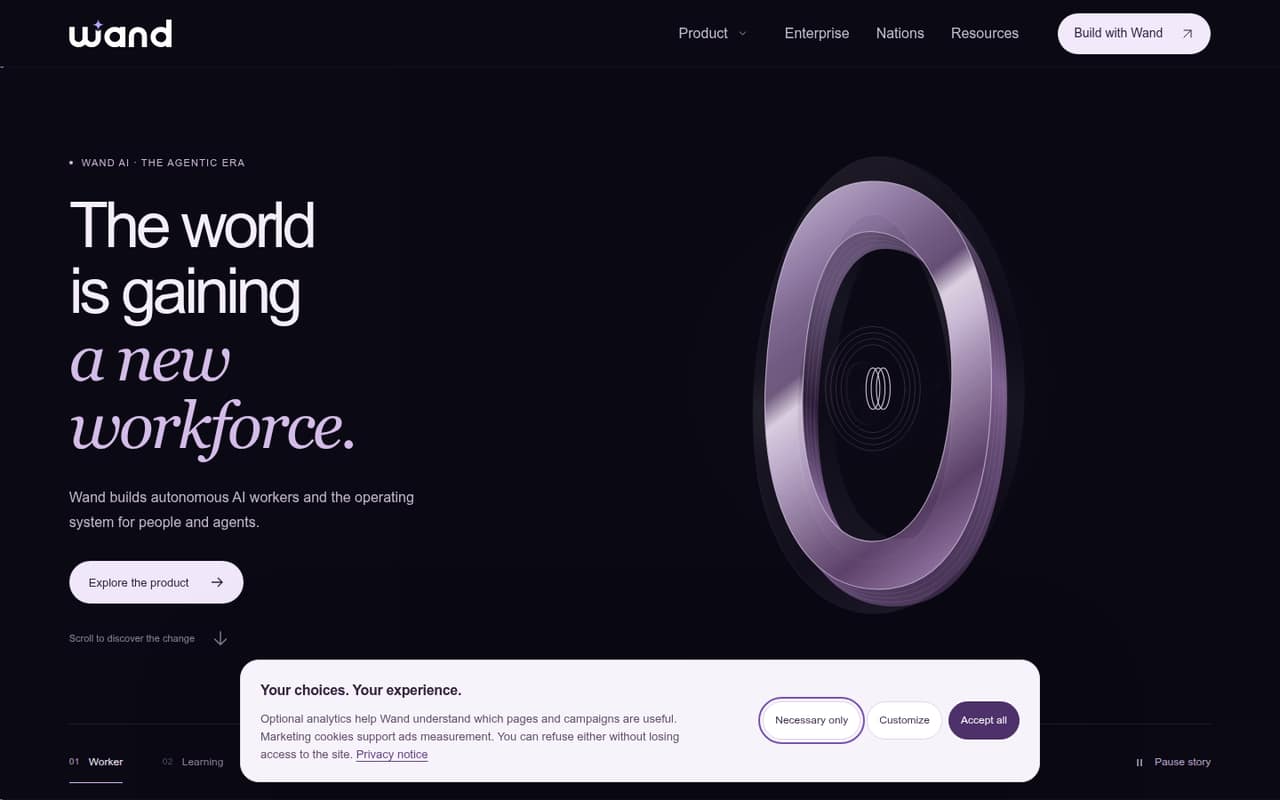
Wand AI combines autonomous agents with Wand OS, an organizational layer for coordinating people and agents. Its core features include agent identity, initiative, memory and learning, plus a Registry, Teams and Governance. That is a broader scope than a model API, but developers need to confirm how it connects to existing systems.
The reported plans start with a free tier and rise to $29 per user per month, or $24.17 per user per month with annual billing, for Catalyst. The enterprise plan lists on-premise deployment. Before adopting Wand for production workflows, confirm its integration options, usage accounting, data export and operational commitments with the vendor.
Good fit if
- Teams coordinating people and AI agents
- Organizations evaluating governed agent workflows
- Enterprises seeking on-premise deployment
Skip it if
- Developers seeking a documented model API
- Teams needing published SDKs and rate limits
- Projects requiring clear data-export terms
ScoresHow it rates
What works
- Agents have persistent identity and operating history
- Agents can plan, act and check results
- Memory and learning support repeat work
- Registry, Teams and Governance cover organizational coordination
- Enterprise plan lists on-premise deployment
What doesn't
- Public API and SDK details are unclear
- The free plan is capped at 50 messages monthly
- Catalyst includes 300 messages per month
- Overage terms are not listed
- Source licence and data-export terms are unclear
01What Wand AI is, technically
Wand AI is a commercial platform for deploying autonomous AI workers and coordinating them with people. Its product has two parts: Wand Agents, which carry work forward, and Wand OS, which provides shared organizational structures and governance. The homepage describes agents that recognize work, plan, act within their authority and check results; they also have identity, operating history and memory.
In a software stack, Wand sits above the underlying models and organizational systems: the product is framed around assigning responsibilities and coordinating work, not exposing a general-purpose model endpoint. Wand Registry connects people and agents into a structure, Wand Teams coordinates processes, and Wand Governance aligns policies, objectives and capabilities. The Enterprise plan lists on-premise deployment; the product is therefore not described as hosted-only. The homepage does not explain how Wand connects to a customer’s existing applications, so teams should establish that boundary before treating it as an execution layer for production work.
02Wand AI API, SDKs and docs
Wand’s homepage presents an organizational product surface—Agents, Registry, Teams and Governance—rather than a documented developer API. It does not name a REST API, webhooks, CLI, plugins, programming languages or SDKs. That leaves a key integration question for developers: how agent responsibilities and results connect to the applications and data already in a stack.
Before building around Wand, ask the vendor for its current developer documentation and confirm SDK support, authentication, supported languages, integration protocols, rate limits and error behavior. Also clarify whether integrations can trigger agents, provide context, receive completed work or manage permissions. The homepage describes enterprise on-premise deployment, but does not explain the deployment interface or configuration process. Until those details are confirmed, treat Wand as an organizational agent platform to evaluate with the vendor, not as a drop-in API or library with a known implementation path.
03Wand AI pricing for developers
The website does not publish self-serve pricing. Reported plan figures list Spark at $0 per month for up to 3 users, 50 messages per month, 500k data storage per chat and unlimited custom models. Catalyst is $29 per user per month, or $24.17 per user per month with annual billing; it lists unlimited users, 300 messages per month, 2M data storage per chat and unlimited custom models.
Infinity costs $99 per user per month, or $82.50 with annual billing, and lists 1,000 messages per month, 5M data storage and everything in Catalyst. Enterprise pricing is custom and lists unlimited users, unlimited everything, on-premise deployment, dedicated support and advanced security. The plans make seat count a direct cost driver for paid tiers, while message allowances vary by plan. The pricing information does not define message accounting, overage charges or the unit behind data storage, and no add-ons are listed. Confirm those terms, along with annual billing conditions, before estimating production spend.
04Wand AI: open source, self-hosting and lock-in
The vendor doesn't publish an open-source licence or data-export policy. Wand is presented as a commercial product with paid plans; the Enterprise plan lists on-premise deployment, but that is not the same as an open-source release or an unrestricted self-hosting option. Ask the vendor which components run on-premise, what remains dependent on Wand services, and whether model choice and configuration are portable.
Migration could involve more than moving prompts: Wand describes persistent agent identities and histories, reusable memory, organizational roles, processes and governance. The homepage does not establish how those objects can be exported or recreated elsewhere. Before adopting it, request export formats, retention and deletion terms, and a tested exit path for agent definitions, histories, policies and workflow state. Without those details, switching costs are difficult to estimate.
05Wand AI in production
Wand’s product description puts agents inside organizational processes and says they act within their authority and check results. Those are useful design goals, but production teams still need concrete controls: how authority is configured, how actions are approved, what gets logged, and how a failed or incorrect task is rolled back. The homepage describes Governance as aligning policies, objectives and capabilities; it does not detail enforcement or audit behavior.
Plan limits are also material: Spark lists 50 messages per month, Catalyst 300 and Infinity 1,000. Confirm what counts as a message, whether limits apply per user or workspace, and what happens at the cap. The vendor lists on-premise deployment, dedicated support and advanced security for Enterprise, but teams should get deployment, availability, incident-response and compliance commitments in writing. Ask for load and reliability limits, backup and recovery procedures, and data-retention terms before making Wand a dependency for operational work.
Questions people ask
What does Wand AI do?
Wand AI combines autonomous agents with Wand OS, a platform for coordinating people and agents. The vendor describes agents that recognize work, plan, act within their authority and check results. Wand Registry connects people and agents, Teams coordinates processes, and Governance aligns policies, objectives and capabilities.
Does Wand AI offer a developer API or SDK?
Wand’s homepage describes its Agents and organizational platform, but does not name a public API, SDK, programming language or CLI. Ask the vendor for current developer documentation and confirm integration protocols, authentication, supported languages, rate limits and error handling before planning an implementation.
How much does Wand AI cost?
Reported plan figures list Spark at $0 per month, Catalyst at $29 per user per month or $24.17 with annual billing, and Infinity at $99 or $82.50 with annual billing. Enterprise pricing is custom. The website does not publish self-serve pricing, so confirm current prices and billing terms with Wand.
Can Wand AI be self-hosted?
The Enterprise plan lists on-premise deployment. The plan details do not establish which components run on-premise or whether a deployment can operate independently of Wand services. Ask the vendor about architecture, required connections, customer-managed infrastructure and what support is included.
Can I export my Wand AI data if I leave?
The vendor does not publish data-export terms on its homepage. Wand describes persistent agent identities, operating history, memory and organizational structures, so ask which of those can be exported, in what formats, and how retention and deletion work before putting important workflows on the platform.