
We may earn a commission if you buy through links on this page. It never changes a score or a ranking. How we make money
The bottom line
A simple hosted SERP API with strong batch options and pricing details to verify before scaling.
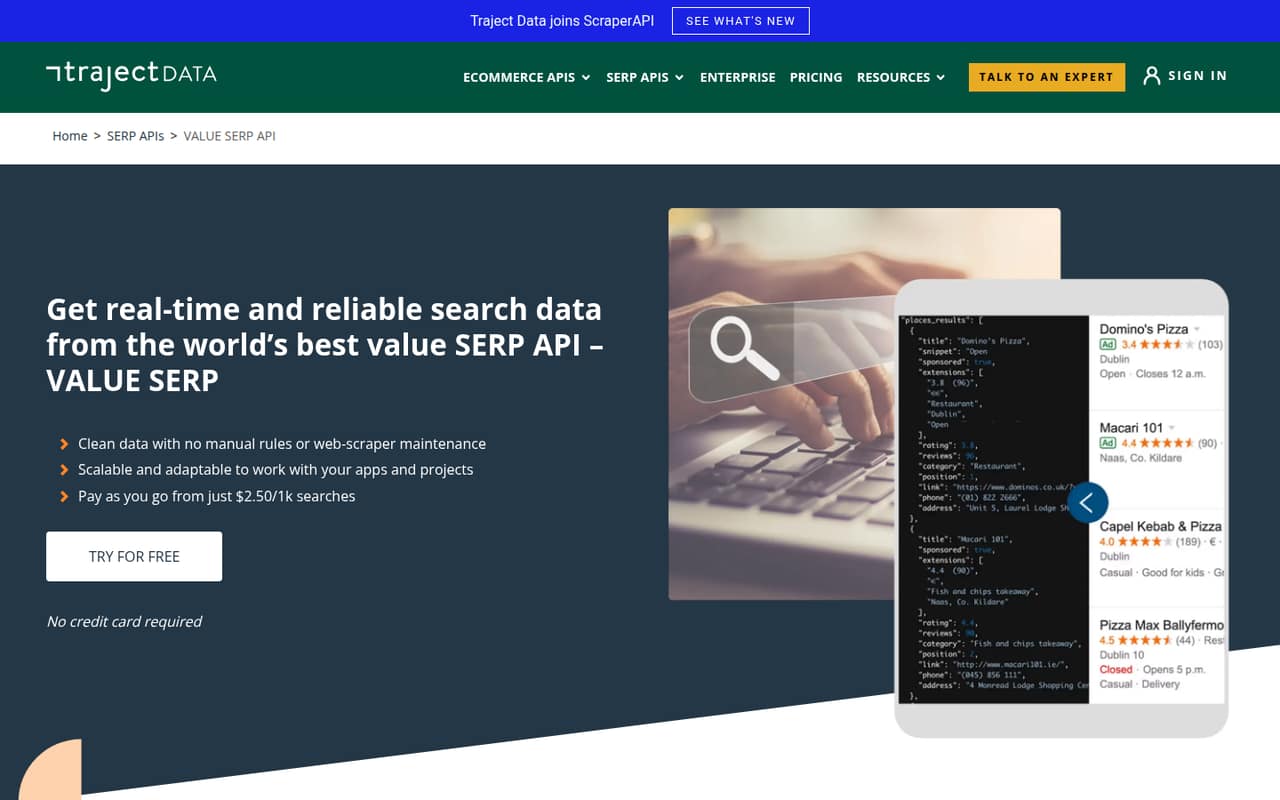
ValueSERP is a hosted Google search results API. Send GET requests and receive JSON, HTML, or CSV, with location and device targeting. Its batch feature supports scheduled or on-demand runs and delivery to major cloud object storage services.
Plans start at $50/month billed annually for 25,000 credits; pay-as-you-go starts at $2.50 per 1,000 requests. The vendor advertises a free tryout, but lists no free plan or trial terms. Check credit accounting, overages, and production requirements before committing.
Good fit if
- Apps needing live Google SERP data
- Localized search collection at scale
- Scheduled batches delivered to object storage
Skip it if
- Teams requiring a self-hosted scraper
- Projects needing published SDKs or CLI
- Buyers requiring detailed compliance terms
ScoresHow it rates
What works
- GET requests return JSON, HTML, or CSV
- Location and device targeting are supported
- Batches can schedule up to 15,000 requests
- Results can go to major cloud storage services
- Published plans include real-time request limits
What doesn't
- No free plan is listed in pricing
- Monthly prices are shown only with annual billing
- SDKs, languages, and CLI are not named
- Overage rates and credit accounting need confirmation
- Self-hosting and compliance details are not published
01What ValueSERP is, technically
ValueSERP is a hosted API service for retrieving Google search results. It sits between an application or data pipeline and Google search: your code sends a GET HTTP request with parameters, and ValueSERP runs the search and returns results in JSON, HTML, or CSV. It is not presented as a library, CLI, or server that you install in your own environment.
The service handles SERP collection and parsing, including location and device targeting. Its Locations API helps identify supported Google search locations. For bulk work, Batches can run on a schedule or on demand, with results sent to configured cloud object storage. The vendor says batches can contain up to 15,000 requests.
That architecture suits applications that need search data without maintaining their own result-page parsing. It also makes ValueSERP a dependency in the data path: your application relies on its availability, request limits, result formats, and credit accounting. Treat it as an external data service, not a portable scraping component.
02ValueSERP API, SDKs and docs
The documented integration surface on the homepage is a GET HTTP request: pass parameters, then receive results in JSON, HTML, or CSV. Location targeting uses the ValueSERP Locations API, and requests can target a specific device type. For bulk collection, Batches support recurring monthly, weekly, daily, or hourly runs, plus manual on-demand runs. Destinations include Amazon S3, Google Cloud Storage, Microsoft Azure Blob Storage, Alibaba Cloud OSS, and other S3-compatible object storage.
The vendor advertises comprehensive documentation and support resources. The homepage does not name SDKs, programming languages, a CLI, or plugins. Confirm SDK availability and authentication, retry, pagination, and error-handling guidance in the vendor’s docs before choosing an integration path. The named delivery mechanism is batch-to-storage; the homepage does not describe webhooks.
The basic request-and-response model is accessible from most stacks that can make HTTP requests. For production, build around the API contract and output format you need, rather than assuming a language-specific client or CLI is available.
03ValueSERP pricing for developers
The pricing page lists no free plan, while the homepage advertises a free tryout with no credit card required. It does not publish the trial’s duration, credit allowance, or limits, so confirm those terms before using it for a sustained workload.
Paid plans are listed with annual billing: 25,000 credits per month costs $50/month, 200,000 costs $240/month, and 1,000,000 costs $1,000/month. Their stated rates are $1.60, $1.20, and $1.00 per 1,000 credits, respectively. The page labels annual billing as 10% off; monthly prices are not shown. Pay as you go starts at $2.50 per 1,000 requests. Enterprise pricing is custom.
The plans include rate limits of 250, 1,000, and 1,500 real-time requests per minute, and up to 10,000 batches. The homepage separately says a batch can contain up to 15,000 requests. Confirm how credits map to requests, what happens at plan limits, and whether overage charges apply; the pricing page lists no add-ons or overage rates.
04ValueSERP: open source, self-hosting and lock-in
ValueSERP is presented as a hosted API service. The vendor does not publish an open-source license or a self-hosting option, so teams should treat it as a closed, hosted dependency unless the vendor confirms otherwise. That means the request path and SERP processing depend on ValueSERP’s service rather than code you can run and modify yourself.
The API returns JSON, HTML, or CSV, and batches can deliver results to customer-defined object storage destinations, including S3-compatible storage, Google Cloud Storage, Azure Blob Storage, and Alibaba Cloud OSS. Those formats and destinations can make it easier to retain data outside the service, but the vendor does not publish a dedicated export or migration process in the published product details.
A replacement would need to reproduce your request parameters, location and device targeting, batch schedules, and downstream parsing. Before adopting it, confirm data retention, deletion, and export terms, and keep your collection logic decoupled from ValueSERP-specific response fields.
05ValueSERP in production
The published real-time request limits are 250 requests per minute on the 25,000-credit plan, 1,000 on the 200,000-credit plan, and 1,500 on the 1,000,000-credit plan. The vendor says batches can hold up to 15,000 requests; the plans list up to 10,000 batches. Confirm whether those batch limits apply per account, billing period, or another window, and how queued work behaves when limits are reached.
The homepage advertises 99.95% uptime, but does not establish an SLA in the published material. Ask about incident response, support coverage, retries, timeouts, and service-level commitments before making the API a critical dependency. Also verify credit consumption for failed requests and multi-step downloading, which the vendor says can make subsequent page requests at no additional cost.
The vendor does not publish security certifications or compliance details on the vendor's site. For production workloads, check authentication, data retention, deletion, and any requirements for storing credentials or search data in cloud destinations.
Questions people ask
Does ValueSERP have a free plan or trial?
The pricing information lists no free plan, but the homepage advertises a free tryout with no credit card required. It does not state the trial’s duration, request allowance, or feature limits. Confirm those terms with the vendor before relying on free access for development or ongoing workloads.
How much does ValueSERP cost?
Pay as you go starts at $2.50 per 1,000 requests. Annual-billing plans are listed at $50/month for 25,000 credits, $240/month for 200,000 credits, and $1,000/month for 1,000,000 credits. The pricing page says annual billing is 10% off, but does not show monthly plan prices.
What formats does the ValueSERP API return?
ValueSERP returns Google search results in JSON, HTML, or CSV. Requests use GET HTTP calls, and the service supports location and device targeting. If your application depends on specific response fields or schema stability, verify the relevant response documentation before integrating.
Can ValueSERP send batch results to cloud storage?
Yes. The vendor lists Amazon S3, Google Cloud Storage, Microsoft Azure Blob Storage, Alibaba Cloud OSS, and other S3-compatible object storage as batch destinations. Batches can run on monthly, weekly, daily, or hourly schedules, or manually on demand.
What are ValueSERP’s request and batch limits?
Real-time limits are 250, 1,000, or 1,500 requests per minute, depending on the credit plan. The plans list up to 10,000 batches, while the homepage says each batch can contain up to 15,000 requests. Ask the vendor how batch counts are measured and what happens when a limit is reached.