
We may earn a commission if you buy through links on this page. It never changes a score or a ranking. How we make money
The bottom line
Good for turning prompts into deployable apps; less clear as a programmable platform.
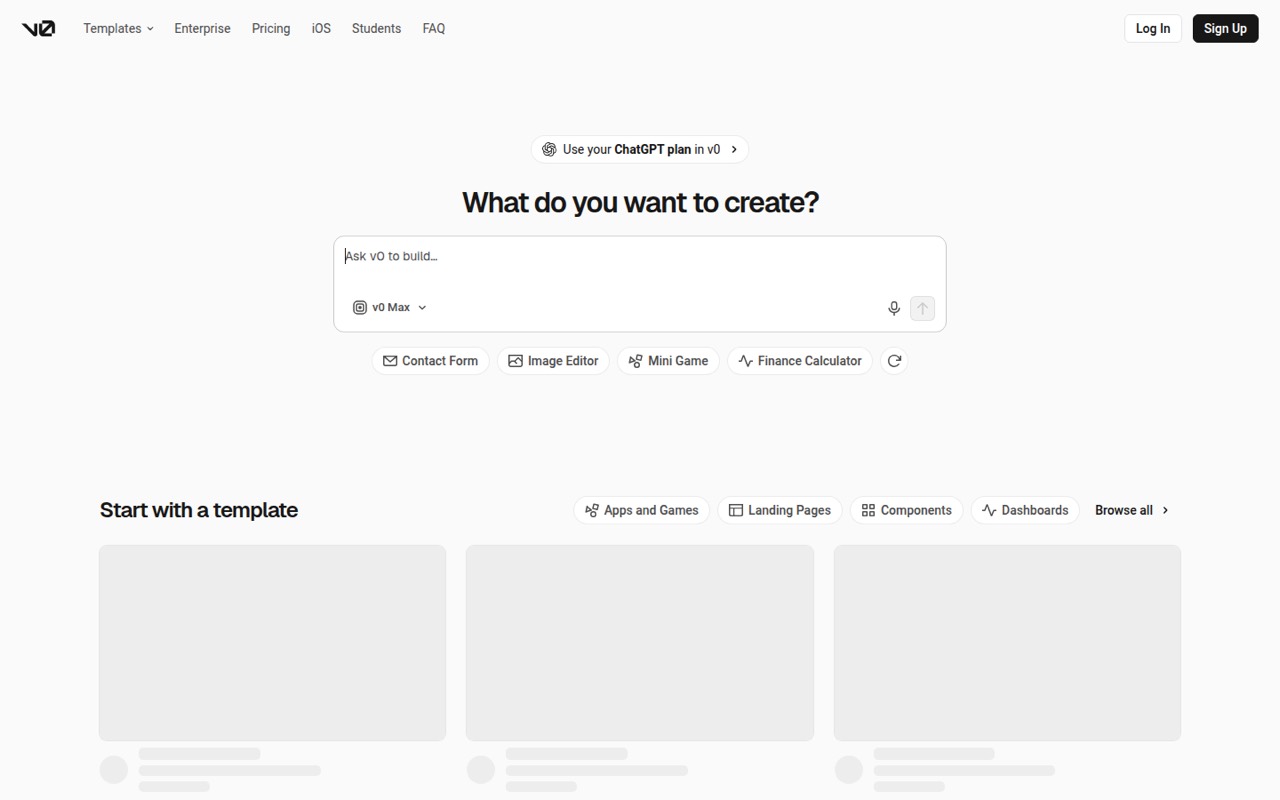
v0 is a hosted AI app builder: prompt it to generate an application, refine the result in visual design mode, sync code to GitHub, and deploy to Vercel. That makes it useful for prototypes and UI-heavy projects already headed to Vercel.
The trade-off is a developer workflow centered on the web app rather than a documented API or SDK contract. Free use is capped at seven messages a day, and paid plans combine monthly credits with token-based model rates. Reddit feedback ranges from praise for UI generation to reports of errors and disappointing answers.
Good fit if
- Vercel-bound prototypes
- UI-focused app scaffolding
- Developers who want visual editing
Skip it if
- Teams requiring a documented SDK
- Self-hosting or open-source deployments
- Unreviewed production code
ScoresHow it rates
What works
- Generates working applications from prompts
- Pushes code directly to GitHub
- One-click deployment to Vercel
- Visual controls with a live preview
- Templates and reusable design systems
What doesn't
- Free plan allows seven messages daily
- Additional credit pricing is not published
- No named language-specific SDK workflow
- No documented self-hosting route
- Reddit users report errors and poor answers
01What v0 is, technically
v0 is a hosted AI app-building service, not a library or self-hosted server. You describe an application in prompts; v0 generates working code that you can refine in its visual design mode, sync to a GitHub repository, and deploy to Vercel. It sits between an idea or rough specification and a codebase that can be reviewed, edited, and published.
That workflow targets teams building web applications, landing pages, dashboards, and components. Templates provide a starting point, while design systems let you define colors, typography, and styles for reuse across projects. The homepage also describes an iOS app for building on a phone.
For a developer, the key architectural question is whether v0 is a code-generation step or a runtime dependency. Its advertised path is to generate and publish an app, with GitHub as the handoff into a normal repository workflow. Review the generated code and its dependencies before treating the result as production software.
02v0 API, SDKs and docs
The documented integration surface is v0's hosted app, GitHub sync, app integrations, and deployment to Vercel. You can connect GitHub and push code to a repository, use visual controls with a live preview, and deploy with one click. The homepage also says v0 can build with tools and APIs, with automatic integrations that require no accounts.
That is different from a defined API-first workflow. The homepage does not establish an API endpoint, authentication scheme, SDK package, supported programming languages, CLI, or webhook contract. Don't build an internal automation around an assumed interface: confirm API and SDK support, language coverage, and limits in the vendor's docs before committing to that design.
The product also describes an agentic workflow that plans, creates tasks, and connects to databases while it builds. That may help move from prompt to app, but developers should still check how generated code connects to external services and whether those integrations fit their existing repository and deployment process.
03v0 pricing for developers
The Free plan costs $0 and includes Vercel deployment, Design Mode, GitHub sync, and seven messages per day. New users also get $5 in one-time credits. That is enough to explore the workflow, but the message cap makes it a limited allowance for regular app development.
Plus costs $30 per user per month and includes $30 in monthly credits per user, $2 in daily login credits per user, all models, and chat sharing and collaboration. Business is $100 per user per month, with the same listed credit allowances and training opt-out by default. Enterprise pricing is custom; its listed benefits include data never used for training, SAML SSO, role-based access control, priority access with no queues, and guaranteed customer support SLAs. The pricing page lists monthly rates, not annual prices.
The bill can grow beyond seats: teams can purchase additional shared credits, but their price is not published. Model usage is priced per million tokens; for example, Pro lists $2 input and $10 output, while Max lists $5 input and $25 output. Check model choice and credit consumption before budgeting a production workflow.
04v0: open source, self-hosting and lock-in
v0 is presented as a hosted service, not a self-hosted server. The vendor doesn't publish an open-source licence or self-hosting option, so teams that need to run the builder on their own infrastructure should not assume they can.
GitHub sync provides a practical route for moving generated code into a repository your team controls. That lowers the risk of keeping application code only inside the builder, but it is not the same as exporting every part of the v0 workspace. Before adopting it, check what moves with the code: generated assets, configuration, environment variables, deployment settings, and any project history you need.
The deployment path favors Vercel, so migration may require adapting deployment configuration and integrations to another platform. Keep the generated app in your own repository, document external services, and avoid making undocumented v0 behavior part of your production architecture.
05v0 in production
Treat v0 as an app-generation and editing tool, not a substitute for code review, security review, or production operations. Check generated authentication, authorization, input handling, secrets, database access, and dependency choices before deployment. The homepage describes database connections and one-click production deployment, but a fast deployment path does not establish that an app is secure or reliable.
The Free plan's seven daily messages are a clear usage limit; the pricing page also lists priority access with no queues for Enterprise and guaranteed customer support SLAs. Those are not stated uptime guarantees. Confirm the service limits and support commitments that apply to your account before making v0 part of a release process.
Reddit reports are mixed. One r/nextjs thread describes frequent errors on first prompts, while another commenter says v0 can generate good UI but is not a frequent choice. A separate r/vercel post complains about a $1.78 bad answer. These are individual reports, not a reliability measure, but they reinforce the need to review output and monitor spend.
From the threadsWhat users say
Developer sentiment is mixed: some users value v0 for UI generation and simple projects, while others report errors, disappointing answers, or frustration with cost. The comments offer anecdotes rather than a reliable measure of quality.
V0 is pretty great at generating ui sometimes but I still don't reach for it often
I do occasionally get errors but overall isn't as you described
1.78 for a bad answer this shit is getting unusable really
LLMs are great to scaffold feeatures, not finalise them
Questions people ask
What is v0 AI good for?
v0 is aimed at generating working applications from prompts, then refining them with visual controls and a live preview. It also offers templates and reusable design systems. Developers can sync code to GitHub and deploy to Vercel, making it a fit for prototyping and UI-led projects that need a short path to a live site.
Can v0 generate production-ready applications?
v0 can generate applications and deploy them to production, but deployment does not guarantee production readiness. Review the generated code, authentication, data access, dependencies, and security before launch. Reddit users report both useful UI output and occasional errors, so treat the generated application as code to validate, not as an audited release.
What design system does v0 use?
The homepage describes design systems as reusable colors, typography, and styles, and offers templates, components, and full-page designs. It does not name a single required design system. You can define styles for use across projects; check the vendor's docs for details on how those styles map to your codebase.
Does v0 work with GitHub and Vercel?
Yes. v0 says it can connect to GitHub and push code directly to a repository. It also offers one-click deployment to Vercel. Those integrations are the clearest documented handoff from generated project to code review and hosting; check the vendor's docs for the setup and permissions required for your account.
Can developers use v0 through an API or SDK?
The advertised workflow centers on the hosted v0 app, GitHub sync, integrations with tools and APIs, and Vercel deployment. Confirm API access, SDK packages, supported languages, and usage limits in the vendor's docs before designing an automated or programmatic integration around v0.