
We may earn a commission if you buy through links on this page. It never changes a score or a ranking. How we make money
The bottom line
Useful business automation in a hosted app; public API and deployment details need confirmation.
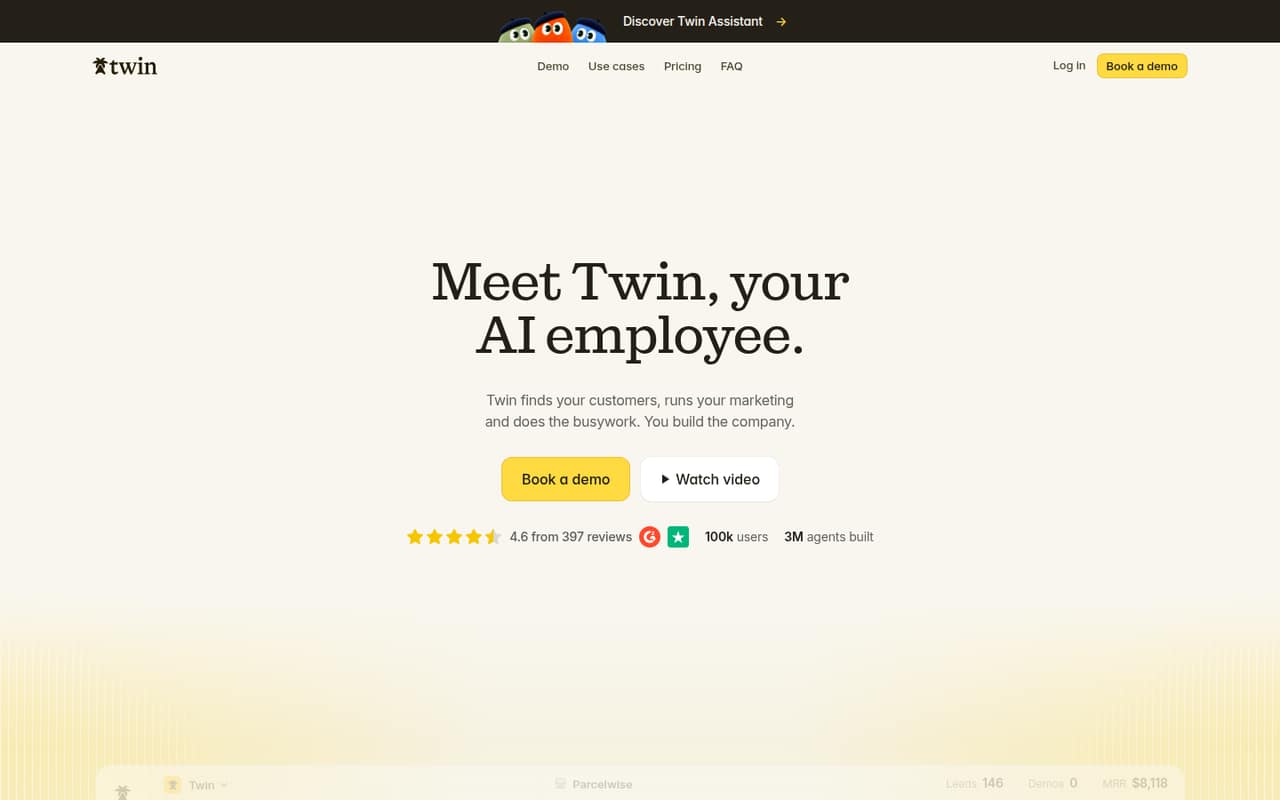
Twin is a hosted AI assistant for prospecting, outreach, content, ads, reporting and invoicing. Its plans connect common business apps and offer agents, scheduled runs and, on Pro, a browser agent and lead enrichment.
For developers, the main question is whether Twin can fit a production stack: the vendor does not publish API, SDK, self-hosting or data-export details. Treat it as a managed business tool until the vendor confirms those requirements.
Good fit if
- Small businesses automating routine work
- Teams running outreach and marketing
- Agencies managing client agents
Skip it if
- Teams requiring a documented public API
- Organizations requiring self-hosted software
- Workloads with strict published rate limits
ScoresHow it rates
What works
- Prospecting, outreach and marketing workflows in one app
- Connects Gmail, Slack, Notion, Sheets and calendar
- Unlimited agents and scheduled runs on Plus
- Review queue can gate messages before sending
- Pro adds browser agent and lead enrichment
What doesn't
- Vendor does not publish public API or SDK details
- No free plan is listed
- Self-hosting and source availability are not published
- Rate limits and usage overages are not published
- Data export and migration path need vendor confirmation
01What Twin is, technically
Twin is presented as a hosted AI assistant, not a library, CLI or self-hosted server. It operates as a business-automation layer: users connect apps and websites, assign tasks to agents, and review some outputs before they are sent. The workflows cover finding prospects, drafting personalized outreach, analyzing calls and customer feedback, creating social content, setting up ads, reporting results in Slack, and handling invoices and payment follow-ups.
That puts Twin alongside a company’s existing CRM, email, advertising and collaboration tools rather than replacing them as a code-level component. The homepage says it connects with more than 5,000 apps and shows connections for Gmail, Slack, Notion, Sheets and calendar on Plus. The review queue is relevant for outbound work: emails, posts and replies can be held for approval. For a software stack, the key distinction is that this is an application to configure, not a documented programmable agent runtime.
02Twin API, SDKs and docs
The integration surface described for Twin is its app and website connections, plus workflows that work across web, email, sheets and chat. Plus lists connections for Gmail, Slack, Notion, Sheets and calendar; the homepage also advertises more than 5,000 apps. Pro adds a browser agent for websites. Twin’s review queue can put emails, posts and replies behind human approval, and the homepage describes reports delivered in Slack.
The vendor does not publish public API endpoints, authentication methods, SDKs, supported programming languages, a CLI or webhook details on the homepage. We would not plan a code-level integration around those capabilities without confirmation. Ask Twin’s team for API documentation, SDK support and examples for your stack before making it a dependency. The homepage links to use cases and a demo, but does not describe a developer documentation portal. Treat the product as a connected SaaS workflow until the vendor confirms otherwise.
03Twin pricing for developers
Twin has no listed free plan. Plus costs $29 per month and includes unlimited agents and scheduled runs, connections to Gmail, Slack, Notion, Sheets and calendar, web, email, sheets and chat tasks, and up to five customer dashboards. Pro is $149 per month and adds a browser agent, lead prospecting and enrichment, and image and video generation. Store starts at $399 per month and adds customer dashboards as needed, one agent tuned per customer, and the ability to run agents on customers’ behalf. Enterprise pricing is custom.
The pricing page lists monthly starting prices and does not publish annual billing or discounts. It does not describe a usage-based charge, request allowance, overage rate or seat-based fee, so do not assume that a high-volume deployment has a fixed total cost. No add-ons are listed. Before production use, ask whether plan prices cover your expected agent runs, customer dashboards and connected services, and whether additional usage changes the bill.
04Twin: open source, self-hosting and lock-in
Twin is presented as a hosted service. The vendor does not publish a software license, source-code repository or self-hosting option, so teams should not plan to run the product in their own cloud or on-premises without a direct confirmation. The plans describe managed agents and integrations, not a deployable package.
The vendor also does not publish a data-export process or migration tooling. That matters if agents accumulate prompts, customer information, campaign settings or workflow logic that a business later needs to move. The integrations may reduce some switching friction because work happens across existing apps, but they do not establish that Twin’s agent configuration or history can be exported. Ask what data can be downloaded, in what format, and what remains accessible after cancellation before storing operationally important work in Twin.
05Twin in production
Twin’s production fit depends on controls that are not described on the homepage or pricing details: request and agent-run limits, uptime commitments, retry behavior, audit logs, permissions, data retention, and security or compliance certifications. Ask the vendor for these details, along with how browser agents handle authentication and what happens when a connected service changes its interface.
The plans list unlimited agents and scheduled runs on Plus, but that does not establish unlimited compute, requests or throughput. The pricing page does not publish rate limits or overage terms. Pro adds a browser agent, which can automate websites, but teams should confirm failure handling and human approval controls before relying on it for customer-facing or financial actions. Twin’s review queue is a useful stated control for outbound content; it is not a substitute for documented access controls, monitoring and recovery procedures.
Questions people ask
Does Twin have a public API or SDK?
The vendor does not publish public API endpoints, SDKs, supported languages or authentication details on the homepage. Its documented integration surface includes app and website connections, with examples such as Gmail, Slack, Notion, Sheets and calendar. Ask Twin to confirm API availability and provide current developer documentation before planning a code-level integration.
How much does Twin cost?
Plus is $29 per month, Pro is $149 per month, Store starts at $399 per month, and Enterprise has custom pricing. The pricing page lists monthly starting prices and does not publish annual billing or discounts. Twin does not list a free plan or add-ons.
Can Twin send messages without approval?
Twin’s homepage says emails, posts and replies can go through a review queue before sending. It also describes agents that run tasks and scheduled runs, but does not detail approval settings for every workflow. Confirm which actions can be gated and whether approval rules can be configured for your use case.
Can I self-host Twin or export my data?
Twin is presented as a hosted service, and the vendor does not publish a self-hosting option, software license or data-export process. If you need an on-premises deployment or must retain portable copies of agent configurations and workflow data, ask Twin for those terms before adopting it.
Does Twin have a free trial?
The pricing page does not list a free plan, and a free trial is not published. Plus is the lowest listed plan at $29 per month. Contact Twin to confirm whether it offers a trial or a guided evaluation before purchase.