
We may earn a commission if you buy through links on this page. It never changes a score or a ranking. How we make money
The bottom line
A hosted verification API starting at $0.05 per verification; delivery and fallback need scrutiny.
Twilio Verify is a hosted verification service in Twilio’s user-authentication offering. It provides verification and identity lookup tools, with pricing starting at $0.05 per verification and a free trial that requires no credit card.
The integration story benefits from Twilio’s server-side SDKs and authentication tutorials, but public user reports flag uneven international OTP delivery and WhatsApp-to-SMS fallback friction. Confirm channel behavior, limits and costs for your target markets before depending on it.
Good fit if
- Teams already using Twilio
- Apps adding account verification
- Pay-as-you-go OTP workloads
Skip it if
- Teams requiring self-hosted verification
- Apps needing guaranteed channel fallback
- Projects without delivery monitoring
ScoresHow it rates
What works
- Starts at $0.05 per verification
- Usage-based pricing with volume discounts
- Free trial requires no credit card
- Official server-side SDKs are available
- Supports verification and identity lookup
What doesn't
- International OTP delivery can vary
- Automatic WhatsApp-to-SMS fallback may need setup
- Rate limits are not published on the homepage
- The free trial's usage limits are not published
- A hosted service cannot be self-hosted
01What Twilio Verify is, technically
Twilio Verify is a hosted verification service, not a library, CLI or self-hosted server. It sits behind your application’s account-creation, login or other verification flow: your backend requests a verification, and the service helps confirm a user’s identity. Twilio positions Verify within its user-authentication offering, alongside identity lookup tools intended to help fight fraud and keep customer accounts secure.
The architectural trade-off is straightforward. You use Twilio’s hosted platform rather than running verification infrastructure yourself, so the service becomes an external dependency in your authentication path. The homepage also promotes Twilio’s broader communications platform, but Verify’s role is account verification—not a replacement for your application’s authentication system. Your app still needs to decide when to request verification, what to do with the result and how to handle delivery failures. Budget for monitoring those steps as part of the integration.
02Twilio Verify API, SDKs and docs
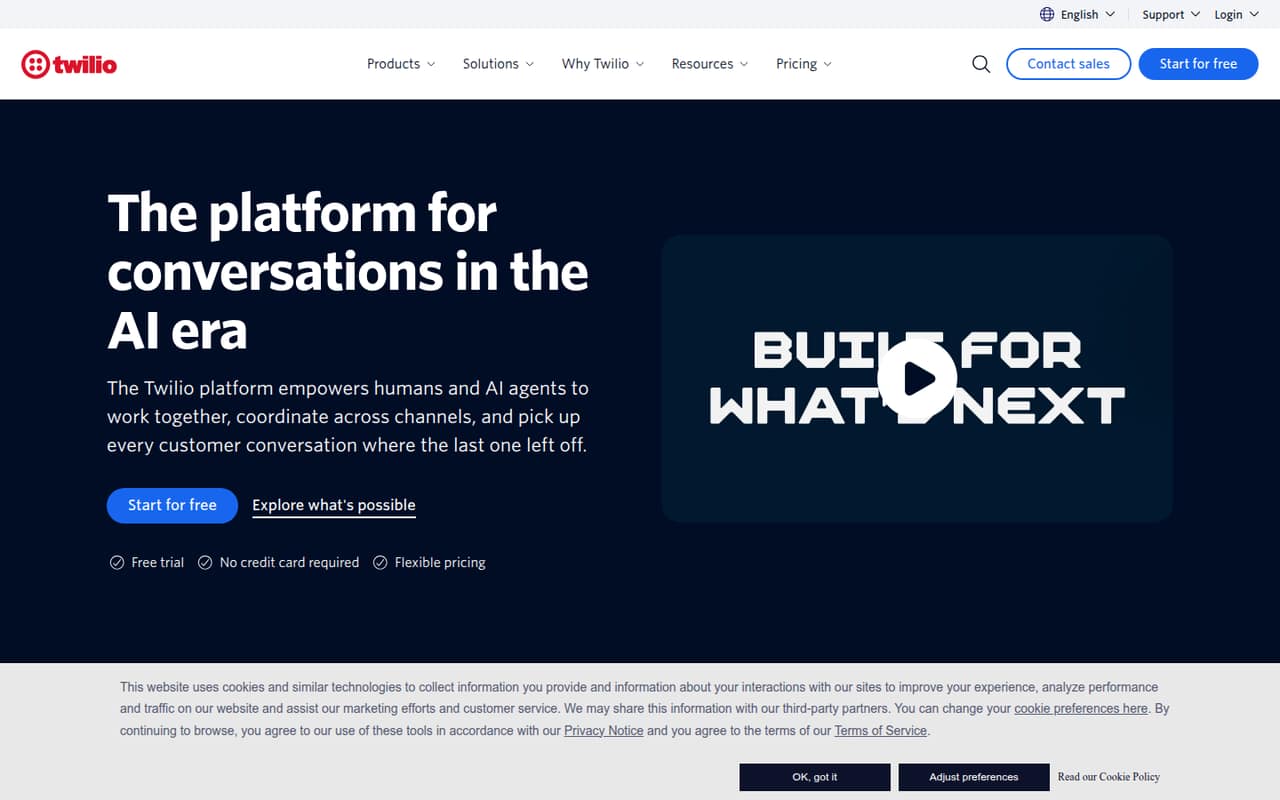
Twilio presents Verify as part of its user-authentication offering and provides official server-side SDKs to get started. The homepage names Python, C#, PHP, Ruby, Java and JavaScript SDKs, and shows a curl example for sending a message through Twilio’s messaging API. Those examples illustrate Twilio’s general integration surface; they are not Verify-specific code samples.
A separate tutorial announcement describes passwordless authentication with TOTP and Twilio Verify, with sample projects in PHP, Python, Node.js, .NET and Go. That gives teams several named paths to explore, though the languages listed for general SDKs and the tutorial differ. The homepage directs developers to Twilio’s docs but does not name a Verify CLI or plugin. Check the Verify documentation for the exact API calls, SDK methods, supported channels and configuration steps for your stack before implementation.
03Twilio Verify pricing for developers
The listed plan is Pay as you go, starting at $0.05 per verification. Twilio describes pricing as usage-based and says volume discounts are available as usage scales. At the starting rate, 1,000 verifications would cost $50 before any volume discount; that arithmetic is not a quote for a particular destination or workload.
Twilio offers a free trial with no credit card required. Treat that as a trial, not as a known ongoing free allowance: the vendor does not publish the trial’s Verify-specific limits here. The pricing page lists no monthly or annual billing option. For production estimates, model expected verification volume and retries, then confirm the applicable rate and any destination or channel differences with Twilio. Reddit users report paying for multiple attempts when a delayed OTP leads users to request another code. The $0.05 starting price is therefore a baseline, not a full cost forecast.
04Twilio Verify: open source, self-hosting and lock-in
Verify is a hosted Twilio service, so you cannot self-host the verification service as an alternative to using Twilio’s platform. Twilio’s homepage names official server-side SDKs, but does not publish their licenses there; check the relevant repository and license before adopting an SDK. The service itself is not presented as open-source software.
The vendor does not publish data-export or migration details on the homepage. Plan for the verification flow to depend on Twilio’s API and account configuration, and keep your application’s user records and authentication decisions under your control. A migration would mean replacing the provider integration and validating the new service’s delivery and verification behavior. Ask Twilio what verification records can be exported, how long they are retained and what account data is available if you need to leave.
05Twilio Verify in production
Before launch, confirm rate limits, destination coverage, delivery expectations and the behavior of each enabled channel. The homepage does not publish Verify-specific rate limits or service-level commitments; ask Twilio for the limits and support terms that apply to your account. Build monitoring around delivery, completion rates, retries and verification errors, and test the full flow in each target market.
Reddit reports point to two operational risks. One developer describes international OTPs arriving late enough that users request a second code, increasing paid attempts while hurting signups. In another thread, a developer reports that WhatsApp verification remained pending with error 63024 and did not automatically fall back to SMS. A commenter says to consult the Verify team for that error, while another suggests implementing fallback based on returned errors. Treat fallback as behavior to verify with Twilio, not an assumption. Protect account credentials and keep verification decisions server-side.
From the threadsWhat users say
The small set of Reddit reports is mixed, with one developer saying the API was easy to get running and others describing delivery delays or fallback friction. These anecdotes flag production questions to investigate, not a measure of overall service quality.
Twilio was easy to get running and I don’t have many complaints about the API itself
In some countries the first OTP arrives quickly, while in others users request a second code before the first one shows up
You can also hard-code a fallback trigger based on the error codes returned
What an absolute joke of a company. Twilio sucks now days
Questions people ask
What does Twilio Verify do?
Twilio Verify is a hosted service for user verification within Twilio’s user-authentication offering. Twilio says its tools include verification and identity lookup to help fight fraud and keep customer accounts secure. Your application still controls when to request verification and what to do with the result.
How much does Twilio Verify cost?
Twilio lists Pay as you go pricing starting at $0.05 per verification. The service is usage-based, and Twilio says volume discounts are available as you scale. The pricing page does not specify a monthly or annual billing option. Confirm the price that applies to your use case before forecasting production costs.
Does Twilio Verify support automatic SMS fallback?
A Reddit thread reports that WhatsApp verification with error 63024 stayed pending without sending an SMS. A commenter says to consult the Verify team for that error; another suggests triggering SMS fallback based on returned errors. Confirm the supported fallback behavior for your configuration with Twilio before relying on it.
Which languages can I use with Twilio Verify?
Twilio’s homepage names official server-side SDKs for Python, C#, PHP, Ruby, Java and JavaScript. A passwordless-authentication tutorial announcement also lists sample projects in PHP, Python, Node.js, .NET and Go. Check the Verify documentation for the SDK methods and language support relevant to your integration.
Can I self-host Twilio Verify?
No. Verify is a hosted Twilio service, not a self-hosted server. You integrate it into your application through Twilio’s platform. If self-hosting or avoiding a provider dependency is a requirement, assess another verification approach and plan for the work of replacing the API integration.