
We may earn a commission if you buy through links on this page. It never changes a score or a ranking. How we make money
The bottom line
A broad hosted market-data API with clear entry plans, but verify coverage and credit behavior first.
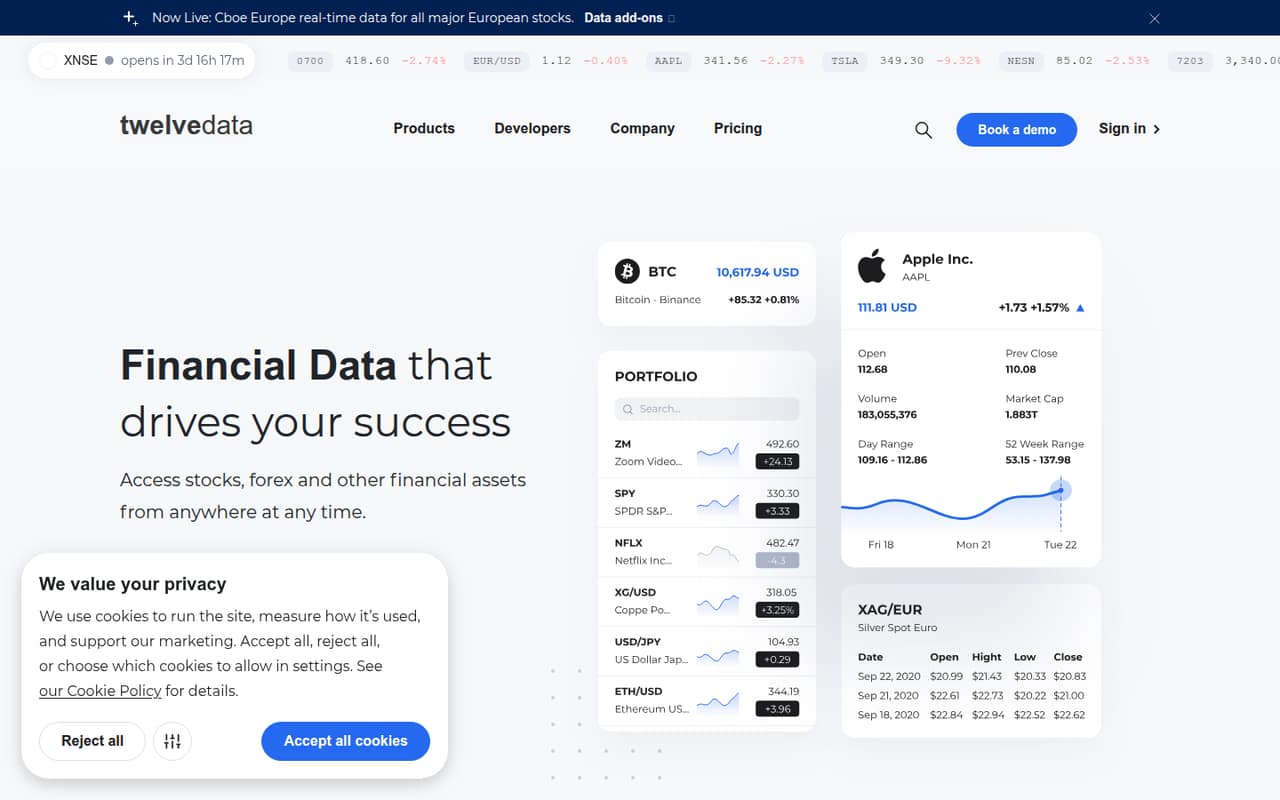
Twelve Data is a hosted financial-data service with APIs, WebSocket feeds, SDKs and spreadsheet add-ins. It covers stocks, forex, crypto, ETFs, commodities and mutual funds, with shared API logic across endpoints. The homepage shows a Python SDK example and direct HTTP examples in Go and C.
The free Basic plan has daily request and market limits; paid tiers increase API and WebSocket credits, market coverage and usage allowances. Reddit comments are mixed: one user favored Twelve Data’s paid plan, while another reported limited TSX ticker coverage on the free plan. Confirm your symbols, history requirements and credit accounting before building around it.
Good fit if
- Fintech prototypes using several asset classes
- Developers who need REST and WebSockets
- Spreadsheet-based market research workflows
Skip it if
- Teams requiring self-hosted market data
- Projects needing unverified exchange coverage
- Futures buyers without confirmed product coverage
ScoresHow it rates
What works
- One API platform covers multiple asset classes
- REST API and WebSocket feeds share structure
- Free Basic plan includes 800 daily requests
- Python example and Go/C HTTP samples are available
- Google Sheets and Excel add-ins are listed
What doesn't
- API credit definitions and cap behavior need confirmation
- Free plan covers only three markets
- SDK languages beyond the Python example need checking
- No public self-hosting option or open-source license is listed
- Reddit users report coverage gaps for some TSX symbols
01What Twelve Data is, technically
Twelve Data is a hosted financial-market-data service: your application calls its APIs or connects to its WebSocket feeds, rather than running a Twelve Data server in your own environment. It supplies data for stocks, forex, crypto, ETFs, commodities, mutual funds and other assets. The vendor also lists fundamentals, spreadsheet add-ins, SDKs and tools such as a request builder and technical indicators.
In a typical stack, Twelve Data sits between market-data sources and your application. A backend can request historical or current data over the API, then normalize or cache the response for a trading system, fintech product or research workflow. A client that needs streaming data can use the WebSocket surface instead. The homepage says the APIs use shared logic across endpoints and that WebSockets share the same structure. That can reduce the number of separate integrations, but it does not remove the need to validate symbol coverage, market hours, history depth and data rights for your use case.
02Twelve Data API, SDKs and docs
The API is an HTTPS request-and-response interface with JSON output in the homepage examples. Its time-series example calls https://api.twelvedata.com/time_series with a symbol, interval and API key. The homepage also shows a Python example using TDClient from twelvedata. Go and C examples make direct HTTP requests, so teams can integrate without relying on a vendor SDK in those languages.
Twelve Data also offers WebSocket feeds, with documentation linked from the developer navigation. The homepage describes the WebSocket structure as shared with the APIs. It lists SDKs for popular languages but does not name the full language set; check the current SDK documentation before choosing a language beyond the Python example. Other listed developer resources include batch requests, technical indicators, a request builder, historical-data guides and extended-hours guidance. Google Sheets and Excel add-ins provide spreadsheet integrations. The homepage does not list a CLI or webhook integration, so confirm those surfaces in the vendor’s docs if your architecture depends on them.
03Twelve Data pricing for developers
The free Basic plan costs $0 per month and lists 8 API credits (800 a day), 8 trial WS credits, three markets and 800 daily requests. The Grow plan is $79 per month, with 377 API credits, 8 trial WS credits, 27 markets and unlimited daily usage. Pro costs $229 per month and includes 1,597 API credits, 1,500 WS credits, 76 markets and unlimited daily usage. Ultra costs $999 per month, lists 10,946 API credits and 10,000 WS credits across 85 markets, and includes a 99.95% SLA.
Venture has no published price or included limits. Enterprise lists custom API and WebSocket credit limits, with pricing not published. Paid plans offer annual billing with a 17% saving, but annual prices are not published. The pricing page does not explain how credits map to endpoint calls or what happens when a plan’s credits run out; ask before estimating production spend. Add-ons include ASX from $120/year, Cboe Canada from $180/year, Cboe Europe from $300/year, and CUSIPs from $9,000/year.
04Twelve Data: open source, self-hosting and lock-in
Twelve Data is presented as a hosted data service. The vendor does not publish a self-hosting option or an open-source license on its product pages, so teams should plan to consume it as an external service unless sales confirms another deployment model. The product pages also do not describe a data-export process; ask what data can be retained or exported under your plan and the applicable exchange terms.
The main lock-in points are the API’s symbols, response formats, credit model and the market-data entitlements attached to your account. The homepage says its endpoints use shared logic, which helps keep integrations within the product consistent, but does not make switching providers automatic. Keep a provider adapter in your own code, map Twelve Data symbols to internal identifiers, and store only data you are permitted to retain. Before launch, confirm whether your application can reuse historical data after cancellation and whether downstream display or redistribution is allowed.
05Twelve Data in production
Plan limits are expressed as API credits, WebSocket credits, markets and daily requests. The pricing page lists 800 daily requests on Basic and unlimited daily usage on Grow and Pro, but the vendor should clarify how credits are counted, whether limits are shared across endpoints, and what the API returns when a cap is reached. Ultra lists a 99.95% SLA; do not assume that commitment applies to other plans or every data feed.
Before depending on the service, test the symbols and history your application needs, and confirm market hours, delay status, exchange entitlements, retention rights and rate-limit behavior with the vendor. The homepage links to system status and trust resources, but teams should request the security and compliance details relevant to their deployment. Reddit feedback is limited and mixed: one commenter said free-plan TSX coverage did not include enough tickers for their needs, while another said Twelve Data became their preferred paid option. Treat those as individual reports, not coverage guarantees.
From the threadsWhat users say
Reddit sentiment is sparse and mixed. Some commenters favor Twelve Data’s paid value, while others question free-tier coverage or say it did not meet their symbol and history needs.
Twelve Data is actually my better choice for a paid subscription. And its cheaper than the pro plan on FMP
I do remember it didn't cover a whole lot of tickers on TSX for the free plan
I tried them, but they didn't have the coverage I needed. I do 1hr timeframes, and if I remember correctly it didn't give enough to cover a full year
Considering Twelve Data, EODHD, Alpha Vantage, Marketstack, and Stooq. Not interested in Finnhub based on things I've read about this
Questions people ask
What does Twelve Data provide?
Twelve Data provides hosted financial-data APIs and WebSocket feeds for stocks, forex, crypto, ETFs, commodities, mutual funds and other assets. Its product list also includes fundamentals, SDKs and Google Sheets and Excel add-ins. Check the vendor’s docs for the specific endpoints and markets your application needs.
Does Twelve Data have a free plan?
Yes. Basic costs $0 per month and lists 8 API credits (800 a day), 8 trial WS credits, three markets and 800 daily requests. Confirm how credits are counted and which markets are included before using the free plan for a production workload.
Which programming languages does Twelve Data support?
The homepage shows a Python SDK example using TDClient, plus direct HTTP examples in Go and C. It says SDKs are available for popular languages but does not name the complete set. Check the current SDK documentation for your language before committing to an integration.
Can I use Twelve Data for real-time feeds?
Twelve Data offers WebSocket feeds described as real-time streams. Available data and entitlements can depend on the market and plan, so confirm the specific exchanges, symbols, delays and WebSocket credit rules you need with the vendor.
Can I self-host Twelve Data?
Twelve Data is presented as a hosted API and WebSocket service, and the vendor does not publish a self-hosting option on its product pages. If your deployment requires self-hosting, ask the vendor directly about deployment options, licensing and data access.