
We may earn a commission if you buy through links on this page. It never changes a score or a ranking. How we make money
The bottom line
Free open-source scanning plus Enterprise analysis, but buyers should confirm deployment and pricing terms.
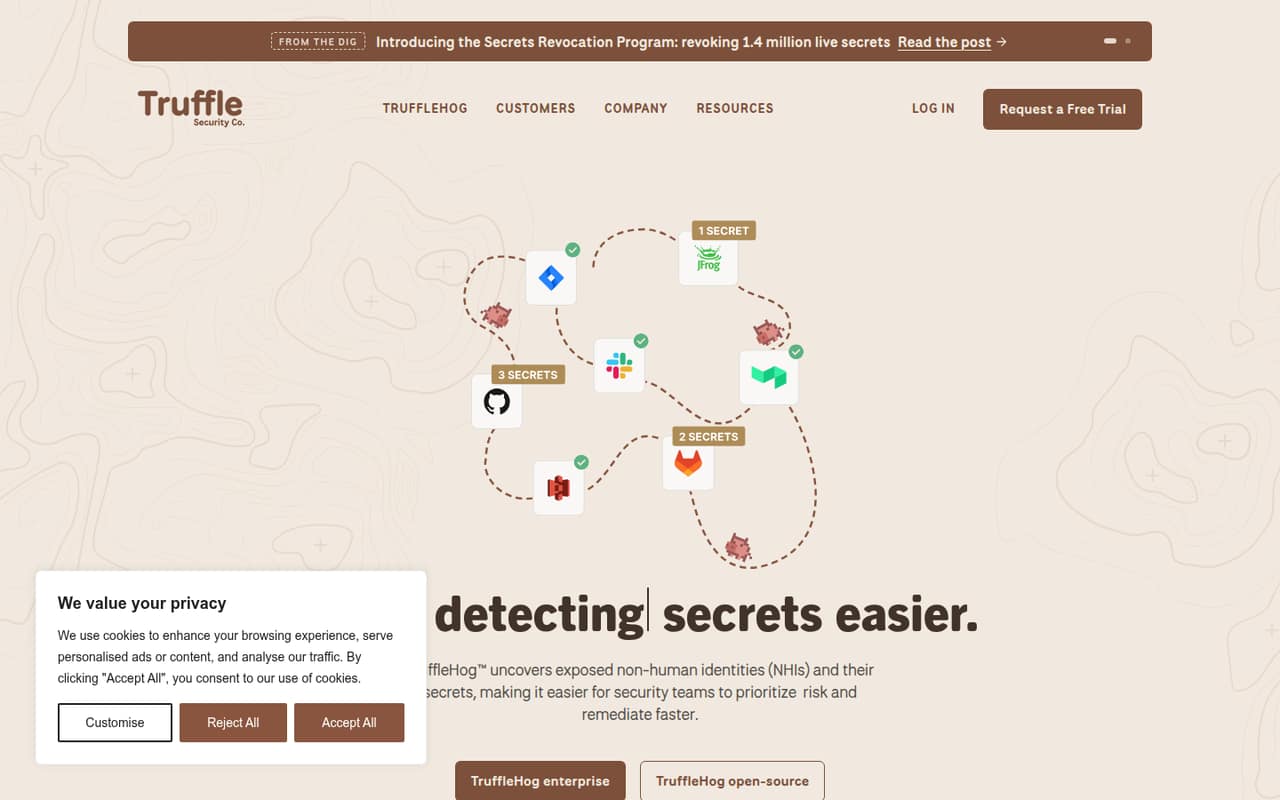
TruffleHog pairs an open-source secret scanner with an Enterprise product for finding, verifying and managing exposed secrets and non-human identities. Its stated scope includes source code, Git history, comments, pull requests and systems such as GitHub, Google Cloud and Slack.
The strongest case is discovery followed by verification and remediation tracking. The open-source option is listed as free; Enterprise pricing, seat limits and usage limits are not published. Confirm deployment, integrations and commercial terms before making it a production dependency.
Good fit if
- Teams scanning source and Git history
- Security groups verifying live credentials
- Organizations tracking secret remediation
Skip it if
- Buyers requiring published Enterprise pricing
- Teams needing a documented SDK matrix
- Organizations requiring confirmed self-hosting
ScoresHow it rates
What works
- Free open-source option
- Verifies more than 800 secret types
- Scans comments, pull requests and Git history
- Maps resources and permissions tied to secrets
- Re-verifies fixes after remediation
What doesn't
- Enterprise pricing and usage limits are unpublished
- API and SDK support details need confirmation
- Deployment options need confirmation
- Licence and data export terms need review
- Reddit feedback on false positives is mixed
01What TruffleHog is, technically
TruffleHog is a secret-scanning engine with an open-source option and a commercial Enterprise product. It finds exposed credentials and non-human identities (NHIs), verifies secrets with providers, and gives security teams tools to investigate risk and track remediation. The vendor says it scans source code and systems beyond repositories, including hidden content, deleted code and version history from GitHub, Google Cloud, Slack and other company tools.
In a stack, it sits alongside source control and security workflows: scan for exposed values, check whether credentials are live, then route findings to the people responsible for revocation or rotation. Enterprise adds visibility, verification and collaboration capabilities, while TruffleHog Analyze identifies resources and permissions associated with NHIs and secrets. The homepage does not establish whether Enterprise is vendor-hosted or customer-managed; the vendor does not publish deployment topology in the pricing notes. Confirm the operating model, data handling and required integrations before rollout.
02TruffleHog API, SDKs and docs
The vendor describes integrations for scanning code and company systems, including GitHub, Google Cloud and Slack. Its stated scan scope includes comments, pull requests, hidden content, deleted code and version history. The product also supports alerts across a platform of the customer’s choosing, with customized messages for developers. That gives teams integration points for detection and notification, but the homepage does not name a REST API, CLI, webhook contract, plugin model, SDK or supported programming languages.
The vendor does not publish an API contract or SDK support matrix in its pricing notes. Confirm SDK support, authentication, supported source-control providers and alert delivery options in the vendor’s docs before designing an integration. The homepage says TruffleHog verifies more than 800 secret types directly with key providers, but does not give per-provider setup requirements or limits. For adoption, validate the exact systems you need to scan and the workflow for sending findings to developers; do not assume that a named integration covers every data type or remediation action.
03TruffleHog pricing for developers
The open-source option is listed as free. The pricing notes do not publish seat or usage limits, so teams should confirm whether their intended deployment has caps on repositories, scans or users. Enterprise is contact-for-pricing, with no published starting price, seat allowance or usage allowance. The vendor also offers TruffleHog Analyze for SaaS, TruffleHog Analyze for Cloud and Forager for monitoring public datasets; prices for all three are not published.
There is no published rate card tying cost to requests, seats, scanned data or compute, and no stated overage policy. Monthly and annual billing terms are also not published in the pricing notes. That makes it difficult to forecast a production bill from scan volume alone. Ask sales for a quote that defines included seats, scan scope, usage thresholds, overages, add-on costs and renewal terms. The free option gives teams a way to evaluate the open-source path, but it does not establish what Enterprise visibility or analysis will cost at scale.
04TruffleHog: open source, self-hosting and lock-in
TruffleHog offers an open-source option, but the pricing notes do not name its licence. Check the project’s licence before modifying or redistributing it, and confirm which capabilities are available in the open-source and Enterprise products. The vendor does not publish self-hosting terms or Enterprise deployment options in the pricing notes, so ask whether customer-managed deployment is supported and what it includes.
The vendor also does not publish data-export formats or a migration path in those notes. Before storing findings and remediation history in Enterprise, ask how to export them, whether alerts and analysis results are portable, and what happens to data when a contract ends. Moving to another scanner may require rebuilding integrations and workflows; the vendor does not publish a migration guide or export specification. Treat those as procurement questions, not assumed product features.
05TruffleHog in production
The production case depends on more than finding strings: TruffleHog says it verifies secrets with key providers, maps associated resources and permissions, tracks remediation status and re-verifies fixes. Before relying on it, confirm which providers and systems are supported for your environment, what access the scanner needs, how often monitoring runs, and how alerts behave during provider outages. The vendor does not publish rate limits, availability targets or scan-volume limits in the pricing notes; get those terms in writing for a production rollout.
Reddit feedback is mixed. One commenter says they have not seen better false-positive rates from TruffleHog than from other scanners, while another developer describes PR scanning that checks whether a token is live and catches secrets in notebook output. A separate thread warns that detection after a secret reaches Git history can be too late. Pair scanning with an explicit revocation workflow, and confirm how findings block or notify in your chosen development process.
Questions people ask
What does TruffleHog scan?
The vendor says TruffleHog scans source code, comments, pull requests and company systems. Its homepage also describes scanning hidden content, deleted code and version history from GitHub, Google Cloud, Slack and other tools. Confirm that the integrations cover your specific repositories and systems before rollout.
Does TruffleHog verify whether a secret is live?
Yes. The vendor says TruffleHog scans more than 800 secret types and verifies them directly with key providers. It also describes continuous tracking of secret status. Confirm which providers and credential types are supported for your environment, and what permissions the verification process requires.
Is TruffleHog free?
The open-source option is listed as free. The pricing notes do not publish its seat or usage limits. TruffleHog Enterprise is contact-for-pricing, and prices for Analyze for SaaS, Analyze for Cloud and Forager are not published. Ask the vendor to clarify limits and paid capabilities for your intended use.
Can TruffleHog automatically remediate leaked secrets?
The vendor says TruffleHog provides an automatic process for developers to revoke leaked secrets and automatically re-verifies each fix. Confirm which providers support that remediation workflow, whether actions require human approval, and how the process fits your credential rotation and incident response procedures.
Does TruffleHog offer an API, SDKs or self-hosting?
The vendor homepage describes integrations and alerts, but the pricing notes do not publish an API contract, SDK support matrix or Enterprise deployment options. Check the vendor’s docs for API and language support, and ask whether customer-managed deployment is available for your plan.
Sources
- TruffleHog homepage
- TruffleHog pricing, compiled via web search from trufflesecurity.com
- Reddit: How are you catching hardcoded api keys from ai scaffolding before they hit the repo
- Reddit: Which is the best open source tool for secret scanning?
- Reddit: Secret Scanning
- Reddit: How are you handling secret prevention in production?