
We may earn a commission if you buy through links on this page. It never changes a score or a ranking. How we make money
The bottom line
A flexible AI gateway with useful governance, but verify integration details and operational risks first.
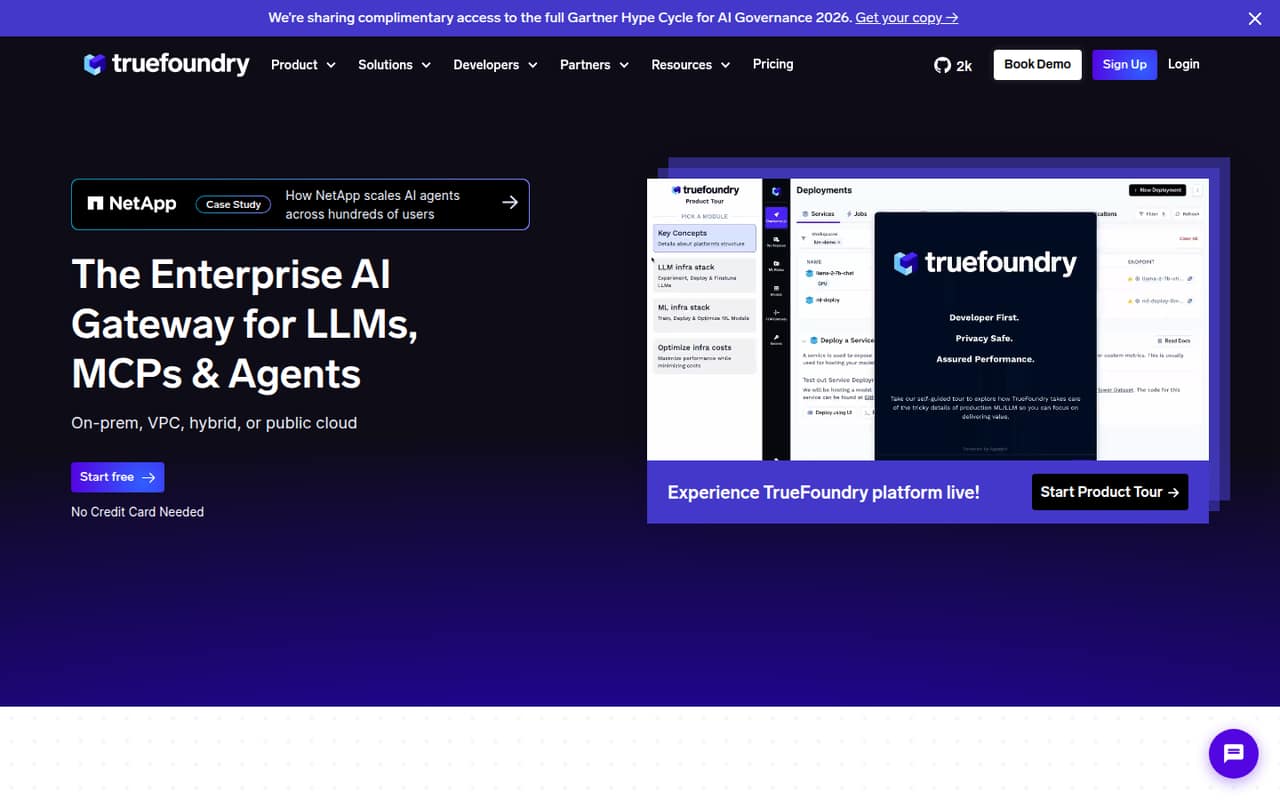
TrueFoundry is a deployable gateway for LLM traffic, MCP servers and agents, with routing, access controls and observability. Its VPC, on-premises and air-gapped options suit teams that need AI controls inside their own environments. The free tier is useful for evaluation; Pro starts at $25 per user/month.
Good fit if
- Teams governing LLM traffic
- Organizations requiring private deployment
- MCP and agent access control
Skip it if
- Teams needing named SDKs
- Projects requiring verified export paths
- Local tools outside gateway traffic
ScoresHow it rates
What works
- Routes models with fallbacks and rate limits
- Centralizes MCP discovery and access controls
- Offers VPC, on-premises and air-gapped deployment
- Traces prompts, tools and model execution
- Free tier includes 10K monthly calls per user
What doesn't
- Homepage names no programming-language SDKs
- Gateway license and source availability are unclear
- Data export and migration details are unpublished
- Pro overages add $20 per 100K calls
- Reddit includes negative DX and security reports
01What TrueFoundry is, technically
TrueFoundry is a deployable AI gateway and management platform, not just a model library or client SDK. It sits between applications, agents and model providers, centralizing model routing, fallback behavior, rate limits and cost controls. Its MCP Gateway adds discovery, authentication, access control and auditing for MCP servers; its Agent Gateway applies identities, usage policies and tracing to agent traffic.
The vendor says it can run in a VPC, on-premises, air-gapped or across multiple clouds. That makes it an option for teams that need gateway controls inside infrastructure they manage, rather than routing every request through a public hosted service. The platform also provides prompt, tool and model traces, metrics, latency and outcomes. Its stated scope is broad, but a gateway controls traffic that passes through it: local MCP servers, subprocesses or direct provider calls may sit outside that path. Teams should map those paths before treating it as a complete agent-control layer.
02TrueFoundry API, SDKs and docs
The integration surface described by TrueFoundry is its AI gateway for model traffic, MCP Gateway for tools and MCP servers, and Agent Gateway for agent access and tracing. The homepage also says its observability is OpenTelemetry-compliant and can connect to Grafana, Datadog or Prometheus. It links to product documentation and a changelog.
The homepage does not name a gateway API protocol, programming-language SDKs, CLI, webhooks or plugins. Before adopting it, confirm the supported endpoint format, authentication flow, SDKs for your languages and how gateway configuration is managed in code. Also check which agent frameworks and MCP server transports it supports; the product's MCP positioning alone does not establish coverage for every tool path. Teams already using OpenTelemetry-compatible observability stacks have a named integration route, but the vendor should confirm the telemetry fields, export behavior and any deployment-specific requirements in its docs.
03TrueFoundry pricing for developers
The Developer plan is free and includes up to 3 users, 10K requests and tool calls per user/month, up to 2 teams, 7-day log retention, 5 model accounts and 5 MCP servers. That is enough for a small evaluation, but the per-user request allowance, team cap and short retention limit may constrain a production rollout.
Pro costs $25 per user/month. It includes unlimited users, 20K requests and tool calls per user/month, up to 10 teams, 30-day log retention, SSO and custom roles. The pricing page lists an overage of $20 per additional 100K requests and tool calls. Model-provider charges pass through and are billed separately, so gateway pricing is not the full inference bill. Third-party guardrails are Enterprise-only and billed on provider usage. Enterprise requires a custom annual commitment and lists custom usage commitments, retention and audit exports, unlimited teams and service accounts, deployment options, priority support, an SLA and onboarding. No annual Pro rate is published.
04TrueFoundry: open source, self-hosting and lock-in
TrueFoundry says the platform can run in a VPC, on-premises, air-gapped or across multiple clouds, so self-managed deployment is an option. The homepage also promotes an open-source agent harness, but that does not establish that the gateway itself is open source. The vendor does not publish the gateway's license or source availability in the information available here; ask which components are open source and what license applies before planning a self-hosted rollout.
The vendor also does not publish data-export formats or a migration procedure. Model routing and MCP configuration may need to be recreated in a replacement gateway, while traces and audit records depend on available export paths. Ask for export formats, retention after termination, configuration-as-code support and a migration plan. Running inside your own infrastructure can reduce reliance on a vendor-hosted data plane, but it does not by itself remove configuration or operational lock-in.
05TrueFoundry in production
The product advertises rate limits, fallbacks, access controls, audit logging and tracing, and says it supports SOC 2, HIPAA and GDPR standards. The homepage also lists 24/7 support with SLA-backed response SLAs. These are vendor claims, not a substitute for checking the applicable reports, contractual SLA, data flows and deployment responsibilities. The published plan limits include request allowances and log-retention periods; specific throughput ceilings, uptime figures and gateway rate limits are not published here. Ask how limits behave during provider failures and whether audit exports are available on your plan.
Reddit feedback is limited and mixed. One commenter reported that TrueFoundry felt clunky and its developer experience was not great. Another alleged that the vendor had emailed customers about provider credentials being leaked; this is an unverified user claim, not an established incident finding. Before production, ask the vendor for a security incident explanation, credential-handling details, an escalation path and a canary-and-rollback procedure. Also inventory direct model calls and local tools that may bypass the gateway.
From the threadsWhat users say
Reddit sentiment is mixed but thin: one user describes clunky developer experience, and another makes a serious, unverified security allegation. Other comments do not provide a confirmed long-term production assessment of TrueFoundry.
TrueFoundry — keeps coming up in conversations with other ML teams for the governance and cost-tracking layer
can't find much real production experience past the first few months though
We tried truefoundry but it felt clunky, devX was not great
they have been emailing us all day about how customers provider credentials are being leaked and they don't know why
Questions people ask
Can we self-host TrueFoundry?
TrueFoundry says it can run in a VPC, on-premises, air-gapped or across multiple clouds. The Enterprise plan lists VPC, on-premises and data residency. Confirm which deployment options are available on your plan, what components run in your environment and who handles upgrades and operations.
What does TrueFoundry cost?
The Developer plan is free for up to 3 users, with 10K requests and tool calls per user/month. Pro is $25 per user/month and includes 20K per user/month; additional 100K requests and tool calls cost $20. Model-provider charges are billed separately. Enterprise requires a custom annual commitment.
Does TrueFoundry provide SDKs or a CLI?
The vendor homepage describes its AI, MCP and Agent Gateways and links to documentation, but does not name programming-language SDKs or a CLI. Check the docs or ask TrueFoundry to confirm endpoint protocols, supported languages, authentication methods and configuration tooling before choosing it for an application.
Can TrueFoundry govern every agent tool call?
Its gateway can centralize controls for traffic routed through it, including model and MCP access. That does not automatically cover local tools, subprocesses or direct provider calls that bypass the gateway. Map your agents' network and local tool paths, then ask the vendor which transports and frameworks it can enforce.
What should we check before using TrueFoundry in production?
Confirm your plan's request allowance and log retention, gateway limits, uptime commitments, credential handling, audit exports and incident response process. The homepage describes security and compliance features, but you should review the applicable reports and contract terms. Test whether local tools or direct model calls can bypass your gateway policies.