
We may earn a commission if you buy through links on this page. It never changes a score or a ranking. How we make money
The bottom line
Broad stablecoin payment coverage, but opaque pricing and sparse integration details leave key buying questions open.
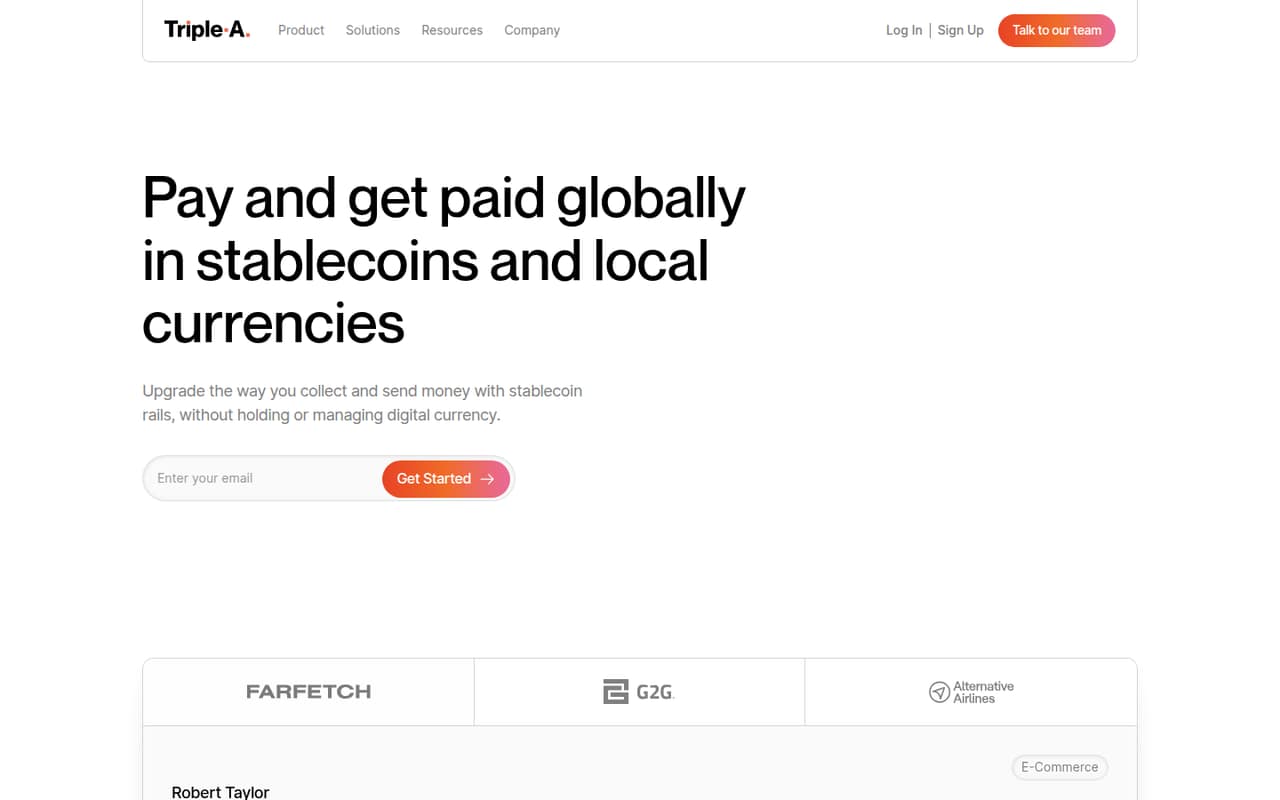
Triple-A is a hosted payment gateway for businesses that collect and send stablecoins and local currencies. Its product covers checkout, payment links and invoices, named-IBAN accounts, stablecoin payouts, local payouts, and white-label remittance. The homepage says businesses can use stablecoin rails without holding or managing digital currency.
The vendor links to API documentation, but the homepage gives few details about protocols, SDKs, languages, or operational limits. Pricing is custom and volume-based, with no published starting price in the available listing. We would confirm integration support, rates, settlement terms, and production limits with Triple-A before committing.
Good fit if
- Businesses accepting stablecoin payments
- Marketplaces paying global sellers
- Platforms needing local-currency payouts
Skip it if
- Teams requiring published API limits
- Projects needing a free payment tier
- Teams requiring self-hosted payment infrastructure
ScoresHow it rates
What works
- Checkout, payment links, and invoices for stablecoin collection
- Named IBAN accounts with stablecoin or local-currency settlement
- Stablecoin payouts available 24/7, per the homepage
- Local payouts cover 30+ currencies across 70+ countries
- White-label remittance is included in the product offering
What doesn't
- Pricing is custom and volume-based
- No public starting price is listed
- SDKs, languages, and API protocol need confirmation
- Rate limits and uptime commitments need confirmation
- No self-hosted deployment option is advertised
01What Triple-A is, technically
Triple-A is a hosted business payments gateway, not a library, CLI, or server that a team installs in its own environment. It sits between a business’s checkout or payout workflows and payment rails for stablecoins and local currencies. The homepage links to API documentation for developers and describes products for accepting stablecoins, collecting through payment links and invoices, receiving funds to a named IBAN, and sending payouts.
The gateway is aimed at businesses that want to add digital-currency payment flows without managing digital currency themselves; that is the vendor’s stated positioning, not a guarantee about every custody or settlement arrangement. Merchants can also settle through stablecoins or local currencies, according to the homepage. Triple-A describes itself as licensed in the US, EU, and Singapore. For a stack decision, treat it as an external payment provider and verify which countries, currencies, stablecoins, and settlement routes apply to your account.
02Triple-A API, SDKs and docs
The homepage links to API documentation and describes a single payment integration for businesses serving 140+ countries. It does not name an API protocol, SDKs, programming languages, CLI, or plugins. Treat the API docs as the integration entry point, then confirm supported SDKs, languages, authentication, API versioning, webhook events, and checkout methods with Triple-A before selecting an implementation.
The product surface spans stablecoin checkout, payment links and invoices, named-IBAN accounts, stablecoin payouts, local-currency payouts, and white-label remittance. Those workflows can involve distinct collection, conversion, settlement, and payout requirements, so ask which are exposed through the API and which require configuration or vendor support. The homepage also links to FAQ and Support. We cannot assess documentation depth or implementation effort from the homepage alone; request an integration guide and sandbox details, and confirm how the API handles retries, duplicate requests, errors, and payment status updates.
03Triple-A pricing for developers
The available pricing listing reports custom, volume-based pricing. It gives no starting price and publishes no monthly or annual billing schedule. It also reports no free plan or free trial. Treat those details as a starting point for procurement, not a quote: ask Triple-A for rates tied to your expected transaction volume, currencies, countries, payment methods, and settlement choices.
The vendor does not publish enough pricing detail here to calculate a production bill or identify overage charges. Ask whether pricing varies by collection versus payout, stablecoin or local-currency settlement, refund handling, conversion, or payout destination. Confirm minimums, any per-transaction charges, currency-conversion costs, and whether volume tiers change during a contract. There is no listed add-on schedule to model separately. Without a free tier or public rate card, teams cannot estimate cost from a small pilot using published prices; get a written quote with representative flows and projected volumes before comparing the gateway with other payment APIs.
04Triple-A: open source, self-hosting and lock-in
Triple-A presents a hosted payment gateway and links to API documentation; its homepage does not advertise an open-source licence or self-hosted deployment. Teams should treat the payment service as vendor-operated and ask directly about deployment options, data residency, and the contractual terms for stored or processed payment data.
The vendor does not publish a data-export process in the homepage information. Before integrating, ask which transaction, customer, reconciliation, and payout records can be exported, in what formats, and for how long they remain available after termination. Migration would mean replacing the provider in checkout, payment collection, settlement, or payout flows, then reconciling historical records and updating operational processes. The difficulty depends on how tightly your application relies on Triple-A-specific payment states, account details, and workflows. Keep an internal payment abstraction and retain the records your finance and compliance teams need.
05Triple-A in production
The homepage advertises local payouts in 30+ currencies across 70+ countries and stablecoin payouts 24/7. Those are product claims, not a published service-level commitment. Before relying on the gateway, ask for supported-country and currency lists for your account, settlement timelines, maintenance terms, uptime commitments, and escalation paths. The homepage does not publish API rate limits, so confirm them along with retry guidance, idempotency behavior, webhook delivery and replay, and what happens when a payout is delayed or rejected.
Triple-A describes itself as licensed in the US, EU, and Singapore. Confirm which regulated entity will serve your business and which licenses or permissions apply to each flow and jurisdiction. Also review custody and conversion arrangements, supported stablecoins and networks, refund handling, reconciliation data, and security documentation. Test failure paths in a sandbox if one is available, including duplicate requests and delayed status updates. Get written answers on limits and support coverage before routing production payments.
Questions people ask
What is Triple-A?
Triple-A is a hosted payment gateway for businesses that collect and send stablecoins and local currencies. Its listed products include stablecoin checkout, payment links and invoices, named-IBAN accounts, stablecoin payouts, local-currency payouts, and white-label remittance. The homepage says businesses can use stablecoin rails without holding or managing digital currency.
Can a business accept stablecoins with Triple-A?
Yes. Triple-A lists stablecoin checkout and payment links and invoices for collecting stablecoins. The homepage positions the service as a way to use stablecoin payment rails without holding or managing digital currency. Confirm supported stablecoins, networks, countries, settlement options, and fees with the vendor before implementation.
Does Triple-A offer local-currency payouts?
Triple-A lists local payouts in 30+ currencies across 70+ countries. It also lists stablecoin payouts to suppliers, sellers, providers, and vendors. Ask the vendor which destinations and currencies are available for your business, what settlement timelines apply, and whether pricing differs by payout route.
How much does Triple-A cost?
The available pricing listing describes Triple-A pricing as custom and volume-based. It does not publish a starting price or monthly or annual billing schedule, and it reports no free plan or trial. Request a written quote based on your transaction volumes, payment flows, currencies, and payout destinations.
Does Triple-A provide SDKs or a self-hosted option?
The homepage links to API documentation but does not name SDKs, programming languages, or an API protocol. It presents Triple-A as a hosted gateway and does not advertise self-hosting. Confirm SDK support and deployment options with the vendor, and ask about data export before building a production integration.