
We may earn a commission if you buy through links on this page. It never changes a score or a ranking. How we make money
The bottom line
Transak gives apps widget and API-based ramps, with variable fees and operational risk to assess.
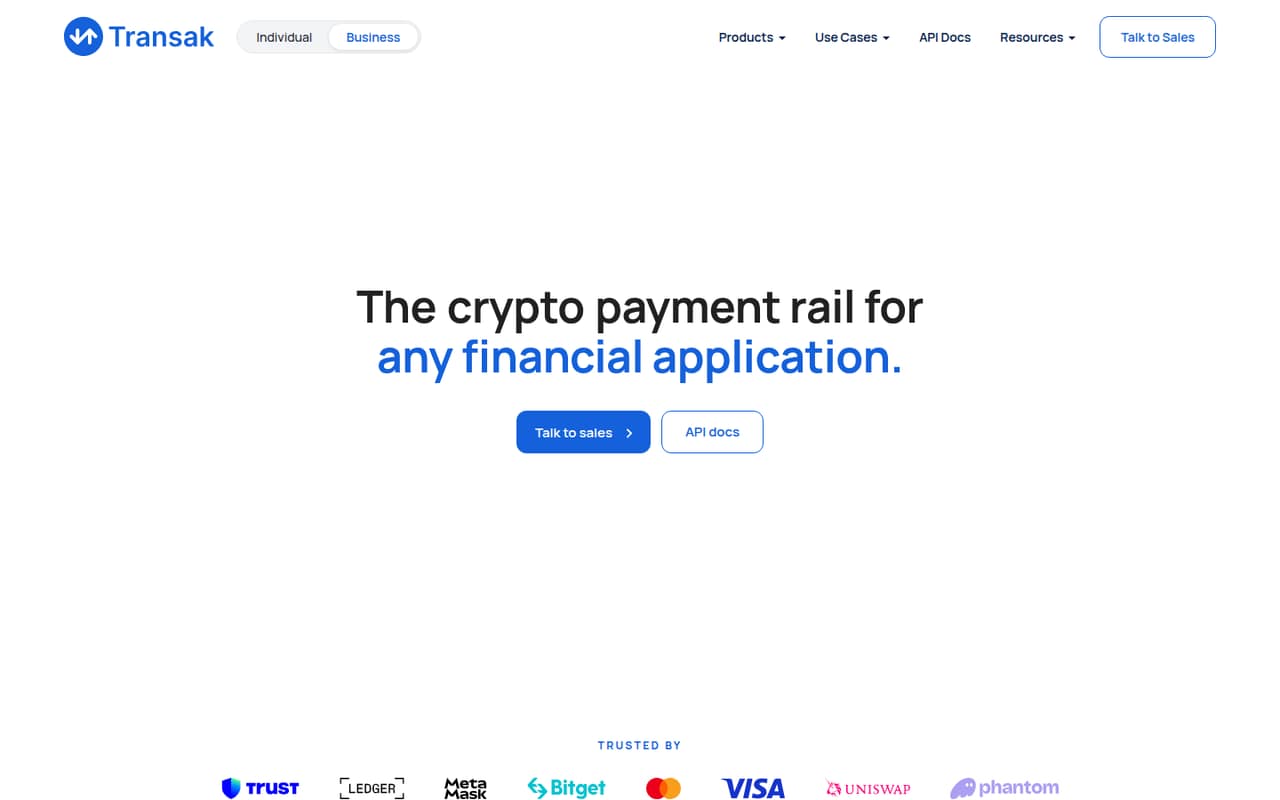
Transak is a hosted crypto payment rail that lets financial apps add fiat on-ramps, off-ramps and virtual account flows through a widget or Whitelabel API. Its integration options include a Web SDK, Mobile WebView, webhooks and WebSockets, plus KYC flows and KYC Reliance.
The pricing page lists transaction-based charges rather than a subscription: a 0%–2.5% exchange-rate spread, a typical Transak fee of 0.5%–5%, and third-party network or liquidity fees. Developer partners also face a one-time $10,000 Whitelabel API integration fee. Reddit reports include delayed transactions, account suspensions and difficulty getting support, so build monitoring and a fallback ramp into production plans.
Good fit if
- Wallets adding fiat-to-crypto checkout
- Exchanges reusing existing KYC
- Apps needing virtual account flows
Skip it if
- Teams requiring self-hosted payment rails
- Projects needing predictable flat pricing
- Apps without transaction support capacity
ScoresHow it rates
What works
- Offers both a pre-built widget and Whitelabel API
- Supports on-ramps, off-ramps and virtual accounts
- Provides Auth Pass-through and KYC Reliance
- Widget supports query-parameter theming
- Webhooks and WebSockets support event-driven flows
What doesn't
- No free plan or subscription price is listed
- Transaction charges combine spread, fees and network costs
- Developer partners pay a $10,000 integration fee
- Supported rate limits and transaction SLAs are not published
- Reddit users report delayed transactions and account suspensions
01What Transak is, technically
Transak is hosted payment infrastructure for financial applications, not a self-hosted server or a standalone crypto wallet. It sits between an app, its users’ fiat payment methods and supported crypto networks. The app can embed Transak’s widget or build its own checkout on the Whitelabel API.
The service handles on-ramps and off-ramps, KYC flows and, for supported use cases, named virtual bank accounts and dedicated wallet addresses for settlement. Its homepage describes virtual IBANs for inbound wires that can credit stablecoins, plus off-ramp settlements to users’ bank accounts. Transak also offers Auth Pass-through and KYC Reliance, allowing a partner to pass a user session or reuse an existing KYC flow.
That puts Transak in the transaction and compliance path: your product controls the user journey to varying degrees, while Transak provides payment access and settlement infrastructure. Transak says coverage varies by payment method, currency and regulatory availability, so validate each intended corridor before designing around it.
02Transak API, SDKs and docs
The homepage offers two integration surfaces: a widget and Whitelabel APIs. The widget includes a pre-built UI, theming through query parameters, a Web SDK and Mobile WebView. The API option gives the app more control over UI and UX and lists Auth, KYC Reliance, webhooks and WebSockets. Transak’s use-case material also names a Create Order API for programmatic funding flows.
The homepage links to widget documentation and API documentation. It does not name programming languages or language-specific SDKs; confirm SDK support and current API details in Transak’s docs before choosing an implementation. No CLI is named on the homepage. The listed integrations suggest a choice between embedding a hosted flow and building a custom interface around Transak’s infrastructure.
For an event-driven flow, plan around the documented webhooks and WebSockets and verify which order states they cover. Ask Transak about authentication, idempotency, retry behavior, webhook signing and API versioning before making those details part of your production design.
03Transak pricing for developers
The pricing page lists no free plan, free trial, monthly subscription or annual subscription. The listed model is pay per transaction, so costs rise with transaction volume and the payment routes your users choose. The pricing page lists a 0%–2.5% exchange-rate spread and says Transak’s fee is typically 0.5%–5% per transaction. Third-party network, gas, validator or liquidity fees can apply at execution.
Developer partners using the Whitelabel API also face a one-time $10,000 integration fee. This is an upfront cost, separate from transaction charges. The transaction limits users receive depend on KYC level, region and payment method; the pricing page does not give a universal limit or a fixed all-in rate.
Model costs using actual corridors and payment methods rather than a single headline percentage. Ask Transak for a quote covering expected volumes, failed transactions, refunds and any partner-specific terms. The pricing page does not list a minimum monthly spend, volume discount or fixed rate that would make costs predictable at scale.
04Transak: open source, self-hosting and lock-in
Transak describes a hosted widget and Whitelabel API, not a self-hosted deployment. Its homepage does not publish an open-source licence or offer source code for the payment infrastructure. The vendor also does not publish a data-export process in the published product materials; ask what order, KYC and settlement records you can export, in what format, and for how long they remain available.
A widget integration is likely the more contained option: replacing it means rebuilding the checkout experience and changing the payment provider. A Whitelabel API can reduce UI dependence, but your backend still relies on Transak’s API, KYC and settlement behavior. Before launch, establish how to retrieve transaction history, reconcile in-flight orders and route new transactions to another provider. Treat provider portability as an application design requirement, not an assumed feature.
05Transak in production
Transak says transaction limits depend on KYC level, region and payment method, and its homepage describes regulatory and payment coverage as global. It also lists card, bank transfer, SEPA and Apple Pay options for relevant use cases. Validate supported assets, networks, countries and corridors for your exact product; the homepage cites 136+ assets across 45+ networks for one wallet use case, not a universal guarantee for every integration.
The published materials do not publish API rate limits, uptime commitments, latency targets or recovery objectives. Ask about those limits, along with webhook retries, order reconciliation and escalation paths. Reddit users report a purchase that had not reached a wallet after more than 16 hours, difficulty getting a response, and accounts suspended for “internal reasons.” These are individual reports, not a measure of typical performance, but they point to operational risks worth planning for.
Monitor order state from your own system, keep support evidence and provide a fallback payment route. Confirm who handles disputes and failed transactions, including any network fees.
From the threadsWhat users say
Reddit sentiment is mixed but leans negative in the Reddit threads we read. Some commenters describe Transak as cheaper or say it worked for them; others report delayed purchases, account suspensions and poor support.
I bought ETH from Metamask with Transak but it didn't reached my wallet yet. It's been over 16 hours
Cant get a reply from anyone
One day it works the other day they suspend your account for no reason whatsoever stating "internal policies" and such BS
Two scenarios. You spend 1000 dollars on conibase to get any crypto. You pay around 60 on fees. You do that via transak you pay 25 fees. Transak is way cheaper
Questions people ask
Is Transak legitimate and safe to integrate?
Transak presents itself as payment infrastructure for financial applications and says it provides KYC flows and regulatory coverage. That does not remove operational risk: Reddit users report delayed transactions and account suspensions. Review Transak’s security and compliance documentation, confirm coverage for your regions, and ask how it handles account reviews, disputes and transaction failures before launch.
What does Transak do in a payment flow?
Transak provides fiat-to-crypto on-ramps, crypto-to-fiat off-ramps and virtual account payment flows. An app can use a pre-built widget or integrate the Whitelabel API. Transak also offers KYC flows, Auth Pass-through and KYC Reliance. The payment methods, available currencies and regulatory coverage depend on the transaction’s region and route.
How much does Transak cost?
The listed model is pay per transaction, with a 0%–2.5% exchange-rate spread and a typical Transak fee of 0.5%–5%. Third-party network, gas, validator or liquidity fees may also apply. Developer partners pay a one-time $10,000 Whitelabel API integration fee. Transak lists no free plan or monthly subscription.
How can I check a Transak transaction?
Use your application’s order records and the transaction status information available through your Transak integration. The homepage lists webhooks and WebSockets for the Whitelabel API, but does not detail status fields or retry behavior. Ask Transak which identifiers and order states to store, how to reconcile pending transactions, and how to escalate a delayed settlement.
Does Transak support custom checkout and existing KYC?
Yes. The Whitelabel API is intended for teams that want control over their interface, and Transak lists Auth and KYC Reliance as integration features. Its homepage also describes a widget with a pre-built UI, query-parameter theming, Web SDK and Mobile WebView. Confirm the supported SDKs, languages and KYC handoff details in the vendor’s docs.