
We may earn a commission if you buy through links on this page. It never changes a score or a ranking. How we make money
The bottom line
Useful for tracing cross-domain delivery issues; expect enterprise pricing and confirm developer access before committing.
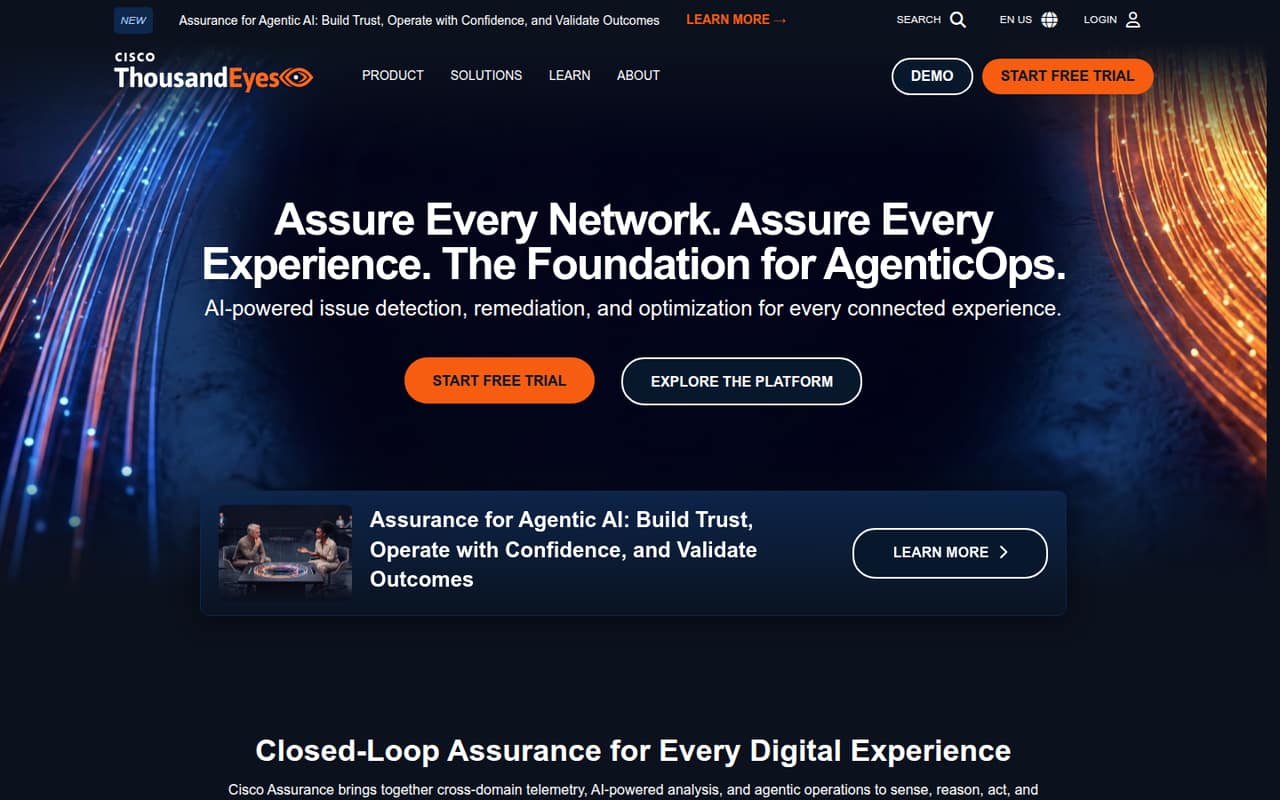
ThousandEyes is a digital experience monitoring and assurance platform that traces service delivery from users to applications across networks, DNS, and services. Its anomaly detection, incident correlation, and workflow automation target operations teams that need to locate problems beyond their own network boundary.
The product's monitoring range is broad, but fixed prices, SDKs, and API details are not published in the information available. Reddit users praise its visibility and effectiveness while flagging cost and deployment effort, so buyers should validate integration requirements and total cost with Cisco.
Good fit if
- Tracing user-to-application network paths
- Global SaaS experience monitoring
- Cisco-heavy network operations teams
Skip it if
- Teams needing published, fixed pricing
- Projects requiring documented SDKs
- Small teams avoiding deployment overhead
ScoresHow it rates
What works
- Maps each hop from user to application
- Correlates network, DNS, and service issues
- Adjusts alert thresholds to changing conditions
- Ranks cross-domain incidents with LLM summaries
- Connects findings to operational workflows
What doesn't
- Fixed subscription prices are not published
- Monitoring limits depend on usage units
- SDKs, languages, and API details need confirmation
- Reddit users describe it as expensive
- Some users report substantial setup effort
01What ThousandEyes is, technically
ThousandEyes is a digital experience monitoring and assurance service, not a library or a self-hosted monitoring server. It collects telemetry from monitoring agents and global vantage points, then visualizes the delivery path between users and applications. The platform connects performance problems across network, DNS, and service layers so operations teams can distinguish an application slowdown from a network disruption.
In a typical stack, ThousandEyes sits alongside the services and networks being monitored. Teams use it to inspect external paths and user experience, then feed telemetry into SIEM, AIOps, and analytics tools or trigger workflows through ITSM, NOC, and automation integrations. Cisco also describes incident correlation, anomaly detection, predictive SD-WAN route analysis, and a natural-language assistant. This places the product closer to cross-domain observability and network assurance than to application instrumentation alone. The annual subscription is divided into products measured by tests, endpoints, providers, regions, cloud accounts, or traffic flows.
02ThousandEyes API, SDKs and docs
ThousandEyes describes integrations with ITSM, NOC, and automation platforms for alerts, incident workflows, and remediation. It also says teams can stream real-time and historical telemetry into SIEM, AIOps, and analytics tools. Those are the named integration surfaces; the vendor should confirm supported API protocols, authentication, SDK languages, CLI availability, and documentation before you design a custom integration.
The product also includes a natural-language assistant for asking questions and exploring telemetry. That may help operators investigate incidents, but it is not a substitute for a documented programmatic interface if your code needs to query tests, manage agents, or export results. Confirm API coverage, quotas, pagination, versioning, and support terms with Cisco. The homepage does not establish a language-specific SDK or a CLI workflow, so avoid assuming either is available when estimating implementation effort. For a production integration, verify how alerts reach your systems and whether remediation actions can be restricted and audited.
03ThousandEyes pricing for developers
The pricing information lists no fixed starting price: ThousandEyes is sold as an annual subscription, and prices are not published. It lists a 15-day free trial but no free plan. Treat the trial as a way to evaluate the service, not as a production free tier; confirm eligibility and terms with Cisco.
Costs are organized around usage rather than one universal metric. Network & App Synthetics is measured by monitoring tests, with test units depending on the number, type, and frequency of tests. Endpoint Experience is measured per user endpoint. Internet Insights uses providers and regions. Cloud Insights uses cloud providers, cloud accounts, and flow logs per second; Traffic Insights uses flows per second. ThousandEyes WAN Insights is for customers with qualified Cisco DNA licensing tiers. Exact limits and prices are not published, and add-on pricing is not listed.
Before rollout, ask for a quote based on test frequency, endpoint count, monitored providers, cloud flow volume, and any licensing you already hold. Also confirm what happens when usage exceeds the contracted allocation; overage rates are not published.
04ThousandEyes: open source, self-hosting and lock-in
The vendor does not publish an open-source licence or describe ThousandEyes as a self-hosted product. Treat it as a vendor-operated service with agents and integrations unless Cisco confirms a different deployment option in writing. The vendor's site does not establish a data-export format or a complete export path, so ask how to retrieve historical telemetry, test configuration, incident records, and agent data before signing.
Migration effort depends on how much your operations rely on ThousandEyes-specific tests, path visualizations, alert logic, and incident workflows. Telemetry sent to SIEM, AIOps, and analytics tools may help preserve some operational data, but it does not establish a portable replacement for the platform's configuration or analysis. Request export formats, retention terms, deletion procedures, and contract-end access. If portability is a requirement, test those paths as part of procurement rather than assuming integrations remove lock-in.
05ThousandEyes in production
The vendor describes dynamic alert thresholds, impact-ranked incident correlation, predictive SD-WAN analysis, and automated operational workflows. These features can reduce manual triage, but buyers should verify alert behavior, incident ownership, data retention, and the controls around automated remediation before depending on them. Confirm service availability commitments, security controls, compliance coverage, and limits for each purchased usage unit with Cisco; published availability and compliance details are not available on the vendor's site used here.
Scaling is tied to plan-specific units such as tests, endpoints, providers, cloud accounts, and flows per second. Since exact limits are not published, model expected growth with the vendor and clarify what happens at allocation limits. Reddit users report that the product can work well and provide useful external visibility, but some describe it as expensive and effort-intensive to deploy. One user also reported that endpoint licenses had a 100-license minimum in their situation; confirm current order minimums and licensing terms directly. Another discussion describes TCP visibility issues in a Zscaler setup, a reminder to validate your own proxy and VPN paths.
From the threadsWhat users say
Reddit sentiment is mixed but leans positive on monitoring value: users praise its usefulness for diagnosing external path problems, while repeatedly raising cost and deployment effort. One discussion also flags an endpoint licensing minimum, and another reports a TCP visibility issue in a specific network setup.
It is extremely helpful when a client contacts us and says there is a problem
It's really expensive. But it does what it says it does
Expensive and requires a ton of effort to deploy and setup
We're using credits that we get with our switch orders and like it OK
Questions people ask
What does ThousandEyes monitor?
ThousandEyes monitors digital service delivery across users, applications, networks, DNS, and services. It visualizes the path between a user and an application, monitors endpoint experience, and offers views of internet providers, regions, cloud traffic, and enterprise traffic. The exact coverage depends on the product and usage units in your subscription.
Does ThousandEyes have a free plan?
The pricing information lists no free plan and gives no fixed subscription price. It lists a 15-day free trial. Ask Cisco to confirm trial eligibility, what features and usage limits apply during the trial, and whether trial data or configuration can be retained after it ends.
How much does ThousandEyes cost?
ThousandEyes is sold as an annual subscription, but fixed prices are not published. Pricing is measured by product-specific units, including tests, endpoints, providers and regions, cloud accounts, and flows per second. Request a quote based on your expected use and ask about limits, overages, and renewal terms.
Does ThousandEyes provide an API or SDK?
The vendor describes integrations with ITSM, NOC, and automation platforms, plus telemetry streaming to SIEM, AIOps, and analytics tools. Confirm directly with Cisco which API protocols, SDK languages, authentication methods, and quotas are supported for your intended integration; do not assume a particular SDK or CLI is available.
Can ThousandEyes be self-hosted?
ThousandEyes is presented as a vendor-operated monitoring service, and self-hosting is not described. The vendor also does not publish an open-source licence on the vendor's site used here. If self-hosting, source access, or data portability is a requirement, ask Cisco to confirm deployment options, export formats, retention, and end-of-contract access.
Sources
- ThousandEyes homepage
- ThousandEyes pricing, compiled via web search from thousandeyes.com, itsecureops.com, cubeapm.com
- Reddit: What is your experience with Thousandeyes?
- Reddit: Anyone using ThousandEyes Endpoint Agents?
- Reddit: Experiences with ThousandEyes?
- Reddit: Thousandeyes Endpoint Agents w/Zscaler