
We may earn a commission if you buy through links on this page. It never changes a score or a ranking. How we make money
The bottom line
Visual UI automation and RPA across platforms, with licensing and integration details to verify.
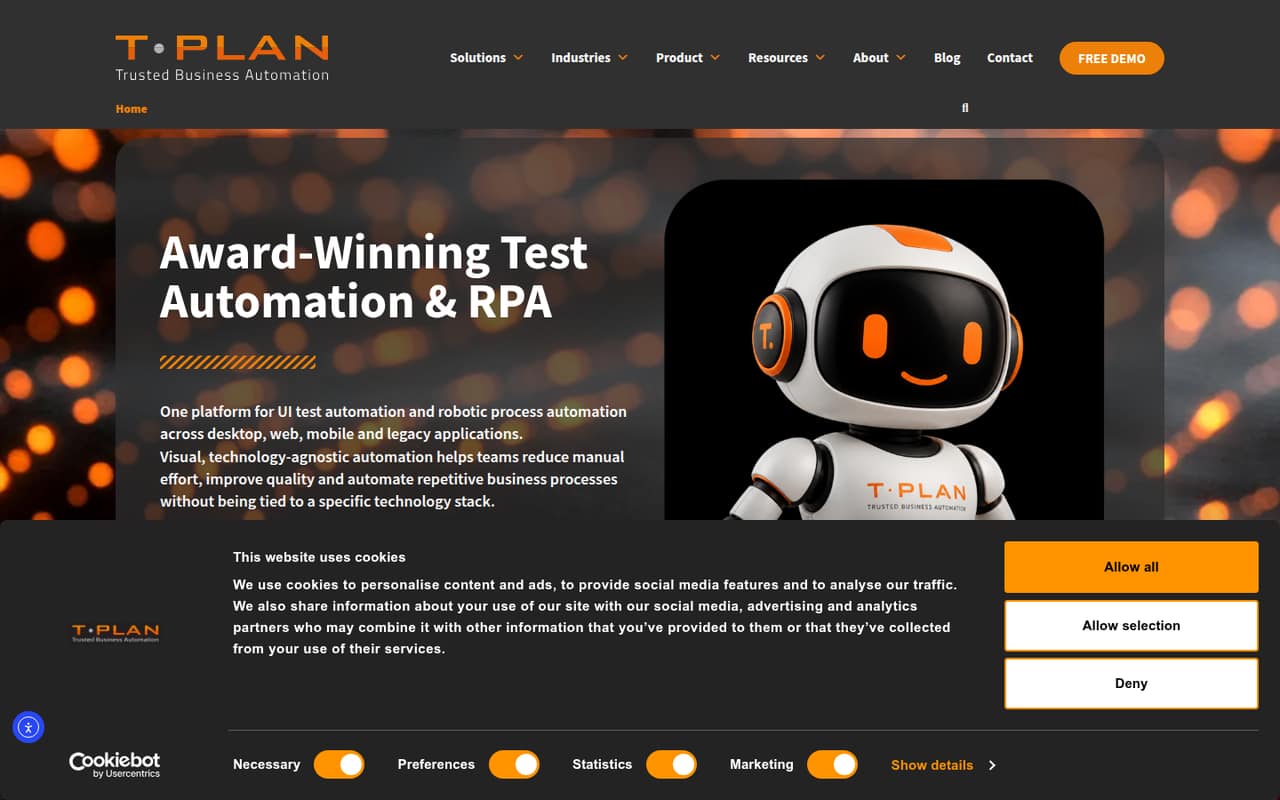
T-Plan Robot combines visual UI test automation and robotic process automation for desktop, web, mobile and legacy applications. Its record-and-playback workflows, visual validation and low-code interface target teams automating through the interface rather than relying on application-specific hooks.
The fit is less clear for teams choosing a developer-first test framework: the homepage names API integration and CLI execution, but not SDKs, languages or API conventions. Pricing starts at £200 per month when billed annually; individual licence prices are not published.
Good fit if
- Teams automating legacy interfaces
- Cross-platform UI testing workflows
- Operations teams building repeatable RPA
Skip it if
- Teams requiring a documented SDK
- Projects needing predictable per-seat pricing
- Buyers requiring open-source self-hosting
ScoresHow it rates
What works
- Combines UI testing and RPA
- Targets desktop, web, mobile and legacy applications
- Record-and-playback creates reusable workflows
- Integrates with spreadsheets, databases, PDFs and APIs
- Supports low-code and no-code workflows
What doesn't
- Individual licence prices are not published
- SDKs and supported languages are not named
- API conventions and rate limits need confirmation
- No free plan; trial length is unpublished
- Licence and self-hosting terms need confirmation
01What T-Plan Robot is, technically
T-Plan Robot is a visual automation platform that combines UI test automation with robotic process automation. It operates at the user-interface level, recognizing and validating applications based on what appears on screen. The vendor positions it for desktop, web, mobile and legacy applications, including environments where teams need to automate without changing the application.
In a stack, it sits alongside test and operations workflows as the layer that records, replays and validates user-facing actions. The homepage describes a visual interface with no-code and low-code workflows, plus integrations with spreadsheets, databases, PDFs, APIs and external data sources. It also names CLI execution in the licence information. The vendor doesn't publish whether the product is hosted, self-hosted or delivered as an installable client on its homepage; confirm deployment, supported operating systems and licensing terms before designing a rollout. The licence model distinguishes development users from live system connections.
02T-Plan Robot API, SDKs and docs
The homepage describes integration with APIs, databases, PDFs, spreadsheets and enterprise systems. It does not define an API style or name supported programming languages, SDKs, webhooks or plugins. The product is presented as a visual, low-code/no-code automation interface, so the documented integration surface to evaluate is the visual workflow builder and its external-data integrations. Ask the vendor for API documentation, supported authentication methods and examples for the systems in your stack, and confirm SDK support in the vendor's docs.
The pricing information says execution via UI and/or CLI is included in the trial, which gives teams a CLI path to evaluate. The homepage points to a training and learning centre with documentation, guides and learning resources, and describes technical support from automation specialists. Before adopting it in CI, confirm CLI installation and invocation, result formats, exit codes, environment configuration and how runs integrate with your build system. Those details affect whether visual workflows can be maintained and operated like code.
03T-Plan Robot pricing for developers
The pricing page lists a starting price of £200 per month when billed annually. It does not publish the price for either named licence or the monthly billing rate. T-Plan Robot has no free plan; a time-restricted trial is available, but its length is not published. The trial includes development and execution features, with execution via UI and/or CLI.
The Developer Licence is priced per concurrent user per month and includes one concurrent user per licence. A licence can be installed on multiple machines, so the stated unit is concurrency rather than machine count. The Execution Licence is priced per live connection per month and includes one live system connection per licence. These are distinct capacity measures: estimate the developers who need concurrent access and the systems that need live connections, then request a quote for each.
The pricing page lists no add-ons or overage rates. Ask how additional concurrent users and live connections are billed, whether monthly terms are available, and what happens when a trial ends. The £200 starting figure is not an individual plan quote.
04T-Plan Robot: open source, self-hosting and lock-in
The homepage does not identify an open-source licence or describe source-code availability. It also does not establish whether T-Plan Robot can be self-hosted, or explain data export and migration. Do not treat the visual workflow model or its integrations as evidence that automation definitions are portable.
Before adopting the platform, ask the vendor who owns workflow definitions and test artifacts, what formats can be exported, and whether exports remain executable outside T-Plan Robot. Confirm where credentials, screenshots and run data are stored, and whether deployment can run inside your network. If workflows depend on vendor-specific visual recognition or execution behavior, replacing the tool may mean rebuilding and validating those workflows. Get the licence, deployment model and exit options in writing before using it for business-critical processes.
05T-Plan Robot in production
T-Plan Robot targets applications that teams operate through the interface, including legacy systems, and its visual validation is designed around what users see on screen. That approach makes it important to verify how workflows behave when layouts, timing or screen environments change. The homepage describes AI-assisted automation as a way to speed creation and reduce maintenance effort, but does not give reliability or performance guarantees.
Before production use, confirm supported operating environments, parallel execution behavior, recovery from failed runs, and how run results are surfaced to monitoring and CI. The vendor does not publish rate limits or scaling limits on the homepage. Security and compliance details, including credential handling and data retention, also need review with the vendor. Budget around the published licence units: concurrent developers and live system connections. The annual starting price is £200 per month, but individual licence rates and capacity expansion costs require a quote.
Questions people ask
What is T-Plan Robot used for?
T-Plan Robot combines visual UI test automation and robotic process automation. The vendor describes workflows for desktop, web, mobile and legacy applications, including functional testing, visual validation, data processing and repetitive business processes.
Does T-Plan Robot have an API or SDK?
The homepage describes integration with APIs and external data sources, but does not name an API style, SDKs or supported programming languages. Ask the vendor for documentation and examples for your preferred language and integration requirements.
Can T-Plan Robot run from the command line?
The pricing information says execution via UI and/or CLI is included in the trial. Confirm command syntax, supported environments, output formats and how CLI execution fits your CI system before relying on it in production.
How is T-Plan Robot licensed?
The Developer Licence is per concurrent user per month and includes one concurrent user. The Execution Licence is per live connection per month and includes one live system connection. The pricing page lists a £200-per-month starting price with annual billing, but individual rates are not published.
Is T-Plan Robot open source or self-hosted?
The homepage does not identify an open-source licence or confirm a self-hosted deployment option. Ask the vendor about source availability, deployment choices, data export and the portability of automation workflows before committing.