
We may earn a commission if you buy through links on this page. It never changes a score or a ranking. How we make money
The bottom line
Strong runtime context for cloud security, with pricing and developer integration details to confirm.
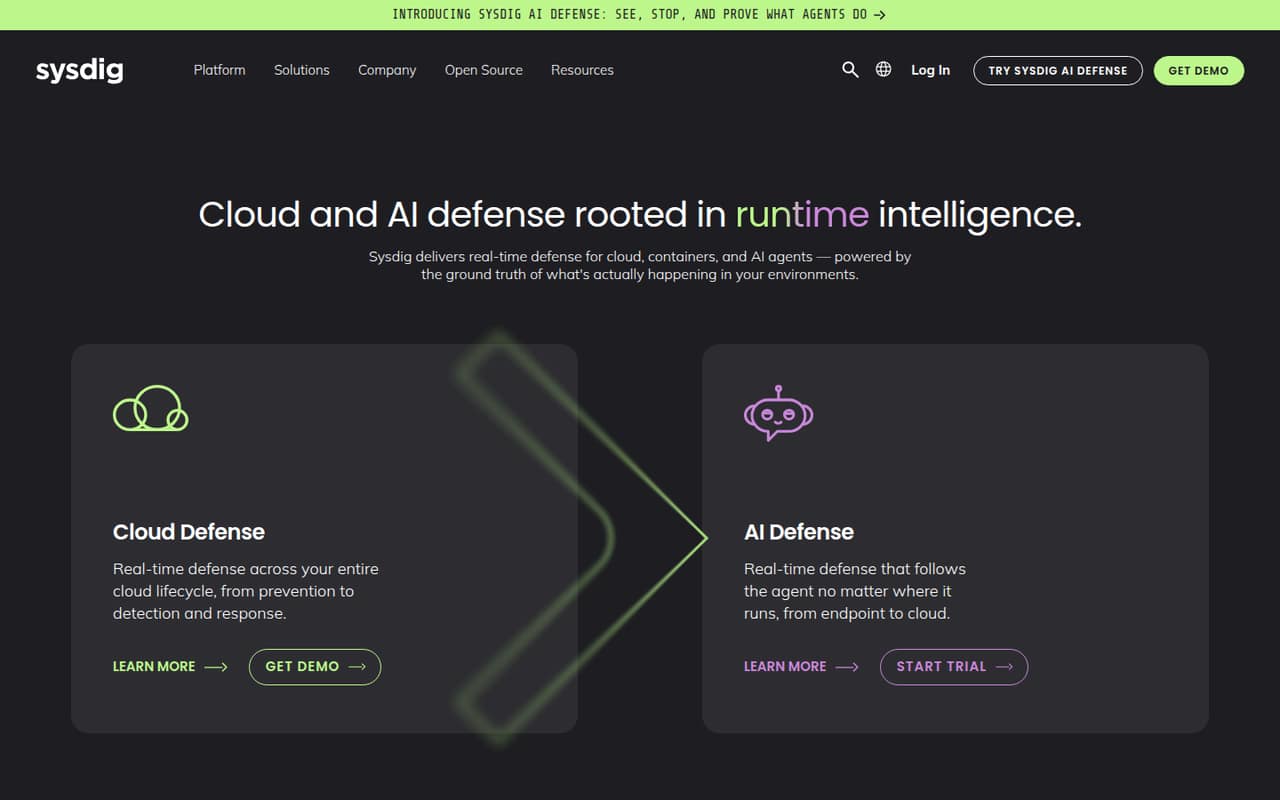
Sysdig is a cloud security and monitoring platform that uses kernel-level system calls to provide runtime context for containers, Kubernetes, workloads and cloud services. Its security offering combines prevention, detection and response, with features for AI agent visibility and response.
The runtime approach is a useful way to prioritize active risk, but Sysdig does not publish exact prices or usage limits in the pricing information available here. Its homepage names integrations, a kernel sensor and agent-side hooks; teams building automation should confirm API and SDK support before choosing it.
Good fit if
- Kubernetes security teams
- Cloud threat detection teams
- Teams securing AI agents
Skip it if
- Buyers needing public list prices
- Teams seeking a documented SDK
- Teams requiring confirmed self-hosting
ScoresHow it rates
What works
- Kernel-level system calls add runtime context
- Unifies cloud prevention, detection and response
- Covers containers and Kubernetes workloads
- AI Defense shows agent actions and can block them
- Sysdig lists open-source projects including Falco
What doesn't
- Exact prices and usage limits are not published
- Secure is licensed per host
- Cloud-log detection and response also bill by events processed
- Confirm API, SDK and language support before integrating
- Platform licensing, self-hosting and data export need clarification
01What Sysdig is, technically
Sysdig is a cloud-delivered security and monitoring platform, rather than a library or command-line tool. Sysdig Secure combines prevention, detection and response across containers, Kubernetes, identities, workloads and cloud services. Sysdig Monitor is its monitoring product. The platform’s central security input is runtime data: Sysdig says it captures live system calls at the kernel level to show what is actually running, rather than relying only on configuration and cloud API data.
In a cloud stack, Sysdig sits alongside the workloads and cloud services it monitors, using a kernel sensor and, for AI agent visibility, agent-side hooks. Its runtime context is intended to help security teams investigate threats and prioritize vulnerabilities that are active and exploitable. Sysdig also offers AI Defense for observing agent actions and blocking actions that go too far. The homepage lists regional Monitor and Secure environments and account login, so buyers should confirm the deployment model and region availability for their own requirements.
02Sysdig API, SDKs and docs
Sysdig’s stated integration surfaces include ecosystem integrations, a kernel sensor and agent-side hooks. The homepage also points to Docs and Sysdig Status, and lists cloud, container, Kubernetes, workload and cloud-service security. It does not name an API protocol, SDK, programming language or CLI in the product material here. Before building automation, confirm in Sysdig’s docs whether Secure and Monitor expose the API, CLI, webhooks, SDKs and language bindings your stack requires, along with their authentication and versioning details.
Sysdig’s open-source projects include Falco, Stratoshark, Open Policy Agent and Prometheus; the homepage describes Falco as detecting threats in real time and Stratoshark as a tool for analyzing, troubleshooting and securing cloud environments. These are relevant ecosystem tools, not evidence that a particular Secure workflow has a supported SDK. Ask Sysdig which integrations are maintained, how they handle new workloads, and whether they support your cloud providers and deployment tooling before planning a production rollout.
03Sysdig pricing for developers
Sysdig does not publish monthly or annual prices, a starting price, exact usage limits, or free-plan availability in the pricing information available here. The listed Sysdig Secure CNAPP plan uses host-based licensing. Secure Detection and Response is licensed per host, with cloud logs billed by events processed. Sysdig Monitor’s price and billing unit are not published. That leaves the main cost drivers visible, but not the rates or the thresholds that determine a production bill.
The homepage invites visitors to start an AI Defense trial, but the trial terms are not published in the pricing information. Do not treat Sysdig’s open-source projects as a free tier for Secure or Monitor. Before a proof of concept, ask for a written quote that covers host counting, event volume, retention, overages, minimum commitments and any add-ons. Also establish how elastic workloads and short-lived hosts affect billing. Without those details, teams cannot reliably estimate costs from the public pricing information.
04Sysdig: open source, self-hosting and lock-in
Sysdig highlights open-source projects including Falco and Stratoshark, and its homepage also lists Open Policy Agent and Prometheus. That does not make Sysdig Secure or Sysdig Monitor open source. The platform’s source availability, license terms and self-hosting options need confirmation with Sysdig; check the license for each open-source project separately rather than assuming a common license.
The homepage lists regional Monitor and Secure environments, but does not establish whether customers can run the commercial platform themselves. Data export formats, retention after cancellation and migration tooling also need confirmation. Runtime rules and workflows may be portable if they use open-source components such as Falco, but buyers should not assume that platform configuration, alert history or investigation data will transfer cleanly. Get export and exit terms in writing before putting production security workflows behind the service.
05Sysdig in production
The vendor's site gives no exact usage caps or rate limits, so confirm sensor coverage, event-volume thresholds, retention, alert delivery and support commitments with Sysdig before relying on it for incident response. Test how quickly newly deployed workloads appear, what happens when a sensor is unavailable, and how the platform behaves during a busy deployment cycle. Also review the security and compliance documentation for your environment; the homepage does not establish which certifications or controls apply to each service.
Reddit feedback on Sysdig Cloud monitoring is positive about container and orchestration visibility. One r/devops commenter praised its agent and called the UI an area needing improvement. Other commenters described process-level metrics and network visibility favorably. These are individual reports, not reliability data or a guarantee for current Secure deployments. The comments also raise a practical evaluation point: verify the workload coverage and usability your team needs, then ask Sysdig for production references and support response terms.
From the threadsWhat users say
The Reddit comments about Sysdig Cloud monitoring lean positive on agent and container visibility, with a usability caveat. They are individual reports and do not establish current performance or support quality for every Sysdig product.
I haven't found anything else on the market that actually has as sane an approach to container and PaaS / orchestration monitoring as Sysdig
Their UI needs some love
It provides unprecedented insights into the process-level traffic flow and makes debugging high-latency conditions easy to debug
Their agent is also quite hard to beat
Questions people ask
What does Sysdig do?
Sysdig provides cloud security and monitoring for containers, Kubernetes, workloads and cloud services. Sysdig Secure combines prevention, detection and response, using kernel-level runtime data to show what is running. Sysdig AI Defense adds visibility into AI agent actions and can block actions that go too far.
How much does Sysdig cost?
Sysdig does not publish monthly or annual prices or a starting price in the available pricing information. Secure CNAPP licensing is host-based; Detection and Response is billed per host, with cloud logs charged by events processed. Ask Sysdig for a quote with usage thresholds, overages and any minimum commitments.
Does Sysdig have an API or SDK?
Sysdig’s product material names ecosystem integrations, a kernel sensor and agent-side hooks, but does not name an API protocol, SDK or programming language. Confirm the API reference, authentication model, available SDKs and CLI support in Sysdig’s docs before designing an integration.
Can I self-host Sysdig?
The available product material does not establish whether the commercial Sysdig Secure or Monitor platforms can be self-hosted. Sysdig lists open-source projects such as Falco and Stratoshark, but those should not be treated as proof that the commercial platform is self-hostable. Confirm deployment options and support terms with Sysdig.
Does Sysdig offer a free plan or trial?
The pricing information does not publish free-plan availability or trial terms. Sysdig’s homepage invites visitors to start an AI Defense trial, but does not give its duration, limits or eligibility there. Confirm the trial scope and whether it includes Secure or Monitor before planning an evaluation.