
We may earn a commission if you buy through links on this page. It never changes a score or a ranking. How we make money
The bottom line
A practical Postgres-backed BaaS, with usage costs and service coupling to plan around.
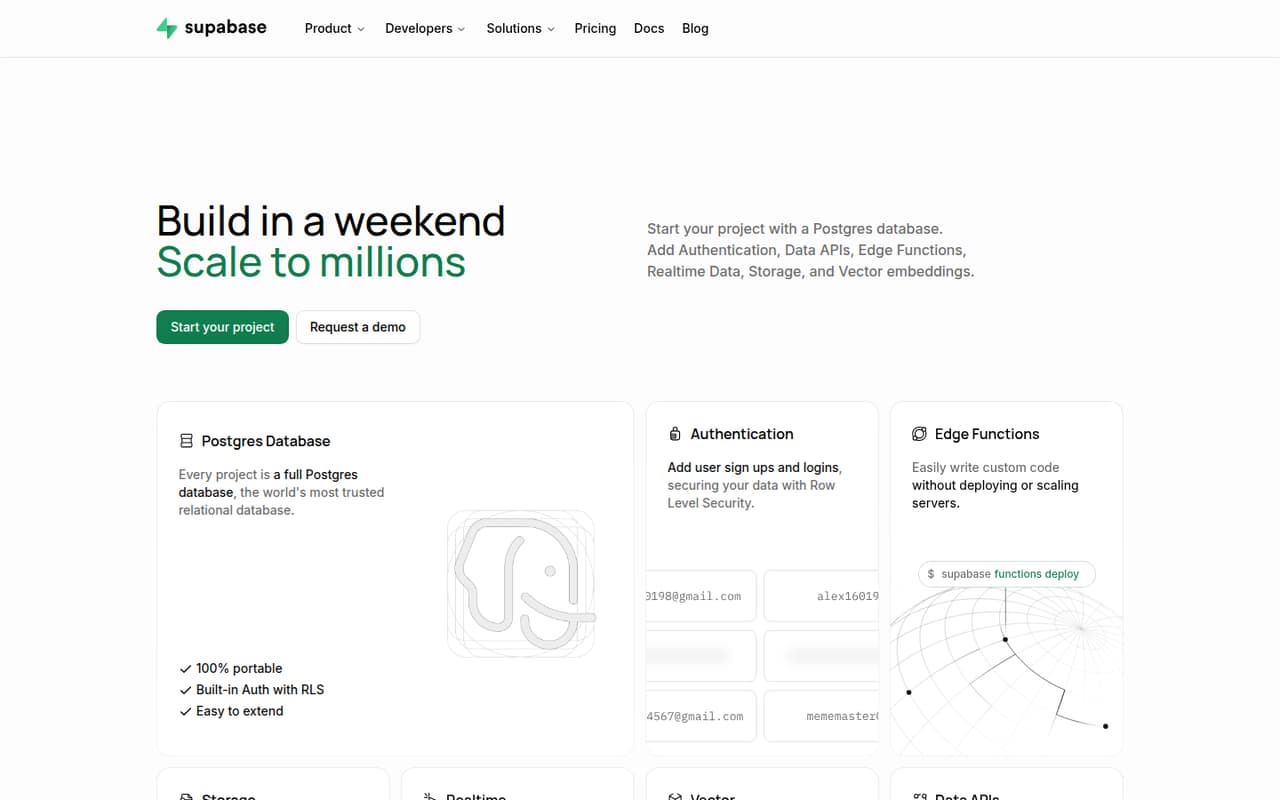
Supabase is a hosted backend platform built around a portable Postgres database. It adds Auth, file storage, REST APIs, Edge Functions and realtime features, so a team can assemble common backend services without managing each one separately.
The bundle is appealing for small teams and prototypes, but putting access policies, business logic and identity deeply into the platform can complicate migrations. Developers on Reddit praise the quick setup and also report RLS complexity, self-hosting friction and concerns about moving Auth.
Good fit if
- Teams building around Postgres
- Small apps needing built-in Auth
- Prototypes with modest usage
Skip it if
- Teams avoiding managed-service dependencies
- Complex business logic in RLS
- Workloads needing published rate limits
ScoresHow it rates
What works
- Full Postgres database at the center
- Built-in Auth with Row Level Security
- REST APIs are ready to use
- Storage, realtime and functions are integrated
- Free plan supports two active projects
What doesn't
- Free projects pause after one inactive week
- Egress and storage add to production bills
- Auth migration can involve password-reset constraints
- Reddit users report RLS and trigger debugging friction
- Self-hosting reports mention dashboard feature gaps
01What Supabase is, technically
Supabase is a hosted backend-as-a-service platform, not a database library. Each project gets a full Postgres database, with managed services around it: authentication, file storage, REST APIs, realtime synchronization and Edge Functions. The architecture puts Postgres at the center and gives applications managed interfaces to common backend work.
That places Supabase between an app and its infrastructure. An application can call its REST APIs, use Auth for sign-ups and logins, store media, and run custom code through Edge Functions without deploying or scaling servers. The database is described as portable, and it includes Row Level Security (RLS), which can enforce access rules at the data layer.
Supabase also offers Vector tools for managing embeddings, Cron for recurring jobs and Queues for durable message delivery. These additions broaden the platform beyond a database plus login service. The trade-off is that teams need to decide which logic belongs in Postgres policies and functions, which belongs in their application server, and how much of the stack to couple to Supabase.
02Supabase API, SDKs and docs
The documented integration surface includes ready-to-use REST APIs and the JavaScript package @supabase/supabase-js. Supabase’s homepage shows a React example that creates a client with a project URL and anon key, then queries a table with .from('todos').select('*'). It also links to React docs. The site names templates for Next.js, Flutter and Expo React Native, and a TypeScript Next.js starter; confirm SDK support and current setup steps in the vendor’s docs before choosing a client.
The homepage shows a CLI deployment command for Edge Functions (supabase functions deploy), along with dashboard tools such as a Table Editor, SQL Editor and RLS Policies interface. The platform also provides instant REST APIs for project data. These options let teams use a generated API or connect through a client library, while keeping SQL available for database work.
Supabase lists integrations and starter projects involving Stripe, Vercel, the Vercel AI SDK, OpenAI and LangChain. The breadth is useful, but teams should review the docs for authentication flows, secret handling and how client-side access is constrained by RLS.
03Supabase pricing for developers
The Free plan costs $0 per month and includes 50,000 monthly active users, 500 MB database per project, 5 GB egress, 1 GB file storage and two active projects. Projects pause after one week inactive. Pro starts at $25 per month, with 100,000 monthly active users, 8 GB disk per project, 250 GB egress, 100 GB file storage and daily backups stored for seven days. Team is $599 per month and adds SOC 2 and ISO 27001, 14-day backups and 28-day log retention. Enterprise pricing is custom.
Usage can raise Pro and Team bills: MAU overages are $0.00325 each, disk is $0.125/GB, egress is $0.09/GB or $0.03/GB for cached egress, and file storage is $0.0213/GB. Paid plans include $10 per month in compute credits; listed compute starts at $10/month for Micro. Additional projects start at $10/month, and log drains cost $60 per drain, per project. Point in Time Recovery, branching and pipelines are also billed add-ons. The pricing page lists monthly prices, not annual billing prices.
04Supabase: open source, self-hosting and lock-in
Supabase’s homepage calls its Postgres database 100% portable. That gives teams a familiar relational database at the core, rather than a proprietary database engine. The homepage does not state the platform’s license, and it does not describe a data-export workflow; confirm the current license and the supported export and restore process before making self-hosting or exit plans.
Reddit users describe running a Supabase community edition themselves. Their reports are mixed: one self-hosting user says the setup is running smoothly, while other commenters mention dashboard features that are unavailable, manual environment-variable configuration and production proxying that took work. Self-hosting shifts responsibility for operations to your team.
Portability does not remove service-level migration work. Postgres data is one part of the stack; Auth, storage, Edge Functions and realtime behavior can create separate dependencies. One Reddit commenter said moving Auth could require a broad password reset. Keep schemas, application logic and identity requirements documented, and test how you would move each service before relying on it long term.
05Supabase in production
Production planning starts with the quotas and billing model. Free projects pause after one week inactive, and the Free plan’s database, egress and storage allowances are limited. Pro and Team provide larger included quotas, but egress, storage, disk and MAU overages can add costs. The vendor’s pricing page does not publish rate limits; ask about the limits that apply to your project and expected traffic before launch.
RLS can enforce data access in Postgres, but it makes policy design and debugging part of application security work. A Reddit thread includes developers who found policies cumbersome and triggers hard to debug; another commenter recommends keeping business logic on a server and treating Supabase as the database and Auth layer. These are individual reports, not a measure of service-wide reliability.
The pricing page lists SOC 2 and ISO 27001 for Team, with HIPAA as a paid Team add-on whose price is not published. Enterprise includes uptime SLAs and 24×7×365 premium support. Reddit users also report self-hosted dashboard gaps and one commenter alleges recurring outages. Verify support terms, compliance needs, backups and recovery procedures against your own service requirements.
From the threadsWhat users say
Reddit sentiment is mixed. Developers value fast setup, low costs for small projects and Postgres portability, while others report RLS complexity, self-hosting friction and concerns about outages or moving Auth.
I tried implementing RLS and defining access policies very quickly became cumbersome and in some cases impossible to define
Most of your concerns melt away if you just ignore the dumb features that are for vibe coders. All that being said, it's far from perfect, and I never use it with the long term expectation to stay there
However its still a little weird what needs to be proxy'd outside and what not. Most guides are also outdated and the official one is great for a basic setup but not suitable for production
Questions people ask
Is Supabase a serverless database?
Supabase is a hosted backend platform built around a full Postgres database, not just a serverless database. It also bundles Auth, storage, REST APIs, realtime features and Edge Functions. Its pricing page lists separate compute sizes and usage charges, so check the project’s plan and compute configuration when estimating runtime costs.
Can I use PostgreSQL with Supabase?
Yes. Each Supabase project includes a full Postgres database, which the homepage describes as 100% portable. Supabase adds services such as Auth, storage and REST APIs around it. Teams should still plan migrations for those services separately from moving relational data.
Is Supabase free to use?
Supabase has a Free plan at $0 per month. It includes 50,000 monthly active users, 500 MB database per project, 5 GB egress, 1 GB file storage and two active projects. Free projects pause after one week inactive, and additional usage or paid features can require a paid plan.
Is Supabase legitimate for a production app?
Supabase offers paid plans for production applications, and Team lists SOC 2 and ISO 27001. Enterprise includes uptime SLAs and premium support. Whether it fits your production requirements depends on quotas, recovery needs, security design and support terms; review those details and test your own operational procedures before launch.
Can I move away from Supabase later?
The database is described as portable Postgres, which can reduce lock-in for relational data. Auth, storage, Edge Functions and realtime behavior may require separate replacements. A Reddit commenter reports that moving Auth could mean a broad password reset. Plan and test an exit path for each service, not just the database.
Sources
- Supabase homepage
- Supabase pricing page
- Reddit: Literally no reason to use Supabase in 2026. I will not promote.
- Reddit: The best decision I ever made is to go with self-hosted Supabase.
- Reddit: what are good alternatives to Supabase for projects?
- Reddit: Any good db service like supabase which offers generous free tier?