
We may earn a commission if you buy through links on this page. It never changes a score or a ranking. How we make money
The bottom line
A capable hosted status page, but paid plans and limited published API details constrain its developer value.
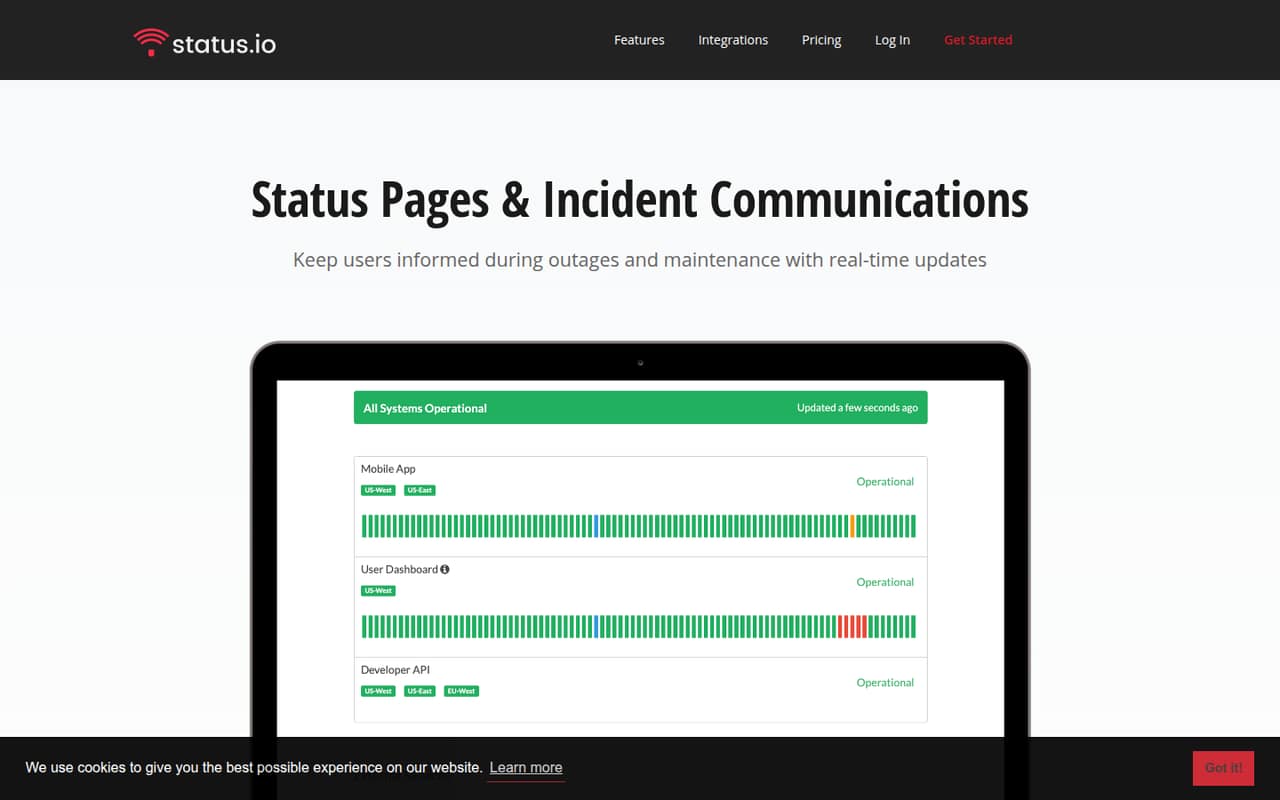
Status.io is a hosted service for publishing status pages, incidents, maintenance notices and metrics. It connects to notification channels including email, SMS, webhooks, Slack and Microsoft Teams, and supports private pages with OIDC or SAML sign-in and optional IP controls.
Plans start at $79 per month, with a 5% discount for annual billing. There is no free plan or trial listed. Subscriber, team-member and metric allowances scale by plan, while the vendor's homepage does not establish API rate limits or SDK support. Treat Status.io as a communications layer alongside monitoring, not as a replacement for it.
Good fit if
- Teams needing hosted public status pages
- Incident updates across multiple channels
- Private pages with SSO access controls
Skip it if
- Teams requiring self-hosted status software
- Projects needing a free status-page tier
- Stacks dependent on documented SDKs
ScoresHow it rates
What works
- Incident updates can change component statuses
- Maintenance scheduling includes subscriber reminders
- Notifications span email, SMS, chat and feeds
- Custom Metric API supports live status-page charts
- Private pages support OIDC, SAML and IP controls
What doesn't
- No free plan or trial is listed
- Basic starts at $79 per month
- Subscriber and team limits vary by plan
- SDKs, languages and API protocol are not published
- Self-hosting and a source-code licence are not published
01What Status.io is, technically
Status.io is a hosted SaaS application for status pages and incident communications. It sits beside monitoring and service infrastructure: teams publish component health, outage updates, planned maintenance and metrics for customers or internal users. It communicates service state; it is not presented as a monitoring system that discovers failures.
Teams can update incidents and component statuses, schedule maintenance with subscriber reminders, and retain a status history. Public pages can be customized with graphics, colors, HTML, JavaScript and CSS. Private pages can require OIDC or SAML single sign-on, with optional IP access control. Subscribers can receive updates through channels such as email, SMS, webhooks, RSS, iCalendar, IRC, Microsoft Teams, Slack and Twitter/X. Live charts can use the Custom Metric API or external sources such as New Relic and Pingdom. The vendor describes its service as running on redundant infrastructure across multiple global regions. That makes Status.io a hosted communications dependency, not a component your team deploys in its own stack.
02Status.io API, SDKs and docs
The homepage names a Custom Metric API for powering live charts and webhooks as a status-notification channel. It also describes integrations with external metric sources including New Relic and Pingdom, plus notification routes such as Slack, Microsoft Teams, IRC, RSS and iCalendar. These are the integration surfaces the vendor identifies; they do not establish a particular API protocol or client library.
The vendor doesn't publish SDK, programming-language, CLI or API protocol details on its homepage. Confirm SDK support, authentication, payload formats and rate limits in the vendor's documentation before building an integration. The stated workflow is oriented around publishing status data and notifications, rather than embedding a local library into an application. Custom HTML, JavaScript and CSS let teams change page presentation, but do not replace a documented API contract. Plan for integration work around the named API and channels, and check how the service handles retries and delivery failures before relying on notifications for incident response.
03Status.io pricing for developers
Status.io has no free plan or free trial listed. Basic costs $79 per month, or $75.05 per month with annual billing, and includes 500 subscribers, five team members, five metrics and one public status page. Standard is $149 monthly or $141.55 with annual billing, with 2,000 subscribers, 20 team members and 20 metrics. Plus is $349 monthly or $331.55 annually, with 5,000 subscribers, 50 team members and 50 metrics. Each includes 24/7 human support. The pricing page lists Enterprise starting at $999 per month, with a public page, custom domain and 24/7 support.
The bill is plan-based, not listed as metered API usage. The allowances most likely to shape an upgrade are subscribers, team seats and metrics; each tier includes one public status page. Annual billing gets a 5% discount, and PO invoicing is available only on annual plans. The pricing page lists no add-ons or overage rates, so ask the vendor how it handles going beyond a plan's limits before launch. There is no low-cost entry point for a small project that needs a free tier.
04Status.io: open source, self-hosting and lock-in
Status.io is sold as a hosted service. The vendor doesn't publish a self-hosted edition or source-code licence, so teams should not plan to deploy the status-page application inside their own infrastructure. The service offers custom HTML, JavaScript and CSS for page design, but those controls do not make the platform self-hostable.
The homepage describes an exportable audit log of status-page changes. That is distinct from a general export of subscriber lists, incidents, metrics or page configuration; confirm which data can be exported and in what format before adopting the service. Migration will require recreating the page and its integrations elsewhere if you leave. The status history and notification workflows can also become dependencies for support and incident communications. Keep copies of operational updates and document the integrations your team builds so a future move does not depend on reconstructing them from the hosted service.
05Status.io in production
The vendor says status pages are hosted on redundant infrastructure across multiple global regions, and each listed plan includes 24/7 human support. That is useful for a communications service expected to remain reachable during an outage, but the homepage does not establish an uptime commitment. Ask about service-level terms and incident handling before making it the only place customers can check service health.
Plan limits are explicit: Basic, Standard and Plus allow 500, 2,000 and 5,000 subscribers respectively, with five, 20 and 50 team members and metrics. Each includes one public page. The vendor doesn't publish API rate limits on its homepage; confirm request ceilings, notification delivery behavior and what happens when subscriber limits are exceeded. Private pages support OIDC or SAML, with optional IP access control. Check identity-provider configuration and access requirements with the team responsible for security. The homepage also lists an exportable audit log, but teams should verify retention and export details for their operational and compliance needs.
Questions people ask
Does Status.io have a free plan?
No free plan or free trial is listed. Basic is the entry plan at $79 per month, or $75.05 per month with annual billing. It includes 500 subscribers, five team members, five metrics and one public status page. Annual billing gets a 5% discount.
What does Status.io cost?
Basic costs $79 monthly, Standard $149 and Plus $349. Annual billing reduces those listed monthly equivalents to $75.05, $141.55 and $331.55. Enterprise starts at $999 per month. The lower three plans include one public page, with subscriber, team-member and metric limits that rise by tier.
Can Status.io send incident notifications to Slack or webhooks?
Yes. The homepage lists webhooks, Slack, Microsoft Teams, IRC, email, SMS, RSS, iCalendar and Twitter/X among its notification channels. It also names a Custom Metric API for live charts. Confirm delivery behavior and API limits with the vendor before relying on these integrations during an incident.
Can I make a Status.io page private?
Yes. Status.io supports private pages with single sign-on through OIDC or SAML identity providers, and optional IP access control. The vendor names OneLogin, Auth0, Okta, Azure and Google as example identity providers. Confirm configuration requirements for your identity provider and network before rollout.
Can I self-host Status.io or export my data?
Status.io is offered as a hosted service, and the vendor doesn't publish a self-hosted edition or source-code licence. The homepage lists an exportable audit log of status-page changes, but that is not a statement that all service data can be exported. Ask the vendor which data is exportable and in what format.