
We may earn a commission if you buy through links on this page. It never changes a score or a ranking. How we make money
The bottom line
Splunk covers security and observability in one platform, but pricing and setup need close attention.
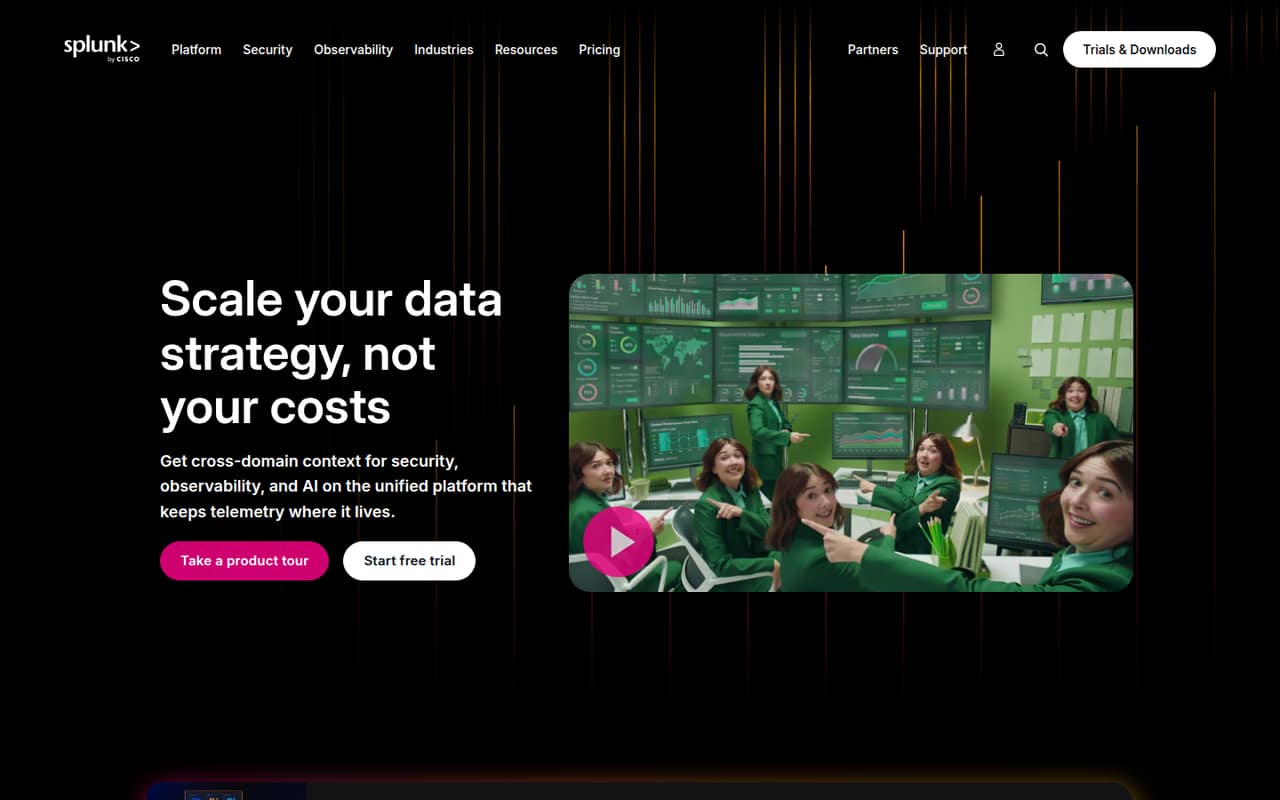
Splunk is a machine data platform for searching telemetry, security operations, observability, and AI agent monitoring. Teams can use the hosted Splunk Cloud Platform or deploy Splunk Enterprise on-premises, in a private cloud, or in hybrid and air-gapped environments.
Its breadth suits organizations consolidating operational data, but core pricing is usage-based and API, SDK, and rate-limit details need validation before implementation. Reddit users report both setup effort and cost concerns at high log volumes.
Good fit if
- Teams consolidating security and observability
- Organizations with private-cloud requirements
- Security teams needing SIEM and SOAR
Skip it if
- Small teams needing predictable flat pricing
- Projects requiring open-source software
- Builders expecting documented SDK details upfront
ScoresHow it rates
What works
- Searches telemetry across tiered data
- Combines SIEM, SOAR, and threat detection
- Monitors applications, infrastructure, and user experience
- Supports cloud, on-prem, private-cloud, and air-gapped deployment
- Offers free observability and agent-observability editions
What doesn't
- Core platform prices depend on usage
- Free-edition limits are not published
- Public homepage lacks named SDKs and languages
- Additional Luna tokens and retention cost extra
- Reddit users report setup effort and high costs
01What Splunk is, technically
Splunk is a machine data platform, not a single-purpose logging library or CLI. Its hosted Splunk Cloud Platform and deployable Splunk Enterprise sit alongside telemetry-producing applications and infrastructure, providing a place to search and analyze data for security, observability, and AI operations.
Splunk says its platform can unify machine data wherever it lives, including searches across tiered data through Federated Search. On the security side, Enterprise Security provides SIEM and threat detection, with Splunk SOAR for response automation. Observability Cloud and AppDynamics cover application, infrastructure, service, and user-experience monitoring. Agent Observability adds monitoring for AI agents, models, and infrastructure, including LLM token usage and attribution.
The deployment choice matters architecturally: Cloud Platform is managed, while Enterprise can run on-premises, in a private cloud, or in an air-gapped environment. That makes Splunk a cross-domain operations layer, but teams should map its data flows and cost meters to their existing telemetry stack before routing production data.
02Splunk API, SDKs and docs
The homepage points builders to Splunk Documentation, Splunkbase, product tours, Splunk Answers, and community resources. It describes platform capabilities such as Federated Search, data management, and AI agent monitoring, but does not identify a specific API protocol, SDK, programming language, or CLI. Treat those resources as starting points for checking how a proposed integration fits your stack, rather than assuming a particular client library or interface.
Before committing to an implementation, confirm the supported APIs, SDKs, language versions, authentication methods, and compatibility requirements in the vendor’s documentation. Also check how your existing telemetry sources connect, whether your planned search can operate across the data tiers you use, and which product handles each workflow. Splunkbase is another place to investigate available integrations; verify ownership, maintenance status, and product-version compatibility for any dependency you plan to add. The homepage provides access to documentation and support resources, but specific integration behavior should be confirmed against the relevant product docs.
03Splunk pricing for developers
Splunk Cloud Platform uses activity-based, ingest, or workload pricing; Splunk Enterprise uses data-ingest or workload pricing. Both include unlimited users, so the core bill is driven by usage rather than seat count. The pricing page lists Cloud Flex spend reallocation and a 0.5x weighted rate for eligible Cisco telemetry on Cloud Platform; Enterprise lists a 50% weighted rate for eligible Cisco telemetry. Core prices are not published as fixed amounts, so model your expected data and workload with sales.
The Observability Cloud free edition and Agent Observability Free edition are available, but their limits are not published. Paid Observability Cloud tiers list $15, $60, or $75 per host per month, billed annually. Agent Observability lists $100 per 1.2 million spans per month, also billed annually; additional Luna tokens and extended retention are available at unlisted prices. Security products are usage-based or quote-based. Database Monitoring and Secure Application are optional paid add-ons. Splunk SOAR and Attack Analyzer require custom quotes.
04Splunk: open source, self-hosting and lock-in
Splunk is not presented as an open-source product. Its Enterprise offering can be deployed on-premises, in a private cloud, in hybrid environments, or in air-gapped environments; self-hosting is therefore an option, but it does not make the software open source. The vendor’s homepage directs users to Documentation and Splunkbase, but teams should confirm license terms and deployment rights for their specific products before procurement.
Plan data portability before ingesting production telemetry. Establish which formats and tools can export your data, how much historical data you need to retain outside Splunk, and whether extraction has a cost. Search queries, detections, dashboards, and automations may also need translation when leaving the platform; treat those as migration work, not just a data-copy exercise. Ask the vendor about export mechanisms, contract-end access, and any restrictions on moving data between Cloud and Enterprise.
05Splunk in production
Splunk’s stated scale is petabyte-scale machine data, but production planning still depends on the price meter, retention needs, deployment model, and telemetry volume. The pricing information does not publish general rate limits or free-edition quotas. Ask the vendor to confirm ingest and workload limits, retention, service levels, security controls, and overage treatment for your selected products before routing critical data.
Reddit users report that high-volume logging can become expensive: a thread about 4 TB per day describes cost and scalability concerns. Another commenter recommends standardizing log formats and identifying which sources drive ingest volume. In a sysadmin thread, a user describes substantial effort to configure agents and add-ons. These are individual reports, not guarantees about every deployment, but they point to practical risks: uncontrolled log volume, integration work, and tuning. Start with data curation and a measured rollout, then verify alerting, recovery, and export procedures against your own requirements.
From the threadsWhat users say
Reddit discussion is mixed but leans negative on cost and setup effort. Some users describe migrations to other stacks, while others focus on log curation and configuration work.
the sheer amount of effort it takes to get things right is astonishing
I successfully migrate Splunk to ELK clusters with zero license cost
As a devops engineer and splunk user, I'd suggest first working towards adopting a standard log format across the company
Elastic Stack. You can self host the open source version on you own stack
Questions people ask
What does Splunk do?
Splunk searches and analyzes machine data for security, observability, and AI operations. Its products include a data platform, security tools, observability monitoring, and AI agent monitoring. Teams use it to investigate telemetry, detect threats, monitor applications and infrastructure, and track AI agent behavior and token usage.
Is Splunk a type of SIEM?
Splunk includes SIEM capabilities through Enterprise Security. The broader platform also covers data search, security orchestration and response, observability, and AI agent monitoring, so Splunk itself is more than a SIEM product.
Is Splunk free to use?
Splunk lists free editions for Observability Cloud and Agent Observability. The core Splunk Cloud Platform and Splunk Enterprise use usage-based pricing, and the listed free editions do not publish their limits. Ask Splunk to confirm whether the available free capacity fits your evaluation or production workload.
Can Splunk run on premises?
Yes. Splunk Enterprise can be deployed on-premises, in a private cloud, in hybrid environments, or in an air-gapped environment. Splunk Cloud Platform is the hosted option. Confirm deployment requirements, licensing, and operational responsibilities with the vendor for your chosen product.
How difficult is Splunk to learn?
Learning effort depends on the products and workflows you need. Splunk offers documentation, training and certification resources, product tours, and community support. A sysadmin Reddit post reports effort configuring agents and add-ons, so budget time for setup and telemetry tuning as well as learning search and security workflows.