
We may earn a commission if you buy through links on this page. It never changes a score or a ranking. How we make money
The bottom line
A hosted email API for teams that want sending, campaigns and inbound replies in one stack.
SparkPost is a hosted email platform for transactional messages, campaigns and inbound replies. Its API, Bird SDKs, CLI and MCP support sit alongside templates, delivery events, domain authentication and analytics; its free plan is capped at 1,000 emails per month and 50 per day.
The feature set covers more than a basic sending API, but the Reddit feedback about SparkPost is sparse and includes one direct report of unhelpful support. Compare its limits and support terms with your expected traffic before putting production mail on it.
Good fit if
- Apps sending transactional and marketing email
- Teams routing replies into applications
- Developers who need delivery event workflows
Skip it if
- Teams requiring a self-hosted mail platform
- Projects needing unlimited free sending
- Buyers who require established support assurances
ScoresHow it rates
What works
- One platform for transactional, campaign and inbound email
- Bird SDKs, CLI and MCP are available
- Sandbox supports delivery, bounce and complaint simulations
- Signed webhooks and idempotent retries are documented
- Templates can be built with React Email
What doesn't
- Free plan caps sending at 1,000 emails monthly
- Free Send API limit is 10 requests per minute
- Dedicated IP add-on prices are not published
- Source availability and self-hosting are not described
- A Reddit user reported an unhelpful support response
01What SparkPost is, technically
SparkPost is a hosted email platform and API, not a library or a mail server you install in your own infrastructure. It sits between application services and recipient mail systems: your app submits messages, and SparkPost handles sending, delivery tracking and email events. The platform also supports marketing campaigns and inbound email, including routing replies and attachments into apps or workflows.
For a typical integration, an application sends transactional messages through the API or SMTP relay, then reacts to delivery, bounce or complaint events. SparkPost provides templates, domain authentication and delivery analytics around that flow. Teams can separate sandbox and production traffic into workspaces, scope API keys by channel, and review permission changes in an audit log. The result is a broader email service than a send-only endpoint, but it also makes the application dependent on a hosted provider for message delivery and related workflows.
02SparkPost API, SDKs and docs
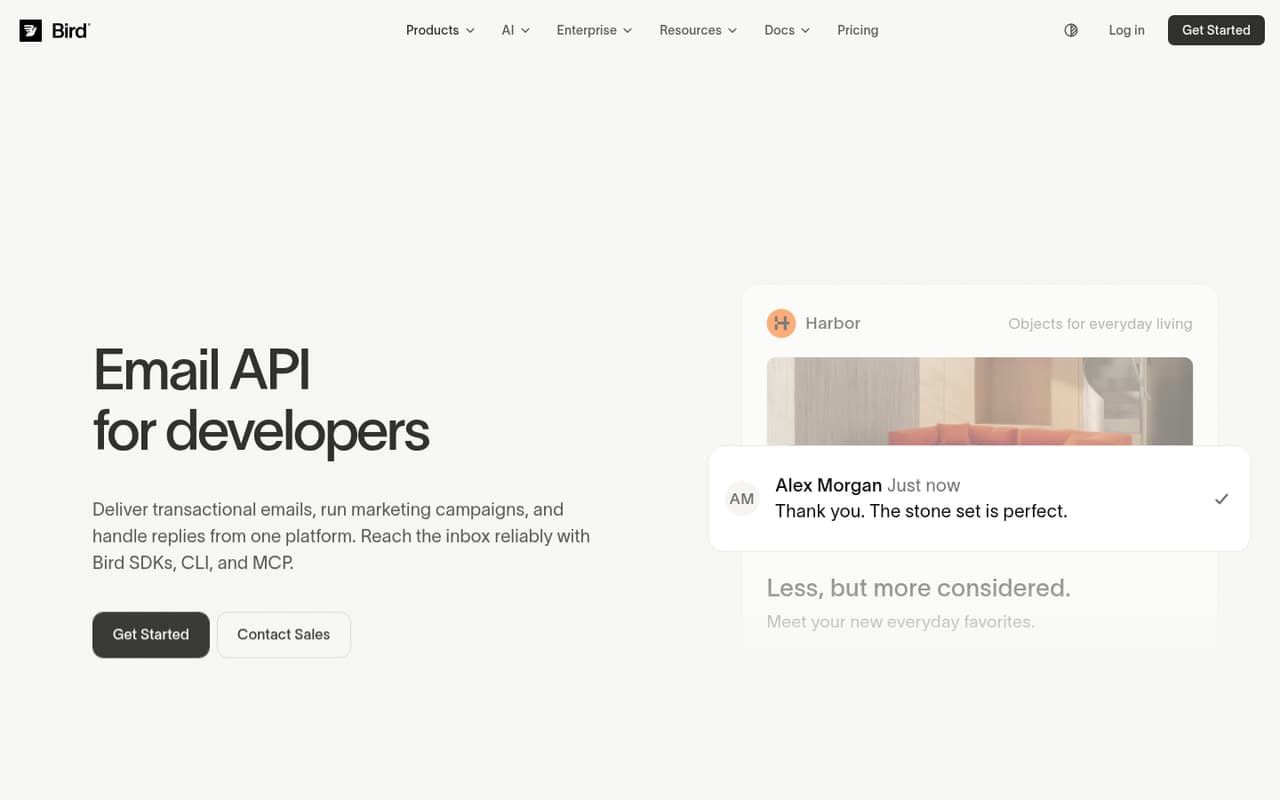
The homepage presents an email API with Bird SDKs, a CLI and MCP. Its examples list Node.js, Python, Go, PHP and cURL, and show email_send followed by email_get to check delivery status. The vendor also describes email sandbox testing, API errors, signed webhooks and idempotency for retrying timed-out requests without duplicate sends.
For application integration, the API can send and track messages; webhooks can notify services about delivery, bounces and spam complaints. SMTP relay is another option for an existing app or mail server, using Bird credentials. Templates can be built with React Email or published for editing without a code deploy. The homepage does not name individual SDK packages or detail their language-by-language coverage, so confirm current SDK support and setup steps in the vendor's docs before choosing a client. The listed CLI and MCP surfaces may suit developer workflows, but teams should verify their required operations are supported.
03SparkPost pricing for developers
The Free plan costs $0 and includes 1,000 emails per month, a 50-email daily limit, 10 Send API requests per minute, one sending domain and five mailboxes. That is enough for low-volume testing, but the daily cap and request limit matter if an app sends bursts.
Startup costs a $15 monthly deposit, with email priced at $0.40 per 1,000 and about 37,500 emails at full deposit. Growth has a $250 deposit, a $0.45 rate and about 555,000 emails at full deposit; its Send API limit is 100 requests per minute. Scale has a $1,000 deposit, a $0.35 rate and about 2.85 million emails at full deposit, with 300 requests per minute in the plan comparison. Paid plans charge from the first send at the plan rate; no annual billing is shown. Dedicated IP add-ons are capped at five on Growth and 10 on Scale, with prices not published. Additional mailboxes, storage and retention use separate Mailbox pricing.
04SparkPost: open source, self-hosting and lock-in
SparkPost is presented as a hosted service. The vendor does not publish source availability or a software license on the vendor's site, and no self-hosted deployment option is described. Teams that require control of the mail infrastructure should ask the vendor about deployment and data handling before adoption.
The vendor also does not publish a data-export process here. Portability depends on how much of the application uses SparkPost-specific features: SMTP relay may make basic sending easier to switch, while API calls, templates, inbound routing and event handling can require migration work. Keep templates and message logic in version control where possible, and treat delivery-event processing as an integration to replace. Confirm what data can be exported, in what format, and how long it remains available before signing up.
05SparkPost in production
Plan limits are the first production check: the Free plan allows 50 emails per day and 10 Send API requests per minute, while paid plans raise the listed request limits to 30, 100 and 300 per minute. The vendor describes dedicated workspaces, scoped API keys, audit logs, signed webhooks and idempotent retries. It also says hard-bounced addresses are automatically suppressed. These controls help with operational handling, but they do not replace monitoring delivery events or testing retry behavior in your own application.
The homepage describes delivery analytics and a sandbox for simulating deliveries, bounces and spam complaints. It does not establish a service-level commitment, so ask about uptime, support response targets and compliance requirements before making it a critical dependency. Reddit feedback is limited: one commenter described SparkPost support as unhelpful after an account ban, while broader email-provider discussions focus on comparing deliverability and integration fit. Treat that account as a warning to clarify account review and escalation processes, not as a reliability measurement.
From the threadsWhat users say
Reddit discussion specific to SparkPost is limited, with one user reporting a poor support interaction after an account ban. Other threads mostly discuss transactional email providers generally, so they offer little direct evidence about SparkPost's reliability or day-to-day use.
This was literally their response (just checked my archive for it):
I asked them to clarify why we were banned
I'm working on a project that needs to send transactional emails like welcome messages, password resets, and receipts
Why would your frontend lib matter here? It's an API
Questions people ask
What is SparkPost used for?
SparkPost is a hosted email platform for transactional messages, marketing campaigns and inbound replies. Developers can send, receive and track email, authenticate domains, manage templates, and route replies or attachments into apps and workflows.
Does SparkPost have a free plan?
Yes. The Free plan costs $0 and includes 1,000 emails per month, a limit of 50 emails per day, 10 Send API requests per minute, one sending domain and five mailboxes. The daily cap can constrain burst traffic even when monthly volume is low.
Which languages does SparkPost support?
The homepage lists Node.js, Python, Go, PHP and cURL, and says the platform offers Bird SDKs, a CLI and MCP. Check the vendor's docs for the current SDK package and supported operations for the language you plan to use.
Can SparkPost receive inbound email?
Yes. SparkPost can route replies from your domain or a forwarding address into an app, including message content and attachments. The platform also describes retrieving attachments and giving an AI agent its own mailbox.
Can I test SparkPost without emailing real customers?
The vendor describes an email sandbox for simulating deliveries, bounces and spam complaints before sending to real customers. It also documents signed webhooks and idempotency for handling events and retrying timed-out requests without duplicate sends.