
We may earn a commission if you buy through links on this page. It never changes a score or a ranking. How we make money
The bottom line
Spacelift coordinates IaC and Day 2 work; confirm integration and deployment costs before scaling.
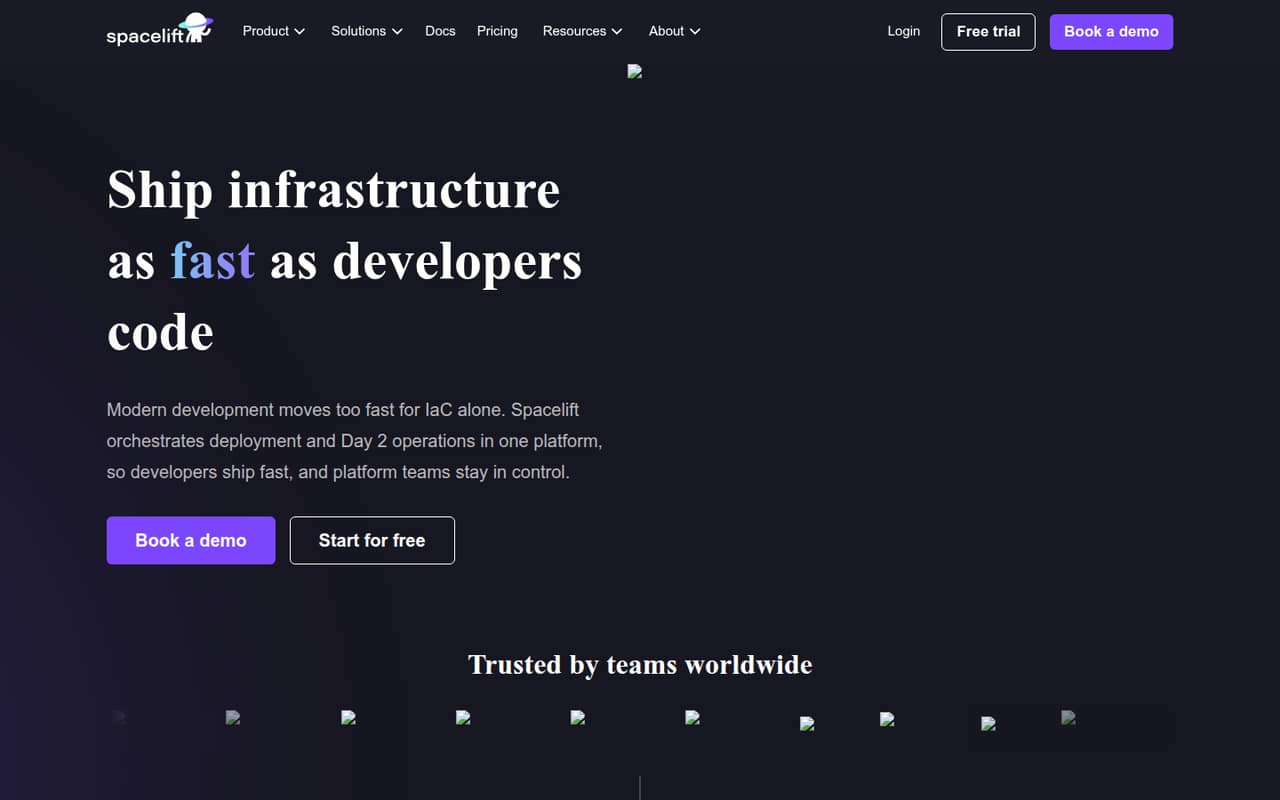
Spacelift is an infrastructure orchestration platform that coordinates IaC workflows and Day 2 operations across Terraform, OpenTofu, CloudFormation, Pulumi, Kubernetes and Ansible. It adds policy controls, drift visibility, self-service blueprints and automation to the infrastructure pipeline.
We rate it well for teams that need governance across multiple IaC tools. The main trade-offs are a limited public picture of API and SDK support, and pricing that only gives a clear figure for Starter; Reddit users report both strong experiences and concerns about cost.
Good fit if
- Platform teams standardizing IaC
- Teams managing many infrastructure stacks
- Organizations needing policy guardrails
Skip it if
- Teams wanting a simple Terraform runner
- Projects requiring published SDK details
- Buyers needing fully public pricing
ScoresHow it rates
What works
- Orchestrates Terraform, OpenTofu, CloudFormation, Pulumi, Kubernetes and Ansible
- Combines deployment workflows with Day 2 automation
- OPA-based policies cover plans, approvals and notifications
- Spaces, Contexts and RBAC support delegated access
- Offers SaaS, self-hosted, on-premises and FedRAMP-authorized SaaS
What doesn't
- The vendor doesn't publish a clear API or SDK overview on its homepage
- Starter is the only paid plan with a published price
- Free is limited to two users and one API key
- Worker counts and support tiers vary by plan
- One Reddit user described the platform as too expensive
01What Spacelift is, technically
Spacelift is an infrastructure orchestration control plane: a platform that coordinates IaC deployment and post-deployment operations rather than a single-purpose Terraform CLI or library. It sits between code repositories, cloud accounts and infrastructure tools, organizing work into stacks and dependencies. The homepage names Terraform, OpenTofu, CloudFormation, Pulumi, Kubernetes and Ansible as supported workflows.
Platform teams use it to standardize runs, apply OPA-based policies, manage access and monitor drift. Developers can use self-service blueprints and Day 2 automations instead of relying on a separate ticket-driven process. The platform also includes an Infrastructure Assistant for viewing resources, detecting drift, running automations and making changes.
Spacelift offers fully managed SaaS, self-hosted deployment in any cloud, on-premises deployment and FedRAMP-authorized SaaS. That gives teams deployment choices, but the specific architecture and operational responsibilities for each option should be confirmed with the vendor.
02Spacelift API, SDKs and docs
The developer workflow centers on stacks, dependencies, policies, blueprints and automations. Spacelift connects IaC and configuration code to cloud accounts, supports dynamic credentials and can trigger configuration after infrastructure changes. The homepage also names webhooks and MCP servers that teams control as integration surfaces. The Free plan includes one API key, but the homepage does not describe an API protocol or endpoint model.
The homepage names no language-specific SDK or CLI. Confirm SDK support and API details in the vendor's documentation before designing an integration around them. The documented product surfaces named on the homepage include Spaces, Contexts, RBAC, OPA-based policies, webhooks and MCP servers; it also links to documentation, a support knowledge base and a product changelog.
This is a workflow-oriented integration model, not a promise of a particular language client. Teams should map their repository events, credential flow and automation requirements to the supported integrations before moving existing pipelines.
03Spacelift pricing for developers
The Free plan costs $0 per month and includes two users, one API key, Spaces, IaC support and OIDC SSO integration. It is positioned for individuals and small teams testing IaC; its two-user and one-key caps make it a limited starting point for a shared production workflow.
Starter is listed at $399 per month on an annual subscription. It includes 10 users, two public workers, a private module registry, a Policy as Code engine and webhooks. Business includes unlimited users, public or private workers, drift detection, templates and blueprints, and Silver Support, but its price is not published. Enterprise starts at five workers and includes an audit trail, SAML 2.0 SSO, MFA and Gold Support; its price is also not published.
The vendor describes pricing as not tied to resources under management. The pricing page does not list usage overages or add-ons, so confirm worker expansion, billing terms and any deployment-specific charges before budgeting. Starter and Business are annual subscriptions; Enterprise offers monthly or annual payment options.
04Spacelift: open source, self-hosting and lock-in
Spacelift offers self-hosted deployment in any cloud and on-premises, as well as fully managed SaaS and FedRAMP-authorized SaaS. Self-hosting is a deployment option, but it does not establish that the platform is open source. The vendor doesn't publish a source-availability or licence statement on its homepage, so ask which components can be inspected, modified or redistributed and what licence applies.
The homepage does not describe a data-export path or migration tooling. Before committing, ask how to export stack configuration, run history, policy definitions and state-related records, and whether those exports can be consumed outside Spacelift. The more a team relies on platform-specific blueprints, policies, dependencies and automations, the more migration work it should plan for. Test that portability against the formats and workflows your team already owns.
05Spacelift in production
Spacelift's production controls include OPA-based policies, Spaces, Contexts, RBAC, audit trails and drift visibility. The homepage also names dynamic credentials and private workers; Enterprise adds SAML 2.0 SSO, MFA and an audit trail, while its plan starts at five workers. FedRAMP-authorized SaaS is listed as a deployment option. Confirm the exact security boundary, compliance scope and audit retention with the vendor before using it for regulated workloads.
The homepage does not publish rate limits, worker capacity guidance or reliability targets. Ask about API and webhook limits, worker scaling, incident response, backups and service-level commitments. Pricing also leaves the cost of additional capacity unclear, so model a busy period and a drift-remediation workflow before signing.
Reddit feedback is mixed. One user said Spacelift was intuitive and powerful across more than 200 stacks, and described using OPA policies with drift auto-reconciliation. Another called it too expensive, while a separate commenter praised its customer service. Those reports are individual experiences, not a substitute for checking fit and support terms.
From the threadsWhat users say
Reddit sentiment is mixed but leans positive among users who have adopted Spacelift. Some praise its policy controls, drift handling and customer service; cost is a concern for at least one prospective buyer.
I also enjoy OPA policies and drift detection a lot
we’ve been running over 200 stacks on it for years now, very intuitive and powerful
We looked into it and found it too expensive for us
great customer service
Spacelift in the news
Questions people ask
What infrastructure tools does Spacelift support?
The homepage names Terraform, OpenTofu, CloudFormation, Pulumi, Kubernetes and Ansible. Spacelift positions itself as an orchestration platform for those workflows, alongside GitOps deployment and Day 2 operations.
Can Spacelift detect and manage infrastructure drift?
Yes. The product includes drift visibility and supports remediation. Business includes drift detection, and the homepage describes policies and automations that teams can use to manage changes.
Can I self-host Spacelift?
Spacelift says teams can choose fully managed SaaS, self-hosted deployment in any cloud, on-premises deployment or FedRAMP-authorized SaaS. Confirm the operational requirements and available features for the deployment model you need.
Does Spacelift have an API or SDK?
The Free plan includes one API key, and the homepage names webhooks and MCP servers as integration surfaces. It does not describe an API protocol or language-specific SDKs; confirm supported API operations and SDKs in the vendor's documentation.
Does Spacelift offer a free plan?
Yes. Free costs $0 per month and includes two users, one API key, Spaces, IaC support and OIDC SSO integration. The user and API-key limits make it most suitable for evaluation or small-scale use.