
We may earn a commission if you buy through links on this page. It never changes a score or a ranking. How we make money
The bottom line
Useful code verification and quality gates, with integration details and production costs to confirm.
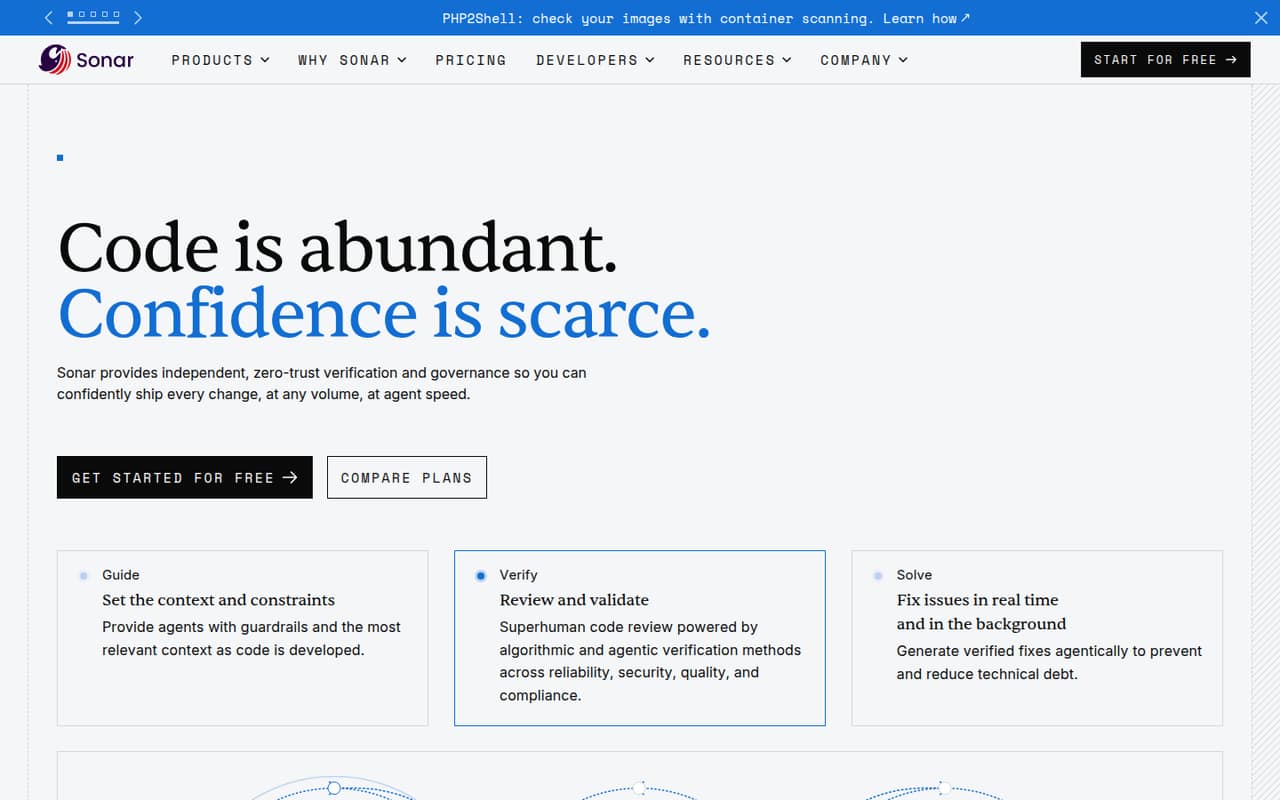
SonarQube is a code verification and governance platform available as Server or Cloud. It reviews code for quality, security and compliance, and its quality gates are designed to validate changes before merge. The homepage also describes dependency assessment and automated remediation products.
The free options make it possible to start without a subscription, while Team starts at $34 per month for up to 100k private LOC. Enterprise pricing is quote-based. We would verify the integration surface, licence terms and any costs above plan limits before making SonarQube a required part of a production pipeline.
Good fit if
- Teams enforcing pre-merge quality gates
- Projects with public OSI-licensed repositories
- Teams seeking code-quality governance
Skip it if
- Teams needing published API details
- Projects requiring predictable Enterprise pricing
- Teams relying on guaranteed support response times
ScoresHow it rates
What works
- Available as Server and Cloud
- Free private-project tier up to 50k LOC
- Team starts at $34 per month
- Quality gates validate code before merge
- Advanced Security assesses dependencies
What doesn't
- Team starting price covers up to 100k private LOC
- Enterprise pricing is quote-based
- Advanced Security requires an extra subscription
- Homepage does not detail API or SDK integration
- Reddit users report support and workflow frustrations
01What SonarQube is, technically
SonarQube is a code verification and governance platform offered as Server or Cloud. It is not described as a language library or standalone CLI: it sits in a software delivery workflow, reviewing code for quality, security and compliance. Its quality gates are intended to validate code before it is merged.
The platform's stated approach is multi-layered, zero-trust verification that produces consistent, explainable, repeatable and auditable findings. That makes SonarQube a control point for teams that want checks applied consistently across code, including code written with AI tools. The homepage also presents separate products for dependency assessment, AI code review, agent guidance and automated remediation; those should not be assumed to be included in every SonarQube plan.
The Server and Cloud options give teams different deployment paths. The homepage does not detail their operational differences, so confirm hosting, administration and data-handling requirements against the relevant product documentation before choosing one.
02SonarQube API, SDKs and docs
The homepage names integrations with Claude Code, Cursor, Devin, GitHub Copilot, Antigravity and Codex. It does not describe a particular API style or name SDKs, programming languages, a CLI, webhooks or plugins. That leaves an important implementation question: how your repository, CI pipeline and developer tools connect to the Server or Cloud product.
Before adopting SonarQube, confirm in the vendor's docs which integration surfaces are available for your setup, including whether there is a REST API, CLI, webhook or plugin workflow, and which SDKs or languages are supported. The homepage does describe quality gates and CI verification, but not the configuration steps or pipeline-specific requirements.
For AI-assisted development, Sonar lists named integrations and describes verification across code review and maintenance loops. Treat that as a starting point, not a substitute for checking whether your editor, repository host and CI system are supported in the way your team needs.
03SonarQube pricing for developers
Developers (Free) is free forever, with up to 50k private LOC, no credit card and no expiry. OSS maintainers (Free) is for public, OSI-licensed repositories and includes SonarQube for OSS, Gitar AI Code Review for OSS and features matching the paid Pro plan.
Team costs $34 per month at the listed starting price and covers up to 100k private LOC. It is for teams with under 50 developers; the price is monthly, and no annual Team price is listed. The 14-day trial includes Advanced Security, but Advanced Security requires an additional subscription outside that inclusion. Team commercial support is also an extra purchase.
Enterprise is for organizations with over 50 developers. It is priced annually by quote, with commercial support starting at 5M LOC. The pricing page does not publish overage rates, so ask how the bill changes when private LOC exceeds the plan threshold. Enterprise Gitar AI Code Review is outcome-priced per PR, not per seat, with pricing not published.
04SonarQube: open source, self-hosting and lock-in
SonarQube is offered as Server and Cloud, and Sonar's news refers to self-managed infrastructure. That gives teams a Server option to investigate if they need to operate the product within their own environment. The free OSS maintainer offer applies to public, OSI-licensed repositories; it does not establish the source licence for SonarQube itself. Check the current licence before assuming the server is open source or can be modified.
The vendor doesn't publish data-export specifics on its homepage. Before rollout, ask what findings, project settings and history can be exported and in which formats. Migration effort will depend on how much your CI workflow, review policies and team processes rely on SonarQube-specific gates and findings. Test that exit path with a representative project rather than treating the free OSS offer as proof of portability.
05SonarQube in production
Before making SonarQube a required pipeline check, confirm how your deployment handles project growth, private LOC thresholds, availability and recovery. The pricing page lists LOC limits and plan distinctions, but not overage rates or service-level commitments. Teams should also verify the security and compliance controls they need for their chosen Server or Cloud deployment, and establish what happens when a quality gate blocks a merge.
The homepage describes auditable findings and quality gates, but does not give operational limits such as request rates or scaling guidance. Ask the vendor for the limits and support terms that apply to your plan, especially for Enterprise deployments.
Reddit accounts are mixed and anecdotal. A poster in r/devops expressed strong frustration with SonarQube, while a poster in r/devsecops described disconnected tools and overlapping findings in a workflow that included SonarQube and other scanners. A poster in r/devops seeking alternatives cited dissatisfaction with support. These reports are reasons to validate your own workflow and support expectations, not evidence of a general failure rate.
From the threadsWhat users say
Reddit sentiment is mixed, with one strongly negative post and reports of workflow fragmentation and support concerns. Other comments treat SonarQube as useful for code-quality checks, but the discussions are anecdotal rather than a broad measure of user experience.
I have nowhere else to express my complete hatred of it
different dashboards, overlapping issues, and zero visibility on whether we’re actually improving
we are unhappy with their support, or lack there of
Sonar in particular is doing code quality which is why teams are using both tools
Questions people ask
What does SonarQube check?
SonarQube reviews code for quality, security and compliance. The homepage describes multi-layered verification that produces consistent, explainable, repeatable and auditable findings. Its quality gates are intended to validate code before merge. SonarQube Advanced Security is a separate product for software supply-chain and dependency assessment.
Can I run SonarQube in my own environment?
SonarQube is offered as Server and Cloud, and Sonar refers to self-managed infrastructure. The Server option is the one to evaluate for an environment you operate. Confirm deployment requirements, administration responsibilities and security controls with Sonar's documentation before selecting a plan.
Does SonarQube integrate with AI coding tools?
Sonar lists integrations with Claude Code, Cursor, Devin, GitHub Copilot, Antigravity and Codex. Check the vendor's docs for the integration method and supported workflows for the specific tool and SonarQube deployment you plan to use.
How much private code can I analyze for free?
Developers (Free) includes up to 50k private LOC, with no credit card and no expiry. The separate OSS maintainers (Free) plan is for public, OSI-licensed repositories and includes SonarQube for OSS, Gitar AI Code Review for OSS and features matching the paid Pro plan.
Does SonarQube fix issues automatically?
The SonarQube Remediation Agent is described as opening verified, ready-to-merge pull requests to address technical debt. Sonar says each fix is scanned and verified by its engine. Check which plan or subscription includes the agent and whether it fits your repository workflow.