
We may earn a commission if you buy through links on this page. It never changes a score or a ranking. How we make money
The bottom line
Good proxy controls and global targeting, but confirm SDK support, limits and migration options first.
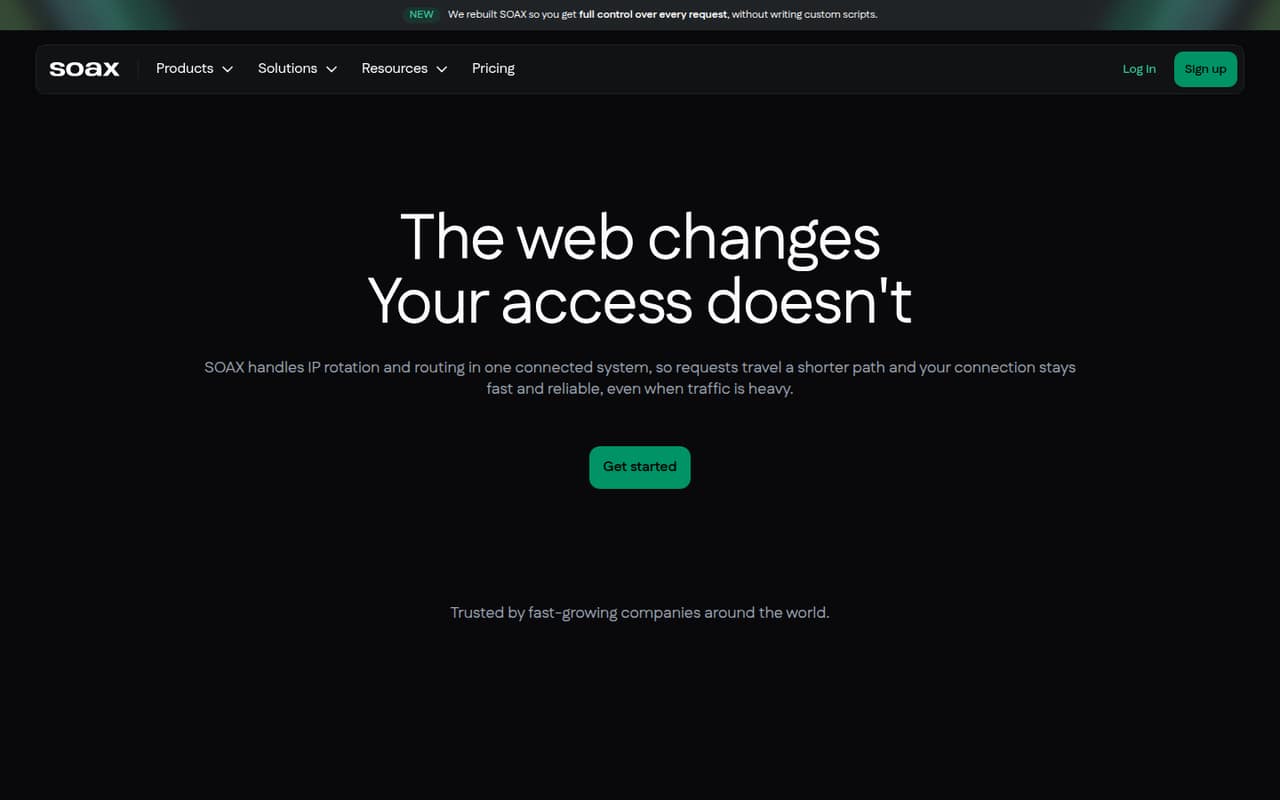
SOAX is a managed proxy network and data-acquisition service, not a library or self-hosted proxy server. It offers HTTP, HTTPS and SOCKS5 access, rotation and sticky-session controls, targeting across 195+ locations, and custom data pipelines.
The control plane is promising for teams that want to manage routing without building their own proxy orchestration. The trade-offs are a $200/month paid entry plan, no proxy SDK details on the homepage, and production limits that need confirmation with SOAX.
Good fit if
- Teams needing targeted proxy routing
- Scraping workloads using HTTP or SOCKS5
- Companies seeking managed data pipelines
Skip it if
- Teams requiring self-hosted proxy infrastructure
- Developers expecting a documented SDK-first workflow
- Small projects needing included free traffic
ScoresHow it rates
What works
- HTTP, HTTPS and SOCKS5 over TCP and UDP
- Rotation by request, count, time or error
- Sticky sessions and configurable request rules
- Targeting by country, city, state or ASN
- Managed pipelines built around a team's schema
What doesn't
- Sandbox includes no proxy credits
- Paid self-service plans start at $200 monthly
- Homepage does not explain proxy SDK integration
- Rate limits and concurrency limits need confirmation
- Open-source, self-hosted and export options are unclear
01What SOAX is, technically
SOAX is a hosted proxy network with a management control plane. It sits between your application or scraper and the websites you request: your client connects through SOAX using HTTP, HTTPS or SOCKS5, while SOAX manages routing, IP rotation, sessions and request rules. It is not a proxy library you embed or a server the vendor presents for self-hosting.
The service is built to handle changing IPs and locations without requiring teams to write their own rotation and routing scripts. You can target by country, city, state or ASN, rotate per request or according to count, time or error, and keep a sticky session on one network node. Packages set access, limits and destinations. SOAX also offers managed data pipelines: technical teams specify a schema and delivery requirements, and SOAX builds the pipeline. That moves the product beyond network access, but puts more of the acquisition stack under vendor management.
02SOAX API, SDKs and docs
The clearest integration surface is proxy connectivity: SOAX lists HTTP, HTTPS and SOCKS5 protocols, TCP and UDP transport, and username/password or IP-allowlist authentication. Applications can route supported client traffic through the proxy rather than adding a vendor library to their codebase. Rotation, sessions, rules and packages are configured through SOAX's control plane.
The homepage also includes a JavaScript-style soax.auth.signUp snippet, but it does not show how to make proxy requests through a JavaScript SDK. It names no language-specific proxy SDK, CLI, webhook or plugin. Treat the integration as protocol-level unless SOAX's documentation confirms a library or API that fits your stack. Before implementation, check the docs for endpoint formats, authentication examples, error behavior and whether your client needs special configuration for UDP or sticky sessions. The homepage describes control features, but provides no detailed code examples for those flows.
03SOAX pricing for developers
The Sandbox plan costs $0/month, but includes zero credits. It provides two proxy packages, one team member and a Tier 1 rate of $5/GB; to use proxies, the vendor says you must buy credits or upgrade. Builder starts at $200/month and includes 200 credits, three packages and two team members, with Tier 1 traffic at $3/GB. Team is $500/month with 500 credits and a $2.20/GB Tier 1 rate; Scale is $1,500/month with 1,500 credits and a $1.50/GB Tier 1 rate.
Enterprise Monthly is $3,000/month, includes 3,000 credits, and lists Tier 1 rates from $0.85/GB. Enterprise Annual requires a 12-month commitment; its price is set by agreement. SOAX says one credit equals $1, and that country tier affects the cost per credit. Top-up credit prices appear at checkout. Approved business accounts can arrange postpaid overage in writing. Check country mix, package counts and seats against your expected usage; VAT is calculated at checkout.
04SOAX: open source, self-hosting and lock-in
SOAX is presented as a managed service. The vendor doesn't publish an open-source licence, a self-hosted edition or a documented data-export route. That means teams should plan around a hosted dependency rather than assume they can deploy the proxy control plane inside their own infrastructure.
The basic proxy integration uses standard protocols and credentials, which may make it possible to change providers without rewriting application logic. The more your system relies on SOAX-specific session behavior, rotation rules, packages or managed data pipelines, the more migration work could involve recreating configuration and validating output. Ask SOAX what data, settings and pipeline results can be exported, in what format, and whether custom pipelines can be transferred. Keep proxy credentials and routing configuration isolated from application code so that provider changes do not require broad code edits.
05SOAX in production
SOAX's homepage claims 99.9% guaranteed uptime, more than 12 million unique IPs in the past 30 days, and 717 million-plus average daily requests over the last 90 days. These are vendor-reported figures, not workload-specific guarantees. The published plan limits include credits, packages and team members; the vendor does not publish rate or concurrency limits on the homepage. Ask for applicable limits, service-level terms, failure handling and billing behavior when requests retry or return partial results.
Production success still depends on target-site defenses and your client behavior. A commenter in one Reddit thread warns that residential proxies alone may not pass modern anti-bot checks, while another raises possible overlap between providers' upstream residential pools. A separate commenter describes SOAX as a legitimate mobile option with broader geographic coverage. Before scaling, validate allowed targets, country-level success, billed traffic per usable result, latency and timeout behavior. Also review the vendor's IP-sourcing and opt-in documentation and confirm security and compliance requirements.
From the threadsWhat users say
The Reddit discussion is limited and mixed. Commenters mention SOAX as an option for mobile proxy coverage, but also raise concerns about shared upstream pools and the limits of proxies against anti-bot systems.
both soax and voidmob are legit options for mobile at scale. soax as the bigger pool with more geos covered globally
even the trusted ones still end up sharing a lot of the same upstream residential SDK pools once you look at the ASN overlaps
Even top-tier pools eventually trigger Cloudflare Turnstile, DataDome, or Akamai when scaling up concurrency
For the larger-load/global-geo part, compare a small matched workload before moving everything:
Questions people ask
Does SOAX have a free plan?
SOAX offers a free Sandbox account with no credit card required. It costs $0 per month but includes zero credits, so it does not include free proxy traffic. The vendor says you need to buy credits or upgrade to a paid plan to use proxies.
Which protocols and authentication methods does SOAX support?
SOAX lists HTTP, HTTPS and SOCKS5, with TCP and UDP transport. Authentication options are username/password and IP allowlisting. Confirm client-specific requirements with SOAX before deploying, particularly if your application depends on UDP or persistent sessions.
How does SOAX proxy rotation work?
SOAX lets you rotate per request, after a set number of requests, after a time period or on error. For sticky sessions, you can lock requests to one network node without rotation. Request rules control how nodes are selected, reused and replaced.
How much does SOAX cost?
Sandbox is free but has zero credits. Paid self-service plans start with Builder at $200 per month, including 200 credits. SOAX says one credit equals $1, while traffic cost per credit varies by country tier. Top-up prices are shown at checkout, and enterprise pricing may be set by agreement.
Can SOAX build a data pipeline for my schema?
Yes. SOAX says it builds custom data pipelines for technical teams that define the schema and delivery requirements. Before relying on a pipeline in production, confirm delivery formats, update cadence, failure handling, export options and how the work is priced with the vendor.