
We may earn a commission if you buy through links on this page. It never changes a score or a ranking. How we make money
The bottom line
Sinch covers multiple communication channels, but production costs and number portability need scrutiny.
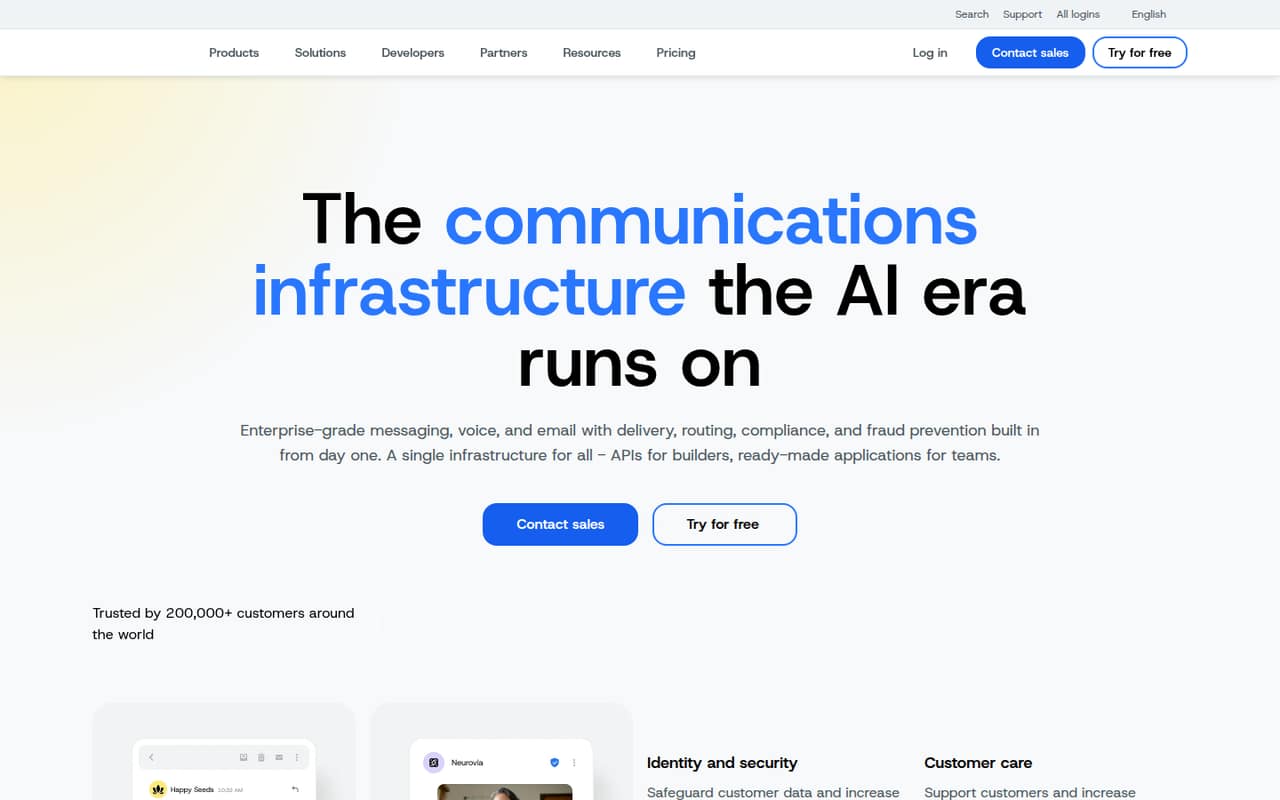
Sinch is a hosted communications platform: developers integrate its messaging, email, voice, verification and numbers APIs, while business teams can use ready-made applications. Its range suits products that need several communication channels from one provider.
The trade-offs are practical: API usage rates and limits require confirmation, and the available Reddit discussion describes difficulty accessing a number’s port-out PIN through a former provider. Set up account ownership and exit procedures before routing critical communications through Sinch.
Good fit if
- Products using multiple communication channels
- Teams needing messaging and voice APIs
- Businesses combining APIs with ready-made apps
Skip it if
- Teams requiring self-hosted communications infrastructure
- Projects needing published API rates upfront
- Organizations without control of number accounts
ScoresHow it rates
What works
- APIs cover messaging, email, voice, verification and numbers
- Supports SMS, RCS, MMS and WhatsApp channels
- Offers ready-made messaging, email and chatbot applications
- Functions starts free, with compute billed by usage
- Developer resources include documentation, SDKs and a CLI
What doesn't
- API usage rates and limits are not published
- Homepage does not identify SDK languages or API protocols
- No self-hosting option is described
- Data export and core API licensing details need confirmation
- A Reddit thread reports difficulty obtaining a number port-out PIN
01What Sinch is, technically
Sinch is a hosted communications platform, not a library or self-hosted server. Applications call its communication APIs for messaging, email, voice, verification and numbers; teams can also use Sinch’s ready-made applications for campaigns, email and chatbots. Its infrastructure layer covers number provisioning and routing services.
That puts Sinch between your application and communications networks. Your code can use the APIs to send messages or handle voice and verification use cases, while Sinch provides the underlying communications infrastructure. The homepage presents SMS, RCS, MMS, WhatsApp, email, voice and SIP trunking as channels. It also describes delivery, routing, compliance and fraud prevention as part of its infrastructure.
Sinch says its platform serves more than 200,000 businesses. It claims 99.99% uptime across 60+ countries; treat that as a vendor claim and ask how the commitment applies to the specific API, route and support plan you need.
02Sinch API, SDKs and docs
Sinch’s integration surface is its communication APIs, with documentation grouped around Messaging, Voice & Video, Email, Verification, and Numbers & Connectivity. The developer site also lists SDKs, the Sinch Build Dashboard, Functions and CLI, extensions and plugins, GitHub, and an API status page. Those entry points give a team places to configure, build and monitor an integration.
The homepage does not name SDK languages or an API protocol. Check the vendor’s documentation for supported languages, authentication, request formats, webhook behavior and versioning before choosing an SDK or designing a service boundary. The homepage also links to partner ecosystems including Adobe, Emarsys, SAP, HubSpot and Shopify, plus Sinch Marketplace and other marketplaces; confirm the exact integration and its maintenance status.
For a production integration, keep channel selection and provider-specific behavior behind an internal interface. That makes it easier to handle channel fallbacks, delivery status and a future provider change without spreading Sinch-specific assumptions through application code.
03Sinch pricing for developers
For API builders, the pricing information lists Pay-as-you-go (Functions / APIs): Functions starts free and charges for compute time, while SMS and Voice are billed per message or minute. The vendor does not publish the rates or usage limits, so estimate costs with Sinch before committing to traffic forecasts. A free starting point is not a fixed-cost production tier.
Sinch Engage has separate monthly plans: Basics is $99 for 3,000 SMS and one user; Conversations is $249 for 10,000 SMS and two users; Pro is $799 for 40,000 SMS and three users; Pro Plus is $1,799 for 100,000 SMS and three users; Advanced is $2,399 for 150,000 SMS and three users. Plans include different features such as workflows, subaccounts, SSO, RCS and onboarding. Custom pricing is listed above 150,000 monthly messages. The pricing page lists a 16% annual-billing discount but no annual dollar amounts. Functions compute and SMS/Voice charges add to API costs; Engage add-ons and overages also need confirmation.
04Sinch: open source, self-hosting and lock-in
Sinch’s APIs and applications are presented as hosted services; the homepage does not describe a self-hosted deployment option. It links to GitHub, but that alone does not establish that Sinch’s core services are open source or identify a license. The vendor does not publish core API licensing, data-export or self-hosting details on its homepage, so ask Sinch directly before treating those as available.
The main migration questions are operational: what happens to phone numbers, message history, templates, contact data and delivery workflows if you change providers? A Reddit thread describes a business trying to port numbers after losing contact with the person who managed its service. That account does not establish a general Sinch policy, but it is a reason to make sure your organization controls its account, invoices, number records and port-out process. Keep message content and contact records in systems you control where possible.
05Sinch in production
Before sending production traffic, confirm the per-channel rates, throughput and account limits with Sinch. The pricing information says usage limits are not published for API plans, and the homepage does not give API-specific scaling limits. Ask about delivery guarantees, regional routing, support response times and what the 99.99% uptime claim covers. For verification and customer communications, review how the relevant products handle security, compliance and fraud prevention for your use case.
Plan for provider-specific delivery failures: log message IDs and status changes, define retry behavior, and avoid retrying blindly when a send may already have succeeded. Keep number ownership and port-out procedures documented. One Reddit thread describes a company unable to obtain a port-out PIN from the former service contact; commenters suggested using invoices and contacting the FCC for help. That is an individual account, not proof of a platform-wide issue, but number access is a production dependency worth testing before a provider transition.
From the threadsWhat users say
The Reddit discussion is mixed and limited: the original poster describes a number-porting problem involving a former service contact, while commenters point to invoices and an FCC complaint as possible routes. It raises an account-control concern but does not establish a broader pattern.
The new provider says they need the port out PIN from Sinch
As long as you have the previous month's invoice and have cleared any outstanding dues, no one can prevent you from porting out
The key question here is: how can you prove ownership of the number?
Questions people ask
Is Sinch a texting app?
Sinch is broader than a texting app. It offers hosted APIs for SMS and other channels, including RCS, MMS and WhatsApp, alongside applications for messaging and campaigns. Developers can integrate the APIs into their own products; teams can use Sinch applications for some communications tasks.
Does Sinch offer a free tier for developers?
The pricing information says Functions starts free, then charges for compute time. SMS and Voice are billed by message or minute. API rates and usage limits are not published there, so confirm expected costs and any account limits with Sinch before using it for production traffic.
What channels does Sinch support?
Sinch lists SMS, RCS, MMS, WhatsApp, email, voice and SIP trunking among its channels. Its product range also includes messaging, email, voice, verification and numbers APIs. Check the relevant product documentation to confirm channel availability and requirements for your region and use case.
Can I self-host Sinch?
Sinch presents its communications APIs and applications as hosted services, and its homepage does not describe a self-hosted deployment. If self-hosting, source availability or a particular open-source license is a requirement, ask Sinch to confirm the options for the specific product.
Can I port my phone number away from Sinch?
A Reddit thread describes difficulty obtaining a port-out PIN after the person who managed the service became unavailable. That account does not establish Sinch’s general porting process. Before relying on a number, confirm the current port-out steps with Sinch and keep account credentials, invoices and number records under your organization’s control.