
We may earn a commission if you buy through links on this page. It never changes a score or a ranking. How we make money
The bottom line
A programmable voice, messaging and AI control plane billed by usage, with transport costs on top.
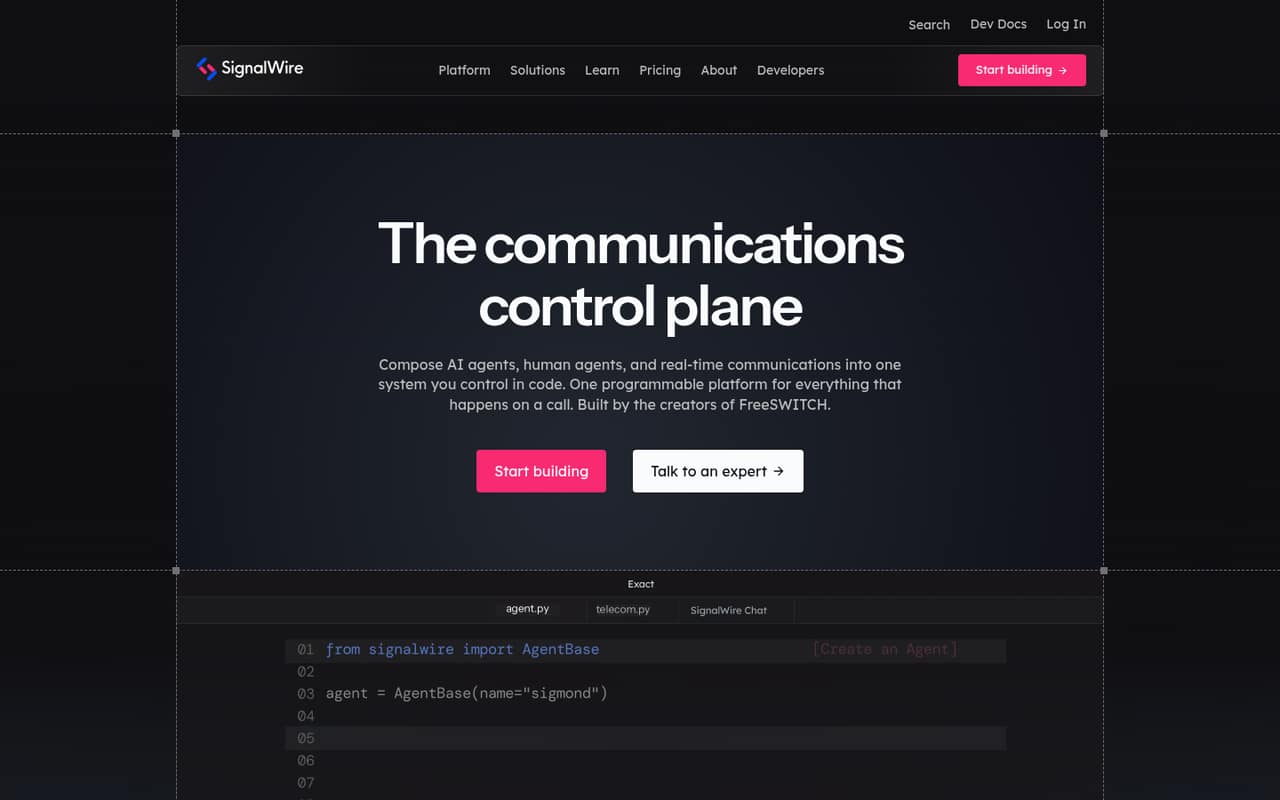
SignalWire is a hosted programmable communications platform for voice, video, messaging and AI. Developers define call behavior with APIs and SWML, while calls remain on the platform as stateful objects. Its AI Agent Runtime adds orchestration, memory and tool calls.
Usage rates are published for voice, messaging and agent runtime, but there is no free plan listed. Budget for transport and feature add-ons as well as runtime. Before adopting it, confirm SDK and language support, production limits, data-export options and self-hosting terms with SignalWire.
Good fit if
- Teams building AI voice agents
- Developers coding call-routing flows
- Apps combining voice and messaging
Skip it if
- Projects requiring a free tier
- Teams needing confirmed self-hosting
- Stacks requiring a named SDK
ScoresHow it rates
What works
- Voice, video, messaging and AI share one control plane
- SWML defines flows in JSON or YAML
- REST APIs cover calls, SMS and number provisioning
- WebSocket supports real-time call control and events
- Usage rates are published for core US services
What doesn't
- No free plan is listed
- Voice transport is billed separately from AI runtime
- SDK languages and specific SDKs need confirmation
- Self-hosting and platform licensing terms need confirmation
- Production rate and reliability limits need vendor confirmation
01What SignalWire is, technically
SignalWire is a hosted programmable communications platform: a control plane and set of APIs for voice, video, messaging and AI, rather than a library or command-line tool. It sits between an application and the communications network, handling call state and execution while application code defines what should happen next. The vendor describes calls as first-class objects with state attached, so developers can build call logic without reconstructing state from a stream of events.
That model is aimed at teams building programmable call flows, IVR, routing, contact-center functions or AI voice agents. Flows can route by caller speech or caller information, and SWML lets developers define communications behavior in JSON or YAML. SignalWire also offers REST APIs for sending SMS, placing calls and provisioning numbers. The company says it was built by the creators of FreeSWITCH, but the product described here is the hosted platform, not FreeSWITCH itself.
02SignalWire API, SDKs and docs
The integration surfaces include REST APIs for SMS, calls and number provisioning, plus WebSocket control for real-time calls and events. SignalWire's Flow language, SWML, defines communications flows in JSON or YAML. The vendor's example uses a prompt, speech language and hints, then switches on the caller's response to route the call. That gives application code a structured way to define call behavior rather than only wiring together separate telephony services.
SignalWire describes APIs and SDKs as platform components, but the available material here does not name SDK packages or supported programming languages. Confirm SDK support in the vendor's developer documentation before choosing a language or estimating integration effort. The same applies to any CLI or framework integrations your build pipeline requires. The homepage links to developer documentation, but details such as authentication patterns, webhook retry behavior, versioning and specific SDK coverage should be checked there. Test how your application handles call events and failures before relying on a flow in production.
03SignalWire pricing for developers
The pricing page lists no free plan, and a free trial is not published. AI Agent Runtime costs $0.16 per minute and includes real-time STT, LLM, standard TTS, orchestration, memory and tool calls. Voice transport is billed separately: US local PSTN costs $0.0066 per inbound minute and $0.0080 outbound; SIP and WebRTC cost $0.0030 per minute. That makes an AI call's total depend on both runtime and its transport path.
Voice API rates also list US toll-free inbound at $0.0147 per minute and outbound at $0.0069. Local numbers cost $0.50 monthly; toll-free numbers cost $0.80 monthly. Messaging API local SMS is $0.00415 per segment; local MMS is $0.010 inbound and $0.020 outbound. WhatsApp Business Messaging costs $0.005 per message plus Meta fees. Additional costs include premium TTS, call recording, transcription, conferencing and number-related services. The pricing page lists usage rates and some monthly or quarterly fees, but not monthly-versus-annual plan billing.
04SignalWire: open source, self-hosting and lock-in
SignalWire says it was built by the creators of FreeSWITCH. That does not establish that the SignalWire platform itself is open source or that its hosted control plane can be self-hosted. The platform's licensing terms, source availability and self-hosting options should be confirmed with the vendor before treating it as an infrastructure you can run independently.
The pricing information describes usage-based platform services, but does not publish data-export options. Ask how to export phone numbers, messaging records, call recordings, transcripts, agent configuration and flow definitions, and whether exports remain available after an account closes. SWML and API-based flows may give teams portable definitions, but calls, numbers and operational data can still depend on SignalWire's services. Treat the platform as a hosted dependency until the vendor confirms its deployment, license and exit terms.
05SignalWire in production
SignalWire's architecture is designed to keep call state on the platform, with code controlling call behavior. The vendor says this avoids rebuilding state from events and presents the same architecture as suitable from 10 to 10,000 calls. That is a product claim, not a published service limit or independent reliability measure. The available pricing details list high-throughput calling tiers from 1 call per second at $0 monthly up to 201–250 calls per second at $40 monthly; the listed tiers require a three-month commitment, and PSTN and SIP are billed independently.
Before launch, confirm the account's call-rate limits, overage behavior, service-level commitments, regional availability, incident process and security or compliance terms with SignalWire. The pricing information does not establish those operational details. Budget separately for runtime, transport, recordings, transcription and any premium TTS. Validate how your application handles delayed or failed events, call transfers and provider outages, and confirm what data can be exported if you need to migrate.
Questions people ask
What does SignalWire do?
SignalWire provides a programmable communications platform for voice, video, messaging and AI. Developers use APIs and code-defined flows to place calls, send messages, provision numbers, route callers and build AI voice agents. Its control-plane model keeps call behavior on the platform while application code defines the flow.
What is SignalWire FreeSWITCH?
FreeSWITCH is the media engine whose creators SignalWire says built the company. SignalWire is the programmable communications platform built around that background; it is not the same product as FreeSWITCH. Confirm the applicable license and deployment options for each product separately.
Is SignalWire free to use?
The pricing information lists no free plan, and a free trial is not published. Core services are billed by usage, with rates for AI Agent Runtime, voice and messaging, plus possible number fees and add-ons. Check the current pricing page and ask SignalWire about any trial or account-specific offer.
How much does an AI voice agent cost?
AI Agent Runtime costs $0.16 per minute and includes real-time STT, LLM, standard TTS, orchestration, memory and tool calls. Voice transport is billed separately; US local PSTN rates are $0.0066 per inbound minute and $0.0080 outbound, while SIP and WebRTC cost $0.0030 per minute.
Is SignalWire an end-user app?
SignalWire is presented as a developer platform for building communications into applications, not as a named end-user calling app. Its documented surfaces include APIs, SDKs and code-defined call flows. Confirm with SignalWire if you are looking for a particular consumer or agent-facing application.