
We may earn a commission if you buy through links on this page. It never changes a score or a ranking. How we make money
The bottom line
A configurable hosted Google SERP API, with clear quotas but production details to verify.
serpstack is a hosted REST API for retrieving Google search results as JSON or CSV. It supports location, language, device and search-type options, so it can feed SERP data into an application or data pipeline without building scraping infrastructure yourself.
The free plan is limited to 100 searches per month, JSON output and non-commercial use. Paid plans start at $29.99 month-to-month, with annual billing listing a lower monthly equivalent. The API is a practical fit for projects that want managed SERP collection; verify reliability, export and data-handling terms before relying on it at scale.
Good fit if
- Apps needing Google SERP data
- Localized search monitoring workflows
- Teams avoiding scraper infrastructure
Skip it if
- Projects requiring self-hosted scraping
- Commercial use on a free plan
- Teams needing published reliability metrics
ScoresHow it rates
What works
- REST API returns Google SERP data in JSON or CSV
- Location targeting covers cities, regions and countries
- Options include mobile, tablet and desktop devices
- Supports web, image, video, news, shopping, ads and questions
- Paid plans list monthly search quotas and overage rates
What doesn't
- Free tier is limited to 100 monthly searches
- Free access is non-commercial and JSON-only
- No language-specific SDK or CLI is named
- Open-source license and self-hosting path are not published
- Enterprise pricing and overage rate are not listed
01What serpstack is, technically
serpstack is a vendor-hosted REST API that retrieves Google search results and returns structured SERP data in JSON or CSV. It sits between an application or data pipeline and Google: your code submits a search request with options, and serpstack handles the proxy network and scraping work before returning results. That makes it an alternative to operating your own proxy pool, browser workers and CAPTCHA-handling system.
The API supports location targeting by city, region or country, plus language and device settings for desktop, mobile and tablet searches. Search types include web, image, video, news, shopping, ads and questions. The vendor’s sample response shows structured fields for ads, local results, a knowledge graph and search information. The API is aimed at applications that need to collect or process Google SERP data; it is not a search engine for end users or a self-hosted scraper.
02serpstack API, SDKs and docs
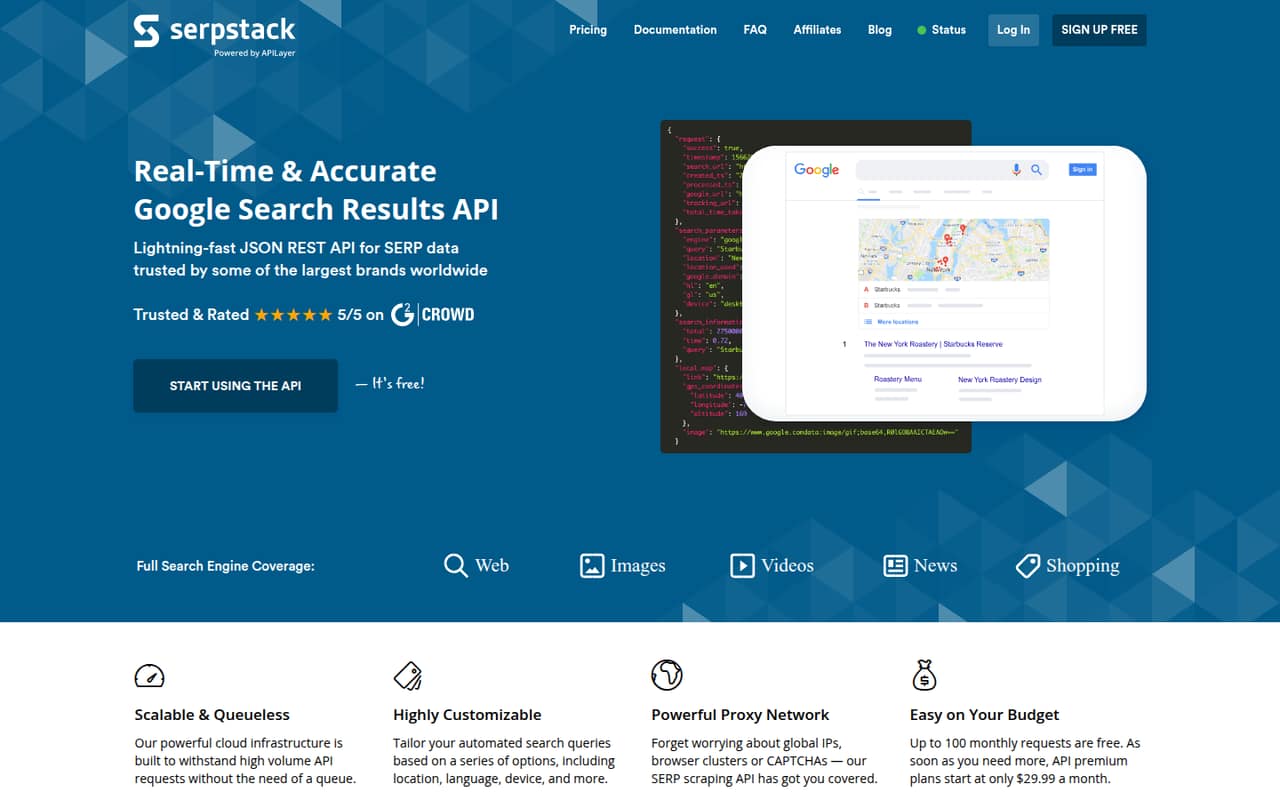
The integration surface is a REST API. The vendor describes it as a JSON REST API and the product facts list JSON and CSV responses. Requests can be customized with options including location, language, device and search type. The homepage provides a sample JSON response with request metadata, search parameters and result sections, which gives developers a view of the returned data structure.
The vendor’s homepage links to documentation, but the vendor's site names no language-specific SDK, CLI, webhook or plugin. Plan to call the REST endpoint from an HTTP client in your stack, and confirm SDK support in the vendor’s docs before choosing a language-specific integration. Check the docs for authentication, parameter names, pagination or result limits, error behavior and response consistency. The vendor also describes its infrastructure as scalable and queueless; treat that as a vendor claim and confirm the service’s operational terms for your expected request pattern.
03serpstack pricing for developers
The Free plan costs $0 and includes 100 searches per month, Google Search API access and JSON-only output. It is restricted to non-commercial use and includes no support, so it is for evaluation or small personal projects rather than a production commercial integration.
Basic costs $29.99 per month, or $26.99 per month on annual billing, for 5,000 searches. It includes JSON and CSV, commercial use and standard support. The listed overage is $0.023992 per extra search. Business provides 20,000 searches for $99.99 monthly or $87.99 on annual billing, with a $0.019998 overage rate. Business Pro provides 50,000 searches for $199.99 monthly or $169.99 annually, with overages at $0.0159992 per search. Those paid plans list no rate limit, but their monthly search quotas still apply. The pricing page says overage fees apply after quota. Annual billing requires a request and lists monthly-equivalent prices up to 15% lower overall. Enterprise has custom pricing, volume searches and a custom SLA; its price and overage rate are not listed.
04serpstack: open source, self-hosting and lock-in
serpstack is presented as a hosted API, not as a library or a server to deploy in your own environment. The vendor’s public product description does not publish an open-source license or a self-hosting option. If your architecture requires source access, on-premises deployment or control of the scraping infrastructure, ask the vendor directly before adopting it.
The vendor also does not publish a data-export mechanism in the product description. The API returns search results in JSON or CSV, which gives your application portable response formats, but that is not the same as an account-level export of stored data. Migration away should be manageable if your code isolates the API client and stores the results it needs in your own systems. Expect to replace the provider-specific request and response handling, and confirm any data-retention or export terms with the vendor.
05serpstack in production
The pricing page lists monthly search quotas and says Basic, Business and Business Pro have no rate limit; it does not remove the quota or the overage charges. The Free plan’s rate limit is not listed. The vendor says its cloud infrastructure is built for high-volume requests without a queue, but the public product description gives no uptime figure or general SLA. Enterprise is the plan that lists a custom SLA.
Before depending on the API, confirm how the service handles transient failures, retries, result changes, timeouts and quota exhaustion. Ask about data retention, security controls and compliance requirements; the vendor’s product description does not publish those details. One Reddit thread about SERP API providers includes a commenter’s concern that location handling and ad-data reliability can be problematic for services in this category. That is a general caution, not a report of a serpstack-specific failure. Test your target locations and result types, and monitor response quality and spend in production.
From the threadsWhat users say
The Reddit discussion is too thin to establish a clear user consensus about serpstack itself. Comments show interest in free tiers and concern about location and ad-data reliability across SERP services, rather than direct reports about serpstack.
Based on my experience handling locations and getting ad data reliably have both been problematic for these types of services
Love and use SERP Api. You guys are doing great
A free tier for pet projects :)
I'm using GeoRanker, they did a good job until now especially with the real-time results. I don't know if they can do high volume in real-time though
Questions people ask
What does serpstack return?
serpstack returns Google search results through a REST API in JSON or CSV, depending on the plan. Its documented result types include web, image, video, news, shopping, ads and questions. The vendor’s example response also shows fields for local results, ads, search information and a knowledge graph.
Can I use serpstack for commercial projects?
The Free plan is for non-commercial use. The Basic, Business and Business Pro plans list commercial use as included, as does Enterprise. Check the current plan terms with the vendor before deploying the API in a commercial product.
How much does serpstack cost?
The Free plan costs $0 for 100 searches per month. Paid plans start at $29.99 per month for Basic, or $26.99 per month on annual billing. Business and Business Pro cost more and include higher search quotas. Enterprise pricing is custom and is not listed.
Does serpstack have SDKs or a CLI?
The vendor describes a REST API and links to API documentation. The vendor's site names no language-specific SDK or CLI, so plan around a standard HTTP client unless the vendor’s documentation confirms support for a client in your language.
Can I self-host serpstack or export my data?
The vendor presents serpstack as a hosted API and does not publish a self-hosting option or an account-level data-export mechanism in its product description. The API can return results in JSON or CSV on eligible plans. Ask the vendor about deployment, retention and export requirements before committing.