We may earn a commission if you buy through links on this page. It never changes a score or a ranking. How we make money
The bottom line
Strong deliverability controls for high-volume senders; confirm limits and pricing before committing.
SendPost is a cloud MTA and email delivery service with an Email API, SMTP relay, webhooks, and a SaaS dashboard for deliverability monitoring and sending controls. It is designed to sit alongside an existing stack, giving teams visibility into ISP responses, IP and domain reputation, and sender-level performance.
Its per-ISP throttling, queue controls, routing, and automation target ESPs and high-volume senders rather than teams looking only for a basic email API. Public monthly tiers start at $7 for 10,000 emails, but overage rates are not published, and current self-serve pricing requires a demo.
Good fit if
- ESPs managing many senders
- Teams investigating deliverability problems
- High-volume email operations
Skip it if
- Projects needing a free tier
- Teams requiring self-hosting
- Senders wanting published overage rates
ScoresHow it rates
What works
- Email API and SMTP relay integration
- Per-ISP throttling and sender queues
- Tracks ISP responses and reputation
- Webhooks for email events
- Automates warmup, retries, and backoff
What doesn't
- No free plan is listed
- Overage rates are not published
- SDK language names are not listed
- Rate limits are not published
- Self-hosting and data export are not documented
01What SendPost is, technically
SendPost is a hosted cloud MTA and email delivery service, not a client library or self-hosted mail server. Applications connect through its Email API or SMTP relay, while a web dashboard provides deliverability analytics and controls for sending traffic. Webhooks report email events to systems in your stack.
The service is intended to sit alongside an existing MTA and application: the homepage says teams can add SendPost for visibility and route traffic through it when ready. It focuses on operational signals that basic sending integrations may not expose, including ISP responses, IP and domain reputation, and sender-level performance. Teams can use per-ISP throttling, queues, routing, and shared or dedicated IP pools to respond to those signals. AI alerts flag bounce, deferral, or reputation changes, and automation covers warmup, backoff, and retries. That makes SendPost more relevant to ESPs and deliverability teams managing multiple senders than to a small app that only needs transactional email.
02SendPost API, SDKs and docs
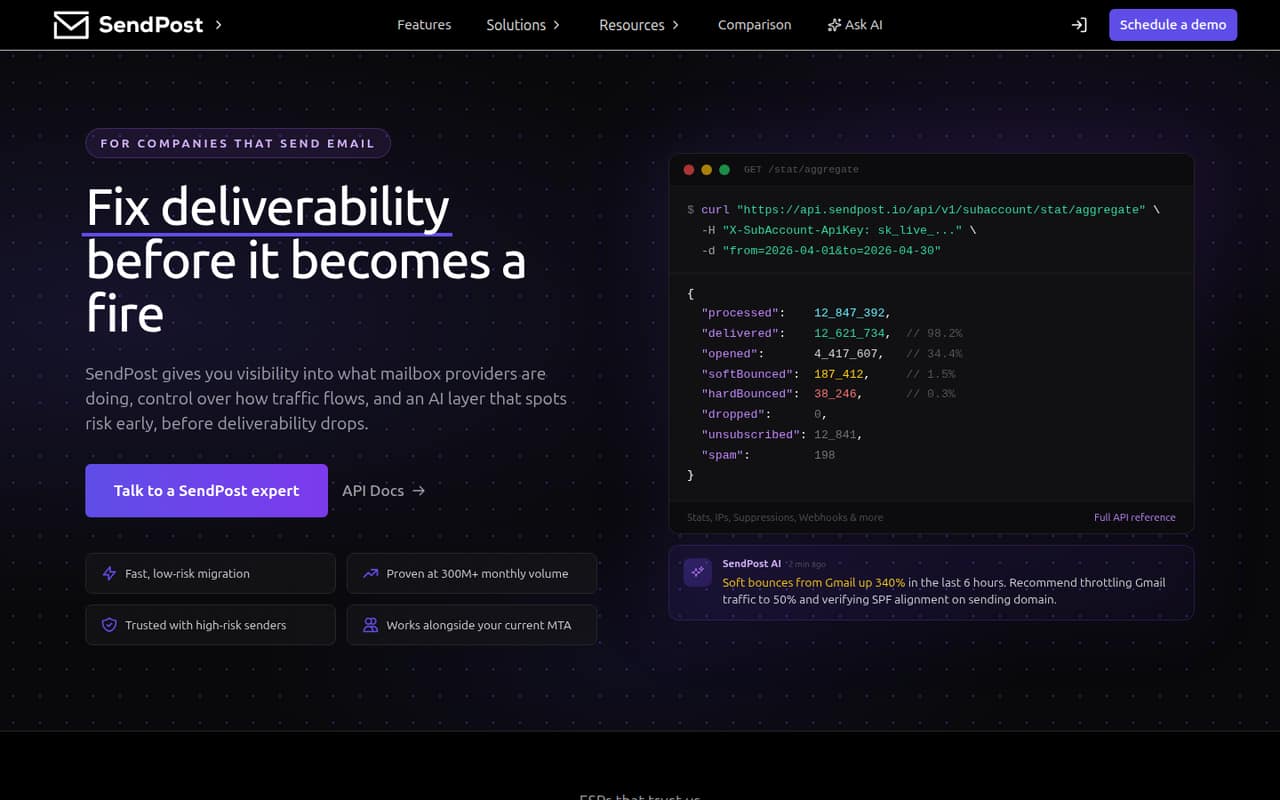
The homepage shows an HTTP API endpoint, GET /api/v1/subaccount/stat/aggregate, queried with date parameters and an X-SubAccount-ApiKey header. Its example returns JSON statistics for processed, delivered, opened, bounced, dropped, unsubscribed, and spam messages. SendPost also offers an SMTP relay, webhooks for opens, clicks, bounces, and complaints, and event logs with traceability.
The vendor says SDKs are available in six languages, but does not name them on the homepage. Check the API docs to confirm support for your language and SDK maintenance status before choosing an integration. The homepage links to API documentation and a full API reference; it does not list a CLI or plugins. The platform also advertises Slack and email alerts, plus Slack-command workflows. Its controls for subaccounts and groups are useful when an ESP needs to separate traffic and reporting across customers. Confirm authentication, webhook retry behavior, and event retention in the docs before relying on them in production.
03SendPost pricing for developers
The pricing information checked on 2026-11-06 lists three monthly USD tiers: Starter costs $7 for 10,000 emails, Growth costs $197 for 600,000 emails, and Scale costs $997 for 3,000,000 emails. There is no free plan, and no free trial is listed. Annual prices are not published.
Each tier includes a monthly email allowance, with overage email costs applying beyond it. The per-email overage rate is not published, so the cost of a traffic spike cannot be calculated from the tier prices alone. Ask SendPost for the overage rate and how usage is counted before routing production traffic. The pricing information also says current self-serve pricing is available on request after scheduling a demo, despite recording public monthly tier prices. Treat the listed amounts as a starting point and confirm the quote, billing terms, and included features directly. Seat charges and add-on prices are not listed.
04SendPost: open source, self-hosting and lock-in
SendPost is presented as a cloud service integrated through its API and SMTP relay. The vendor does not publish a source licence or a self-hosting option, so teams should not plan on running SendPost in their own infrastructure without written confirmation. Data export options are not published either; ask how to retrieve message events, reputation history, and incident records if you leave.
The sending interface is based on standard integration surfaces—HTTP API, SMTP, and webhooks—but its deliverability controls, analytics, and workflows are part of SendPost. Replacing the sending path may be simpler than reproducing those operational features. Before adopting it, confirm whether you can export event and suppression data in a usable format, how long that data remains available, and what happens to IP arrangements when an account closes. The vendor says SendPost can work alongside an existing MTA, which may help teams stage a migration rather than switch all traffic at once.
05SendPost in production
SendPost advertises support for high-volume operations and says it works alongside an existing MTA. Its homepage cites SendX processing more than 300 million emails per month, but those are vendor-published claims, not a service-level commitment. The vendor does not publish API rate limits or reliability targets on the homepage, and the listed plan allowances do not explain burst handling. Ask about throughput caps, queue behavior, incident response, and SLA terms before moving critical mail.
Security and compliance details also need verification. The homepage shows an API key header but does not describe key rotation, access controls, encryption, data residency, or compliance certifications. Confirm these with the vendor, along with webhook delivery guarantees and event retention. For capacity planning, get the overage rate and expected behavior when a plan's monthly email allowance is reached. Use staged traffic routing and monitor ISP responses, bounces, and reputation signals as you increase volume.
Questions people ask
What is SendPost?
SendPost is a hosted cloud MTA and email delivery platform for ESPs and other high-volume senders. It combines an Email API and SMTP relay with deliverability analytics, traffic controls, webhooks, and automation for tasks such as IP warmup and retries.
Does SendPost provide an API and SMTP relay?
Yes. SendPost offers an Email API and SMTP relay, plus webhooks for opens, clicks, bounces, and complaints. The homepage links to API documentation and shows an HTTP endpoint that returns JSON statistics. Check the docs for implementation details and language-specific SDK support.
Which programming languages does SendPost support?
SendPost says it has SDKs in six languages, but the homepage does not name them. Check its API docs or ask the vendor to confirm that a maintained SDK is available for your language. The homepage also describes API, SMTP, and webhook integrations.
How much does SendPost cost?
The listed monthly tiers are Starter at $7 for 10,000 emails, Growth at $197 for 600,000, and Scale at $997 for 3,000,000. Overage rates are not published, and the pricing information says current self-serve pricing is available on request after scheduling a demo.
Can I self-host SendPost?
SendPost is presented as a cloud service, and the vendor does not publish a self-hosting option. If running the sending platform in your own infrastructure is a requirement, ask SendPost directly before adopting it. Its documented integration surfaces are an Email API, SMTP relay, and webhooks.