
We may earn a commission if you buy through links on this page. It never changes a score or a ranking. How we make money
The bottom line
Good code-focused AppSec with useful rules; plan for coverage gaps and finding triage.
Semgrep combines SAST, dependency security, secrets scanning and AI-assisted triage in an AppSec platform with dashboard and API surfaces. Its rules and free tier make it worth evaluating for teams that want code-focused scanning and can own the findings queue.
It is not a substitute for every security tool: Reddit commenters report gaps in DAST and concerns about SCA breadth and AI-code findings. Confirm integrations, coverage and paid add-ons against your stack before standardizing.
Good fit if
- Teams that write custom security rules
- Small teams starting AppSec scanning
- Organizations scanning AI-generated code
Skip it if
- Teams requiring DAST in one platform
- Teams seeking one tool for all AppSec
- Teams without finding triage ownership
ScoresHow it rates
What works
- Combines SAST, dependency security and secrets scanning
- Custom rules are a strong reason to evaluate it
- Free Edition covers up to 10 contributors
- AI credits are included across listed plans
- Remediation guidance is available in pull requests and IDEs
What doesn't
- No DAST capability is listed in the product scope
- AI-credit overages and API rate limits are not published
- Paid add-ons can increase per-contributor costs
- Licence and self-hosting terms need confirmation
- Community rules can be noisy on AI-generated code, per Reddit users
01What Semgrep is, technically
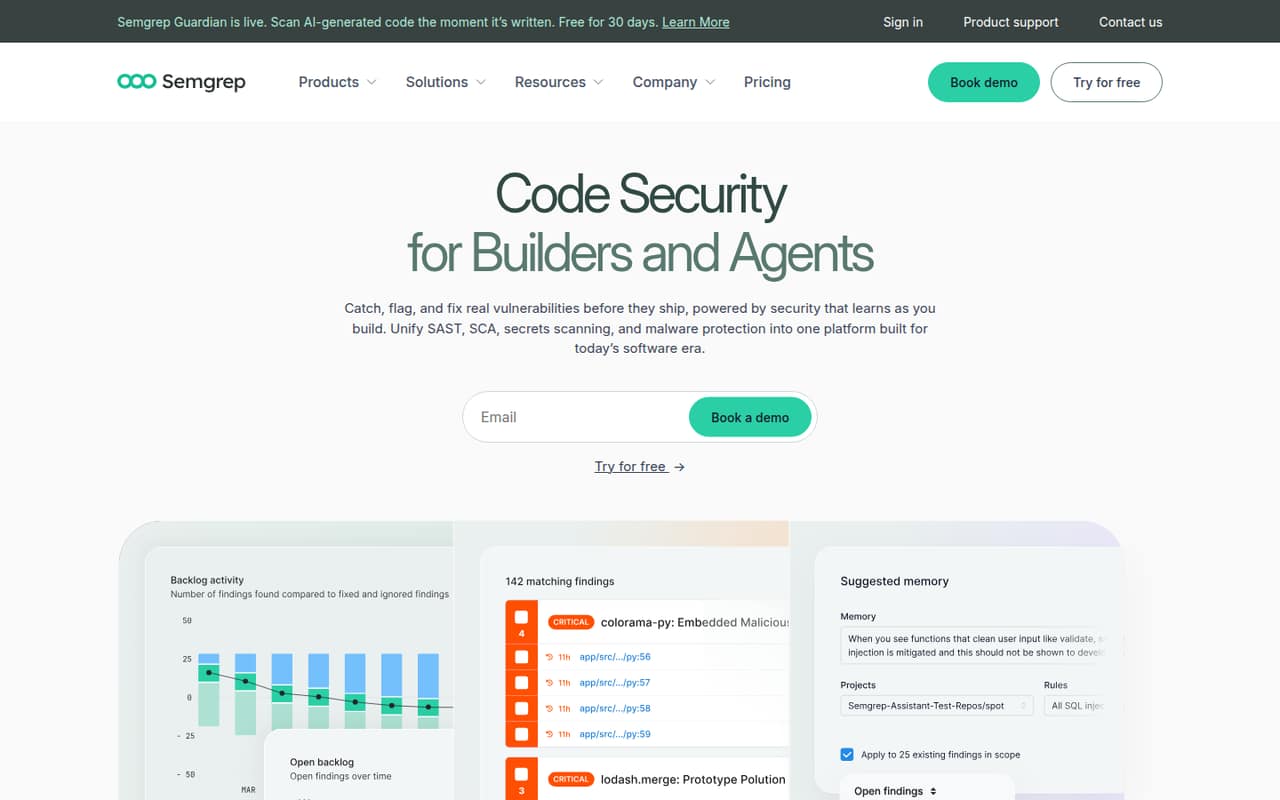
Semgrep is an application security platform for scanning code and its dependencies, with a dashboard and an API surface. It combines static application security testing (SAST), supply-chain security, secrets scanning and AI-assisted analysis. The product also offers Semgrep Guardian for scanning AI-generated code, and Semgrep Workflows for building security pipelines that combine static analysis with AI.
In a software stack, Semgrep sits in the code-security stage: it finds issues, helps prioritize findings and can provide fixes or upgrade guidance in pull requests and IDEs. Its rule registry includes rules written by Semgrep and the community, and its Playground lets users write and share rules. The vendor also names a Community Edition, but the homepage does not establish how its deployment model or licence differs from the paid platform. Semgrep's listed scope is code and supply-chain security; teams needing dynamic testing should plan to evaluate a separate tool.
02Semgrep API, SDKs and docs
Semgrep exposes an API: the vendor says teams can view malware findings on the dashboard or via API. The homepage also points to pull requests and IDEs for remediation, and provides a Registry and an online Playground for finding and writing rules. It links to product documentation and a Community Slack for questions.
The homepage does not name SDKs, programming languages, a CLI, or a specific API protocol. Confirm supported SDKs and languages in Semgrep's docs before designing an integration; also verify whether your required workflow is supported through the API, a pull request or an IDE. The product describes Semgrep Workflows as a way to build and deploy security pipelines combining static analysis with AI, but the homepage does not identify the pipeline interface or its configuration format. Treat those details as an integration check, not an assumption. The published product scope covers rule-based scanning, AI reasoning, triage and remediation, rather than a stated general-purpose developer API.
03Semgrep pricing for developers
Free Edition costs $0 per month and includes up to 10 contributors, 10 repositories, 60 AI credits, and Code and Supply Chain. That is a useful entry point, but its contributor and repository caps matter as a team grows. Teams starts at $30 per contributor per month, includes 20 AI credits per developer per month, supports up to 500 private repositories, and lists OIDC and SAML SSO. Enterprise has custom pricing, 50 AI credits per developer per month and unlimited repositories.
The pricing page also lists Code at $30, Supply Chain at $30 and Secrets at $15 per contributor per month as add-ons. Confirm which products are included in your specific quote before adding these to the plan price. Billing is per contributor, so headcount drives the published plan cost; AI credits have plan-level allowances, but the cost of extra credits is not published. Annual prices are not published. Semgrep Guardian has a 30-day free trial; that is separate from the Free Edition.
04Semgrep: open source, self-hosting and lock-in
Semgrep names a Community Edition and provides a Registry of rules written by Semgrep and the community. Those offerings show a community component, but they do not establish the licence for the paid platform or which parts of the product are open source. The vendor doesn't publish licence, self-hosting or data-export terms on its homepage; confirm them with Semgrep before adopting it for regulated or restricted code.
The Registry and Playground may make rule authoring more portable than a workflow built entirely around proprietary detections, but migration effort will still depend on how much you rely on Semgrep-specific rules, triage decisions and platform integrations. Before rollout, test whether findings and rule configurations can be exported in the formats your existing tools accept. Also ask whether scanning can run in your environment or requires a vendor-managed service.
05Semgrep in production
The published plan limits are clearest around contributors, repositories and AI credits. The vendor doesn't publish API rate limits or uptime targets on its homepage, so confirm both, along with data handling, security controls and support commitments, before putting Semgrep in a release gate. Teams should also test how rule changes affect findings and who owns remediation as the backlog grows.
Reddit commenters report that Semgrep is quick to stand up and that custom rules are a strength. Other commenters describe community-rule noise on AI-generated code, shallow SCA coverage and the need for separate tools when DAST is required. These are user reports, not a guarantee of behavior in your codebase. In another thread, a developer says Semgrep and other static-analysis tools missed a database race condition that caused duplicate charges. Use Semgrep to find code patterns and dependency risks, not as a replacement for runtime testing, review or incident controls.
From the threadsWhat users say
Reddit sentiment is mixed but leans positive on setup speed and custom rules. The main cautions are coverage breadth, AI-code noise and the operational burden of triaging findings.
the custom rules are the actual reason to run it
the community ruleset is noisy on AI code and the SCA is shallow
Semgrep is fast to stand up
after 2-3 months, the issue will be who triages and fixes the findings not which scanner generated them
Questions people ask
What does Semgrep scan?
Semgrep combines static analysis for code vulnerabilities with dependency security, secrets scanning and malware protection. The vendor also describes Semgrep Guardian for scanning AI-generated code, plus AI-assisted detection, triage and remediation. Check the current product and plan details to confirm which capabilities are included in your deployment.
Does Semgrep have a free plan?
Yes. Free Edition costs $0 per month and includes up to 10 contributors, 10 repositories, 60 AI credits, and Code and Supply Chain. It has contributor and repository caps, so teams should check the paid plan before expanding beyond those limits.
Does Semgrep provide DAST?
DAST is not among the capabilities listed on Semgrep's homepage, which focuses on SAST, supply-chain security, secrets scanning and AI-assisted code analysis. Reddit users also report using separate tools for dynamic testing. If DAST is a requirement, confirm Semgrep's current scope with the vendor and budget for a separate solution.
Can we use Semgrep with our languages and CI?
Semgrep provides documentation, a dashboard, an API, a rule Registry, and a Playground for writing and sharing rules. The homepage does not name supported SDKs, programming languages or CI integrations. Check the vendor's docs for language and integration support, and validate the specific pipeline you plan to use.
Can Semgrep be self-hosted?
The vendor names a Community Edition, but its homepage does not establish the edition's licence or self-hosting options. It also does not publish data-export terms there. Ask Semgrep for the current deployment, licence and export details if self-hosting or portability is a requirement.
Sources
- Semgrep homepage
- Semgrep pricing page
- Reddit: Checkmarx vs Semgrep for a team that is mostly shipping AI written code now
- Reddit: ested SonarQube, Semgrep, and Checkmarx on our payment service. none caught the database race condition that caused duplicate charges.
- Reddit: What appsec tool are you using for generated code ?
- Reddit: Semgrep vs Snyk for Jenkins CI Integration