
We may earn a commission if you buy through links on this page. It never changes a score or a ranking. How we make money
The bottom line
A simple hosted Google SERP API with clear tier prices, but production limits need confirmation.
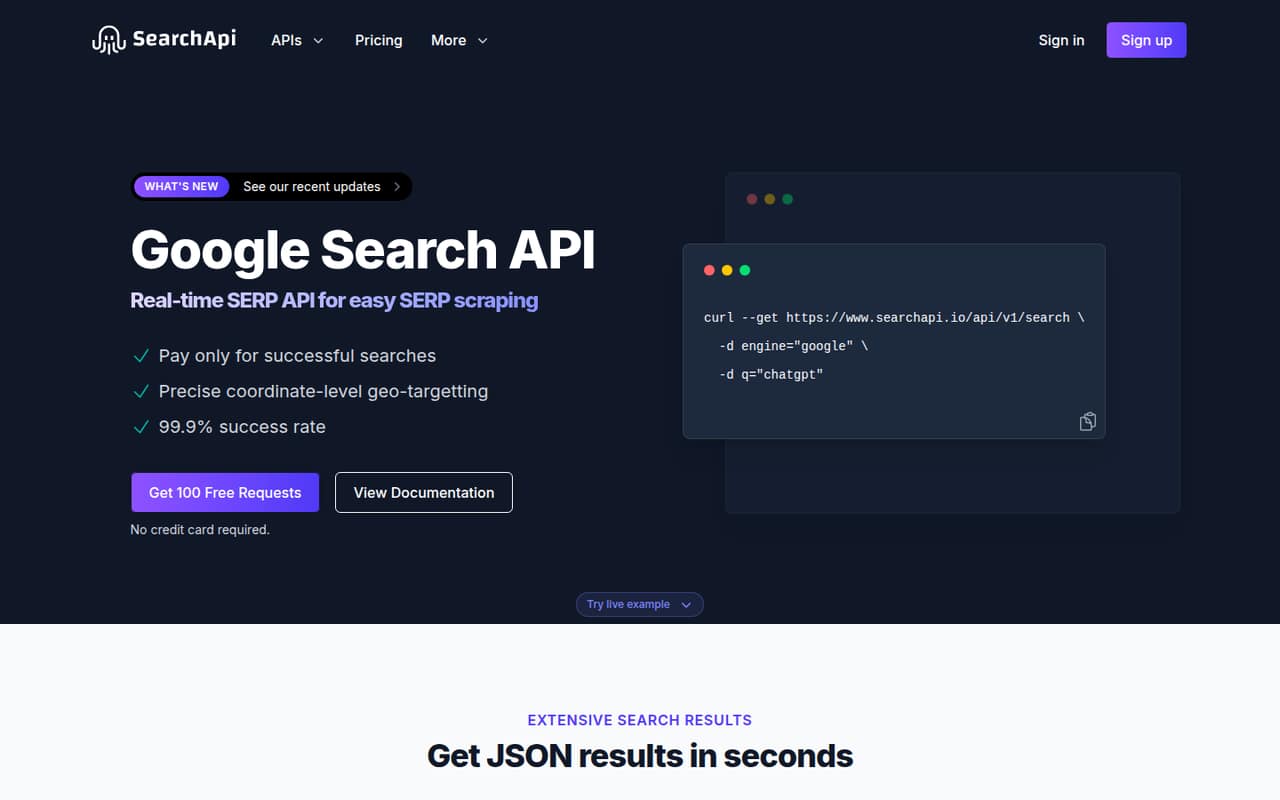
SearchApi is a hosted API that returns real-time Google search results as JSON. Its curl example shows a GET request with query parameters, and the homepage offers 100 free requests.
Monthly plans start at $40 for 10,000 searches. The homepage advertises 99.9% success and billing only for successful searches, but teams should confirm rate limits, overage terms and language-specific SDK support before relying on it.
Good fit if
- Apps that need Google SERP JSON
- Teams preferring a hosted API
- Prototypes using free requests
Skip it if
- Teams requiring self-hosted search
- Projects needing published rate limits
- Buyers requiring named language SDKs
ScoresHow it rates
What works
- Returns parsed search results as JSON
- Homepage offers 100 free requests
- Bills only for successful searches, per homepage
- Supports coordinate-level geo-targeting
- Lists monthly plans from $40
What doesn't
- Homepage example covers Google search
- Language-specific SDKs are not named
- Rate limits are not published
- Overage pricing is not published
- No self-hosted option is listed
01What SearchApi is, technically
SearchApi is a hosted API service for retrieving real-time search engine results. It sits between an application and Google Search: your code sends a query to SearchApi, and the service returns parsed results as JSON. The homepage presents it as a Google Search API and shows a request to https://www.searchapi.io/api/v1/search with engine="google" and a query parameter.
That makes it an external data dependency, not a search library, CLI, or server you run in your own environment. The returned JSON example includes search metadata, parameters, organic results and other parsed result fields. The homepage also advertises coordinate-level geo-targeting and billing only for successful searches. A service like this can feed search features, monitoring jobs or data collection pipelines, but the published material does not establish which other search engines are supported. Confirm engine coverage, query controls and response fields in the vendor’s documentation before designing around them.
02SearchApi API, SDKs and docs
The integration surface shown on the homepage is an HTTP API. Its example uses curl --get against /api/v1/search, passing engine and q as request parameters. SearchApi returns JSON; the example response includes metadata such as request status, timing, requested URL and JSON URL, alongside parsed search results. The homepage links to documentation and offers a live example.
The homepage does not name language-specific SDKs, a CLI, webhooks or plugins. If your stack depends on a maintained client library, confirm SDK support in the vendor’s docs before adopting it; otherwise, plan to call the HTTP endpoint from your own client. The example is enough to show the basic request shape, but it does not establish authentication details, error handling conventions or available query parameters. Confirm those in the documentation, along with response schemas and versioning, before making the API part of a production codebase.
03SearchApi pricing for developers
The homepage offers 100 free requests with no credit card required. The pricing page lists the Developer Plan at $40 per month for 10,000 searches, or $4 per 1,000. Production Plan is $100 for 35,000 searches at $3 per 1,000; BigData Plan is $250 for 100,000 at $2.50 per 1,000; Scale Plan is $500 for 250,000 at $2 per 1,000.
Higher-volume options are Octo 500K at $900 per month, Octo 1M at $1,500, Octo 2M at $2,800 and Octo 5M at $5,000. Their listed rates range from $1.80 to $1 per 1,000 searches. A Custom plan has pricing available on request. The page lists monthly prices and does not show annual billing prices. It also does not publish overage rates or explain whether unused searches roll over, so ask about those terms before setting a production budget. No add-ons are listed.
04SearchApi: open source, self-hosting and lock-in
SearchApi is presented as a hosted API, not a self-hosted server or an open-source package. The homepage’s sample response includes a license field for the returned Google knowledge-graph entity; that is not evidence of a SearchApi software license. SearchApi’s own open-source license and source availability are not published on the vendor's site, so ask the vendor directly if either affects procurement.
Because requests go to a hosted endpoint, your integration depends on SearchApi’s API and availability. The example response provides JSON, which gives your application a structured format to process, but the vendor’s data-export options and migration tooling are not published. Moving away would mean replacing the request path and adapting your application to another provider’s response schema. Keep provider-specific parsing behind an internal interface, and confirm data retention, export and termination terms before storing or depending on returned data.
05SearchApi in production
The homepage advertises a 99.9% success rate, and several paid tiers list a 99.9% SLA. It also says customers pay only for successful searches. These claims do not answer every operational question: the vendor does not publish rate limits, per-plan request throughput figures beyond named throughput tiers, overage rates or detailed SLA terms in the published information. Confirm these before choosing a plan or setting retry behavior.
The higher tiers list Medium Throughput, High Throughput or Dedicated Throughput; Octo plans also list Priority Support and Search Analytics. The security, data-retention and compliance details a production review needs are not published here, so request them from the vendor. One Reddit post calls its subject “annoying memetic based content,” but provides no operational detail or account of API reliability. Treat that as a weak negative sentiment signal, not evidence about production performance.
From the threadsWhat users say
The visible Reddit signal is negative, but the post offers no details about API use or reliability. Treat user sentiment as uncertain rather than as evidence of production quality.
annoying memetic based content
Questions people ask
What does SearchApi return?
SearchApi returns parsed search results as JSON. The homepage’s sample response includes search metadata, query parameters, search information, a knowledge graph and organic results. Check the vendor’s documentation for response schemas and available result fields before coupling application code to a particular structure.
Which search engines does SearchApi support?
The homepage presents a Google Search API and its curl example sets engine="google". It does not establish which other engines are supported. Confirm engine coverage and any engine-specific query parameters in the vendor’s documentation before selecting SearchApi for a multi-engine workflow.
Does SearchApi offer free requests?
Yes. The homepage offers 100 free requests with no credit card required. It does not establish whether those requests renew, expire or carry over, so check the account terms and pricing page before treating the free allocation as a recurring monthly allowance.
How does SearchApi bill unsuccessful searches?
The homepage says customers pay only for successful searches and advertises a 99.9% success rate. The pricing details do not explain how unsuccessful requests are defined or handled in billing. Confirm the billing rules, retry behavior and any request-status distinctions with SearchApi before estimating production usage.
Does SearchApi publish API rate limits?
The listed plans name throughput features such as Medium Throughput, High Throughput and Dedicated Throughput, but the product details do not give numeric rate limits. Ask the vendor for per-plan request limits, concurrency guidance and what happens when a client exceeds its allowance.