
We may earn a commission if you buy through links on this page. It never changes a score or a ranking. How we make money
The bottom line
A convenient hosted scraping stack, but verify credit economics and production limits before committing.
ScrapingAnt is a hosted web scraping API with isolated Chrome rendering, rotating proxies, parallel requests and AI extraction. You can call it over HTTPS with curl, Python requests or Node fetch, or connect an MCP server to supported editors.
The free tier includes 10,000 monthly credits, but lists one concurrent request. Paid plans start at $19/month; credit overages and conversion costs are not published. ScrapingAnt suits teams that want managed scraping infrastructure, but its hosted model and unpublished export and migration details merit a closer look.
Good fit if
- Teams scraping JavaScript-heavy pages
- AI agents needing live web content
- Builders who prefer managed infrastructure
Skip it if
- Teams requiring self-hosted scraping
- Projects needing predictable per-page costs
- Buyers requiring published export guarantees
ScoresHow it rates
What works
- Hosted API combines Chrome rendering and proxies
- Examples cover curl, Python requests and Node fetch
- AI extraction returns structured JSON
- MCP tools support Claude Code, Cursor and Windsurf
- Paid plans list unlimited concurrency
What doesn't
- Credit costs per request are not published
- Overage and seat costs are not published
- Free plan lists one concurrent request
- Self-hosting and an open-source license are not listed
- Export, retention and migration details need confirmation
01What ScrapingAnt is, technically
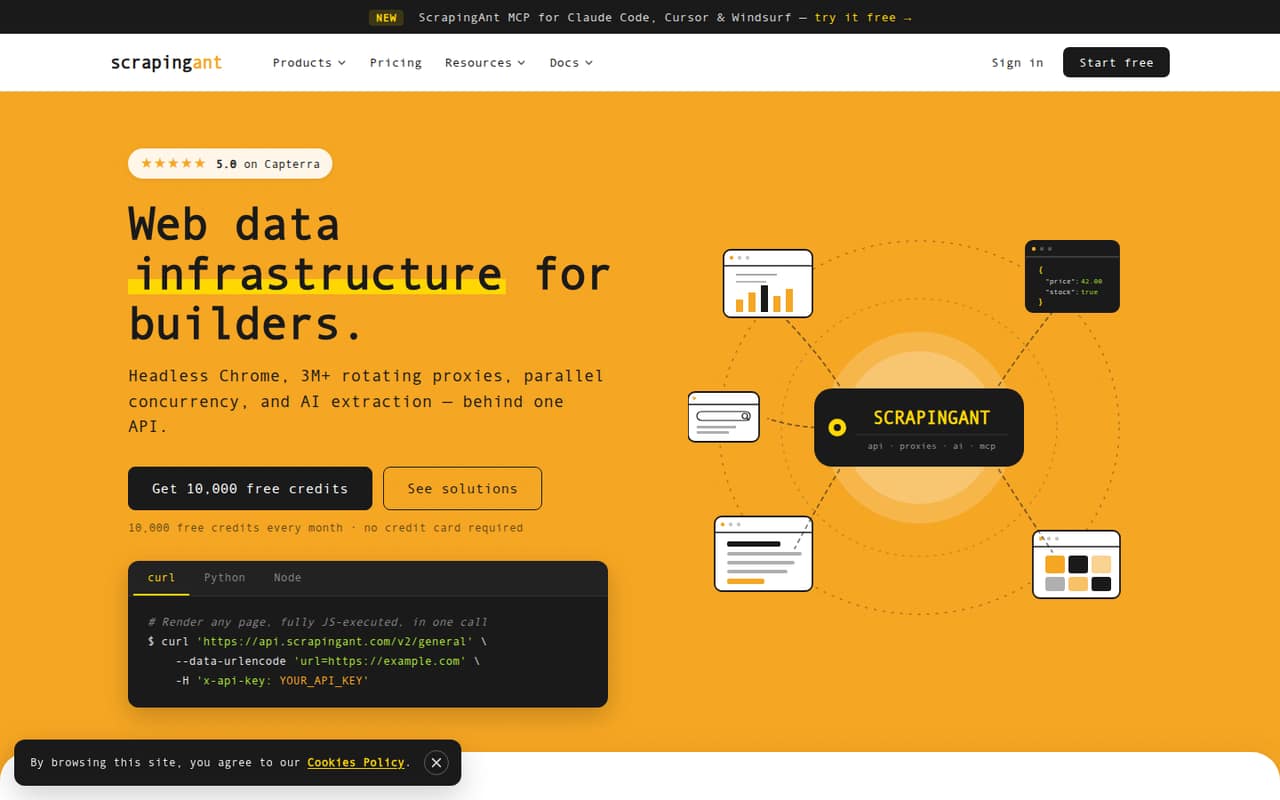
ScrapingAnt is a hosted web scraping API, not a scraping library or self-hosted server. An application sends a URL and options to its API; ScrapingAnt manages browser rendering, proxy selection and request execution, then returns page content or extracted data. The homepage shows the /v2/general endpoint, an x-api-key header and URL parameters.
It is aimed at builders who need to collect content from JavaScript-heavy sites without operating their own browser fleet. Requests run in fresh, isolated Chrome instances, according to the homepage, with options including custom JavaScript snippets, wait-for-selector, cookies and headers. The service also offers rotating residential and datacenter proxies, Markdown output and natural-language extraction to JSON. Proxy bandwidth is billed separately from API credits. In a stack, ScrapingAnt sits between your application or agent and the target website; your code still needs to handle returned data, retries and downstream storage.
02ScrapingAnt API, SDKs and docs
The primary integration is an HTTPS API. The homepage demonstrates GET requests to /v2/general with a target URL and an x-api-key header, using curl, Python's requests package and Node's built-in fetch. It also advertises HTML, Markdown and JSON outputs, AI extraction from plain-language instructions, and browser options such as js_snippet and wait-for-selector.
The homepage shows language examples rather than naming maintained SDK packages. If you need a packaged SDK, confirm its language support and maintenance status in ScrapingAnt's docs. The MCP server exposes HTML, Markdown and text tools and has an HTTP connection command for Claude Code; the vendor also lists Cursor, Windsurf and other MCP-aware editors. This is an integration surface, not a general-purpose scraping CLI. Before building a production client, check the API docs for request schemas, errors, retry guidance and rate limits; the homepage advertises parallel requests but does not give a numeric rate limit.
03ScrapingAnt pricing for developers
The free plan costs $0/month and lists 10,000 API credits monthly, one concurrent request and no credit card requirement. The homepage also promotes 10,000 free monthly credits. The listed paid plans are Enthusiast at $19/month for 100,000 credits, Startup at $49 for 500,000, Business at $249 for 3 million and Business Pro at $599 for 8 million. Custom starts at $699/month for 10 million or more credits. Paid plans list unlimited concurrency.
The pricing page does not publish annual-billing prices, overage costs or seat costs. It also does not publish how many credits a given target page or rendering option consumes, so estimate a workload only after confirming credit use with the vendor. Credits do not roll over, and plans can be restarted mid-month. Residential proxies are a separate bandwidth purchase: 5 GB for $30/month, 10 GB for $55, 25 GB for $130 or 50 GB for $245. Datacenter proxy and custom scraper prices are not published. Check the free-tier concurrency detail with the vendor: its pricing lists one concurrent request, while the homepage advertises no concurrency cap on any plan.
04ScrapingAnt: open source, self-hosting and lock-in
ScrapingAnt presents itself as a hosted service. Its homepage does not offer a self-hosting deployment or publish an open-source license; buyers who need either should ask the vendor directly. The API and MCP server are accessed through ScrapingAnt's hosted endpoints, so using the service means depending on its infrastructure for browser execution and proxy access.
The homepage describes returned HTML, Markdown, text and structured JSON, but does not publish a data-export or retention policy. Confirm what request and result data the service stores, how to retrieve it, and how long it remains available before sending sensitive URLs or content. Migration at the application layer should be manageable if your code uses standard HTTP requests and stores results in your own systems. Proxy configuration, AI extraction prompts and browser-specific options may require adaptation to another provider. Ask for an export path and a clear account-termination process.
05ScrapingAnt in production
ScrapingAnt says requests run in fresh, isolated Chrome instances and advertises horizontal scaling, proxy and geographic targeting, and parallel requests. The homepage says there is no concurrency cap, but the free plan listing says one concurrent request; verify which limit applies before designing a queue or throughput target. It does not publish a numeric API rate limit or service-level commitment on the homepage, so ask about rate limits, availability, retries and incident support for production workloads.
Keep the API key out of client-side code and confirm the vendor's data-retention, security and compliance terms before sending sensitive information. Model cost using measured credit consumption and separate proxy bandwidth; the vendor does not publish overage pricing. A Reddit thread about ScrapingAnt and Puppeteer Cluster includes a commenter describing parallel Chromium instances as a way to reduce scraping time, while another asks for point-and-click help. That discussion offers limited evidence about production reliability or support quality.
From the threadsWhat users say
Reddit feedback is sparse and not enough to establish product reliability or support quality. The discussion includes interest in parallel scraping and a request for more guided, point-and-click help.
Basically it will help you to save time while scraping some site
New to Webscraping, can you EiLI5 why this is useful/different?
Thank you that’s awesome
Was hoping for a point and click. Could you hello me with A site
Questions people ask
Does ScrapingAnt have a free plan?
Yes. The free plan is listed at $0/month and includes 10,000 API credits monthly, one concurrent request and no credit card requirement. Credits do not roll over. The homepage promotes the same monthly credit allowance, but advertises no concurrency cap on any plan, so confirm the free-tier concurrency limit before relying on it.
How much does ScrapingAnt cost?
Paid plans start with Enthusiast at $19/month for 100,000 credits. Startup is $49 for 500,000, Business is $249 for 3 million, Business Pro is $599 for 8 million, and Custom is listed at $699/month for 10 million or more. Credit overages, seats and annual prices are not published.
Which languages can I use with the ScrapingAnt API?
The homepage gives examples using curl, Python with the requests package, and Node.js with fetch. Requests use the /v2/general endpoint and an x-api-key header. If you need a maintained SDK rather than direct HTTP calls, confirm package availability and support status in ScrapingAnt's documentation.
Does ScrapingAnt render JavaScript-heavy pages?
Yes. ScrapingAnt says each request runs in a fresh, isolated Chrome instance and supports JavaScript rendering. The homepage lists options including custom js_snippet, wait-for-selector, cookies and headers. It also offers Markdown output and AI extraction to structured JSON. Check the API docs for the request options and limits relevant to your target sites.
Can I self-host ScrapingAnt or export my data?
ScrapingAnt is presented as a hosted API and MCP service; its homepage does not offer a self-hosted deployment or publish an open-source license. It does not publish a data-export or retention policy there. Ask the vendor about data retrieval, retention and account termination before committing results or sensitive content to the service.