
We may earn a commission if you buy through links on this page. It never changes a score or a ranking. How we make money
The bottom line
Useful hosted scraping APIs, but confirm integration support and per-target credit costs first.
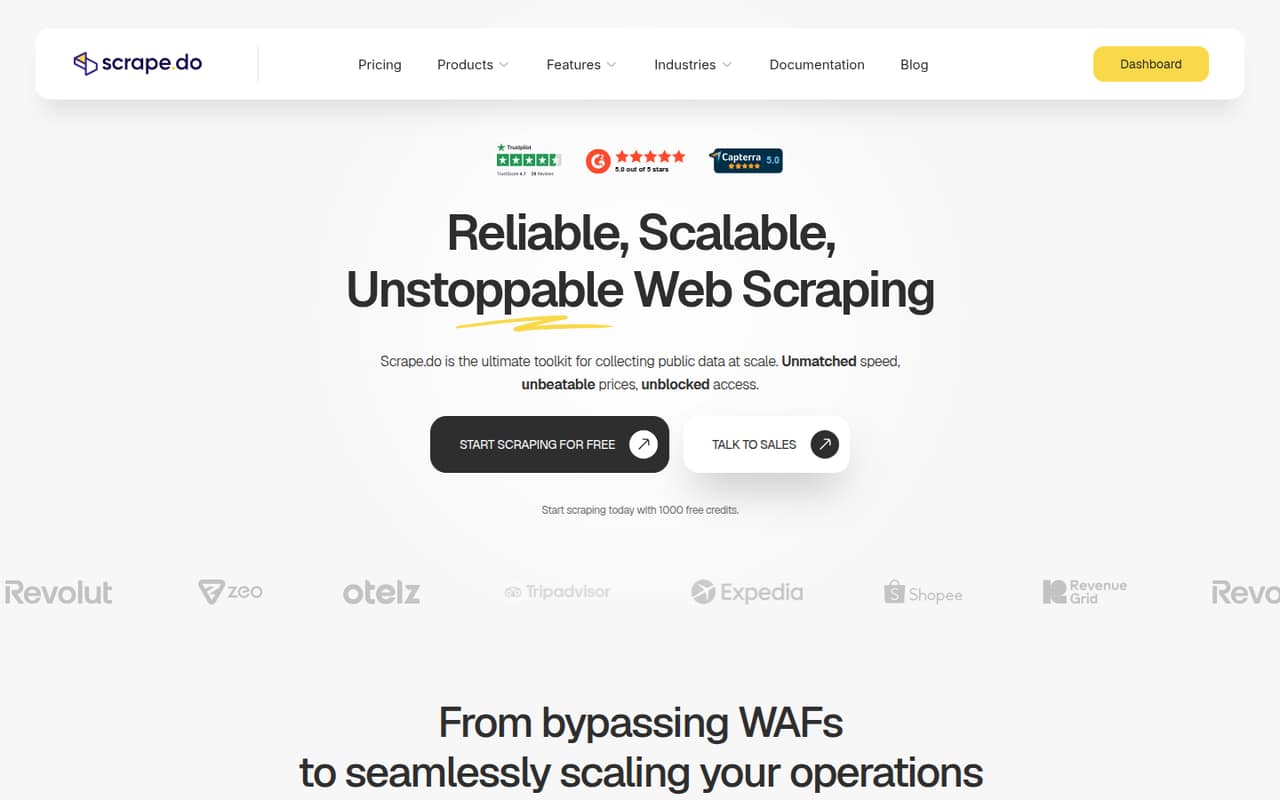
Scrape.do is a hosted web scraping API: send a request and it handles proxy rotation, CAPTCHA challenges and JavaScript rendering. Its Ready Scraper APIs return parsed JSON, while monthly plans meter successful API credits and limit concurrent requests.
The free plan includes 1,000 successful credits and five concurrent requests; paid plans start at $29 per month. Reddit feedback is mixed: one user called it a favorite but said it was more annoying to use than a competitor.
Good fit if
- Teams scraping public websites
- Workflows that need parsed JSON
- Projects needing proxy geo-targeting
Skip it if
- Teams requiring self-hosted infrastructure
- Workflows tied to a specific SDK
- Scraping with fixed monthly costs
ScoresHow it rates
What works
- One-request scraping API handles proxies and headers
- JavaScript rendering and CAPTCHA handling included
- Ready APIs return parsed JSON
- Free plan includes all Scrape.do features
- Geo-targeting covers 160+ countries
What doesn't
- Paid plans cap concurrent requests
- Extra-credit pricing is not published
- SDK and language support needs verification
- Self-hosting and data export details are unpublished
- One Reddit user found it more annoying to use
01What Scrape.do is, technically
Scrape.do is a hosted web scraping API, not a scraping library or self-hosted server. Your application sends requests to its API; Scrape.do handles proxy rotation, headers, CAPTCHA and WAF challenges, and JavaScript rendering. The response is scraped page data, so the service sits between your code and the target website.
The product has two API paths. The general Web Scraping API retrieves data from a site with one request. Ready Scraper APIs are pre-built endpoints for supported sites and return parsed JSON, avoiding HTML selectors in your application. The homepage also lists localization, pagination and filters for Ready APIs.
That setup can reduce the browser and proxy infrastructure your team operates, but it makes the scraping path depend on a hosted service. Geo-targeting is listed for 160+ countries. The vendor describes the data as public web data; teams should check target-site terms and their own compliance requirements before collecting it.
02Scrape.do API, SDKs and docs
The integration surface is an HTTP API: Scrape.do says the Web Scraping API retrieves data with one request, and a Ready Scraper API uses one HTTP call to return parsed JSON. The homepage lists Documentation and a Dashboard. It does not prescribe an application architecture, so a team can keep the vendor call behind its own scraper interface and normalize returned data in its existing pipeline.
The homepage names no particular programming language, language-specific SDK, CLI, webhook, or plugin. Before choosing a stack, check the vendor's documentation for SDK support in your language and for authentication, request parameters, response formats, retries, and error handling. The homepage lists JavaScript rendering and interactions, automatic proxy rotation, CAPTCHA handling, header and user-agent rotation, and geo-targeting as features.
Ready APIs reduce selector work for supported targets, but the team still needs to map returned JSON into its own schema and handle failures. Keep the integration surface narrow so you can change providers or switch endpoint types without spreading Scrape.do-specific response handling through the codebase.
03Scrape.do pricing for developers
Scrape.do has a free plan at $0 per month with 1,000 successful API credits, five concurrent requests, and all Scrape.do features. The Hobby plan costs $29 per month for 250,000 credits and 10 concurrent requests; its listed rate is $0.11 per 1,000 credits. Pro is $99 per month for 1,250,000 credits and 50 concurrent requests, with a listed rate of $0.08 per 1,000.
Business costs $249 per month for 3,500,000 credits and 100 concurrent requests; Advanced costs $699 for 10,000,000 credits and 200 concurrent requests. The pricing page lists per-1,000-credit rates of $0.07 for Business and $0.06 for Advanced. Business adds premium residential and mobile proxies, dedicated support, and team management. Advanced adds custom WAF bypass strategies, a custom SLA, and a dedicated Slack channel. Enterprise pricing is custom, with unlimited successful credits and concurrent requests listed.
Paid plans are listed as monthly billed; annual pricing is not published. Extra-credit pricing is also not published, so ask how overages work before relying on a plan's monthly allowance. Budget against successful credits and concurrency, not just the headline subscription price.
04Scrape.do: open source, self-hosting and lock-in
Scrape.do's scraping APIs are presented as hosted services. The homepage separately lists Scrapeman as free and open source; it does not identify that tool as the API itself. The vendor does not publish a self-hosting option for Scrape.do's APIs, and the homepage does not name an open-source license for Scrapeman. Treat the API as a hosted dependency unless the vendor confirms otherwise.
The vendor does not publish data-export details on the homepage. Ask what request and response data it retains, how you can retrieve it, and what happens when an account closes. The practical migration path depends on how much Scrape.do-specific behavior your code adopts: keep requests behind an internal interface and store results in your own systems to make provider changes easier. Ready API JSON may require more remapping than raw-page workflows if a replacement returns a different schema.
05Scrape.do in production
Plan capacity around the concurrency cap and successful-credit allowance on your tier. The listed plans range from five concurrent requests on Free to 200 on Advanced; Enterprise lists unlimited concurrency. The homepage claims a 99.98% success rate, but teams should confirm how success is measured and whether that figure applies to their targets. Advanced includes a custom SLA; the other listed tiers do not advertise one.
One Reddit thread describes Scrape.do as operating at large scale, while a user comparing scraping services called it a second favorite but said it was more annoying to use. That is a useful warning to evaluate integration friction, not a reliability guarantee. The vendor's homepage lists CAPTCHA and WAF handling, but target sites can change their defenses; test your important sites and build retries, monitoring, and failure handling into your own pipeline.
Before production, ask about data retention, security controls, compliance commitments, and request-level rate limits. Concurrency caps are published, but a per-second rate limit is not. Confirm how credits are consumed for your endpoint and target mix.
From the threadsWhat users say
Reddit sentiment is limited and mixed. One user ranked Scrape.do among their favorites but also found it more annoying to use; a separate thread discusses the operational difficulty of scraping sites that block requests.
Scrape.do: This is my second-favorite service I've tried
It's a bit cheaper than Firecrawl, but much more annoying to use
a scraper that works fine on one site gets blocked instantly on another
Scrape.do runs a web scraping API processing 10 billion+ pages a month
Questions people ask
How much does Scrape.do cost?
The free plan costs $0 per month and includes 1,000 successful API credits. Paid plans start with Hobby at $29 per month for 250,000 credits. Pro costs $99, Business $249, and Advanced $699 per month. Enterprise pricing is custom. The vendor lists per-1,000-credit rates for paid plans, but does not publish extra-credit pricing.
Does Scrape.do have a free plan?
Yes. Free includes 1,000 successful API credits per month, five concurrent requests, all Scrape.do features, and geo-targeting in 160+ countries. It is suitable for trying the API or running a small workload, but teams should check whether its credit and concurrency limits fit their production traffic.
What does Scrape.do's API handle?
The Web Scraping API handles proxies, headers, CAPTCHA and WAF challenges, and JavaScript rendering and interactions. The service also lists automatic proxy rotation and geo-targeting. Ready Scraper APIs provide pre-built endpoints that return parsed JSON, with localization, pagination, and filters listed as built-in features.
Does Scrape.do offer SDKs or a CLI?
The homepage describes an HTTP API and one-call integrations for its scraping endpoints, and links to documentation and a dashboard. It does not name a specific language SDK or CLI. Check the vendor's documentation for support in your stack, along with authentication, request formats, response handling, and retry guidance.
Can I self-host Scrape.do or export my data?
Scrape.do presents its scraping APIs as hosted services. The homepage separately lists Scrapeman as free and open source, but does not identify it as a self-hosted version of the API. Ask the vendor about self-hosting, data retention, and export options before committing; keep returned data in systems you control.