
We may earn a commission if you buy through links on this page. It never changes a score or a ranking. How we make money
The bottom line
A focused APM service with useful agent access and plan limits worth checking before rollout.
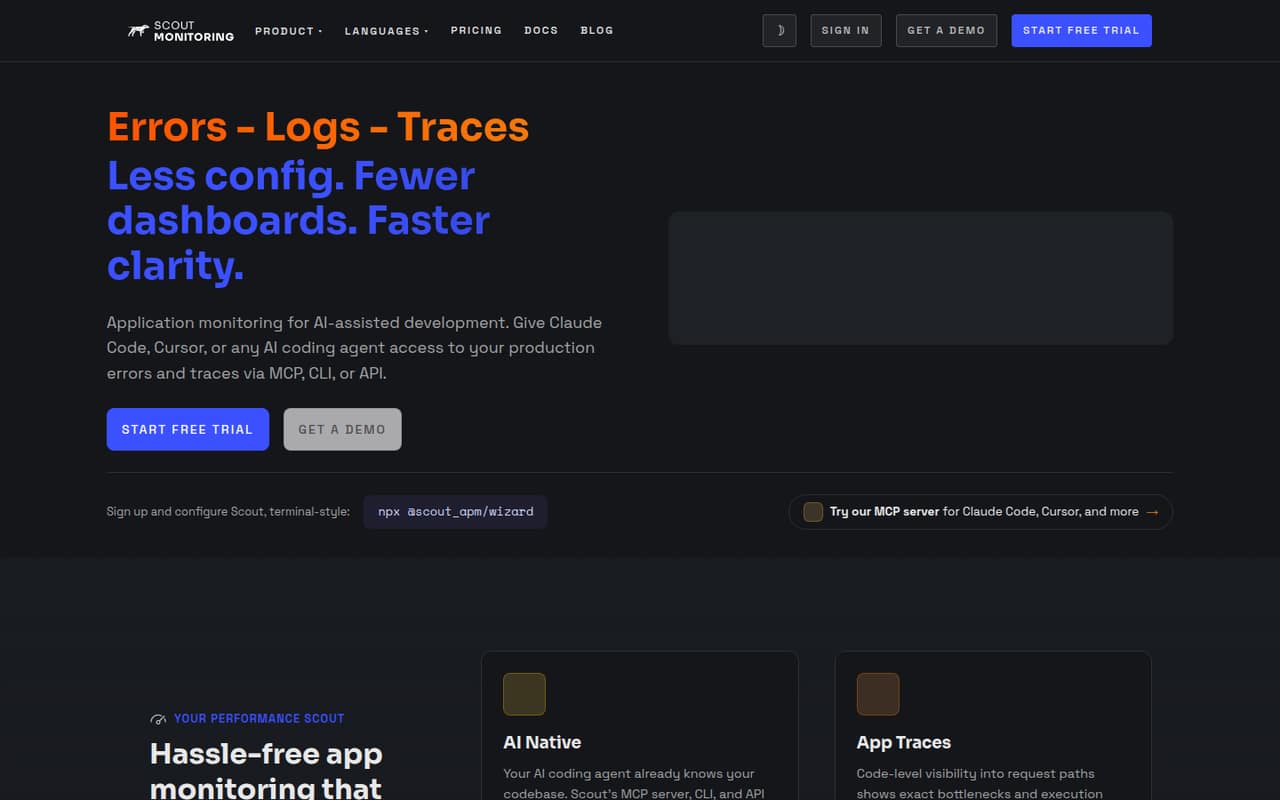
Scout APM combines application traces, logs, metrics, query analysis and error monitoring. Its MCP server, CLI and API expose production data to Claude Code, Cursor and other AI coding tools, while agents for five named languages cover common application stacks.
The setup path is direct, but plan limits vary sharply: most tiers include 1 GB of logs and 5,000 errors, while Production Ready has 30 GB of logs and 50,000 errors. Confirm your expected transaction volume, retention needs and overage terms before using Scout as your main production monitor.
Good fit if
- Teams using supported application languages
- Developers debugging with coding agents
- Small teams needing integrated APM
Skip it if
- Teams requiring self-hosted monitoring
- Stacks outside the named agents
- Workloads needing published overage terms
ScoresHow it rates
What works
- MCP, CLI and API access for coding agents
- Traces connect request paths to code-level bottlenecks
- Logs, errors and performance data share one interface
- Named agents cover Ruby, Python, PHP, Elixir and Node.js
- Free tier includes unlimited users and apps
What doesn't
- Most paid plans include only 1 GB of logs
- Most paid plans include 5,000 errors
- Only Production Ready lists 14-day log retention
- API protocol and rate limits are not published
- License, self-hosting and data export terms need confirmation
01What Scout APM is, technically
Scout APM is an application-monitoring service that pairs application agents with a monitoring interface. You add an agent to an application, configure its key and app name, then deploy; Scout presents traces, logs, errors, metrics and query analysis for debugging and performance work. The homepage also offers a wizard CLI, npx @scout_apm/wizard, to sign up and configure an app.
In a stack, Scout sits alongside the application and its existing error and alerting tools. It focuses on request paths, endpoint performance, slow queries, N+1 problems and error context, rather than acting as an AI coding agent itself. The MCP server, CLI and API are access paths that let coding agents retrieve production errors, traces and performance data. The homepage names Claude Code, Cursor and MCP-compatible tools. It does not describe a self-hosted server architecture, so teams evaluating deployment boundaries should confirm where data is processed and stored.
02Scout APM API, SDKs and docs
Scout names agents for Ruby, Python, PHP, Elixir and Node.js. Its setup examples use the scout_apm Ruby gem, scout-apm Python package, scoutapp/scout-apm-laravel Composer package, scout_apm Elixir dependency and @scout_apm/scout-apm Node.js package. Framework instructions cover Django, Flask, FastAPI, Laravel, Symfony, Express and NestJS. Node.js setup says to require Scout first in the entry point.
For AI access, the vendor offers an MCP server, CLI and API, and names Claude Code, Cursor and MCP-compatible tools. The homepage provides language-specific setup steps and links to full setup docs, plus the npx @scout_apm/wizard configuration path. It does not define the API protocol or provide rate limits on the homepage; confirm API and MCP behavior in Scout's docs before building an integration around them. Named integrations include Sentry, GitHub, Slack, PagerDuty, Okta and Zapier.
03Scout APM pricing for developers
Scout lists a Free plan at $0 per month with 300K monthly transactions, 1 GB of logs, 5,000 errors and one anomaly-monitored endpoint. It includes unlimited users and apps. Paid monthly plans start with Startup at $19 for 600K transactions; Small is $39 for 1.2M; Production Ready is $64 for 1.2M; Medium is $99 for 3M; and Large is $299 for 9M. Each includes unlimited users and apps.
Most paid tiers list 1 GB of logs, 5,000 errors and 10 anomaly-monitored endpoints. Production Ready differs: 30 GB of logs with 14-day retention, 50,000 errors with intelligent grouping and 20 monitored endpoints. Enterprise has custom transaction volume, log storage and retention, with no listed price. Scout lists a 14-day free trial, and says annual billing saves 10%, but exact annual prices are not published. Overages and add-ons are not listed; ask Scout how excess transactions, logs or errors are billed before forecasting a production bill.
04Scout APM: open source, self-hosting and lock-in
The homepage describes Scout as a service configured by installing an application agent, signing up and deploying. It does not establish a self-hosted deployment. The vendor doesn't publish a software license, source availability, self-hosting option or data export process on the homepage. Ask Scout for those terms, including whether you can retrieve raw traces, logs and errors in a portable format.
The agent packages and application instrumentation create some migration work: another monitoring tool may require replacing the agent, updating configuration and rebuilding alert routes. Scout lists integrations with Sentry, GitHub, Slack, PagerDuty, Okta and Zapier, but those do not by themselves establish a complete export path. Before adopting it as a system of record, confirm retention, export formats and what happens to your data if you cancel.
05Scout APM in production
The clearest production constraint is the plan allowance, not a published request rate: monthly transaction volumes range from 300K on Free to 9M on Large, while Enterprise uses custom volume. Most tiers list 1 GB of logs and 5,000 errors; only Production Ready lists 30 GB of logs, 14-day retention and 50,000 errors. Scout does not publish overage behavior in the plan details, so confirm how it handles excess usage and whether monitoring is throttled, paused or billed.
The homepage describes alerts for response time, error rate and throughput, with Slack, PagerDuty, email and Discord integrations. It also describes anomaly detection that learns endpoint patterns. Before relying on those alerts, verify delivery guarantees, API rate limits, data residency, access controls and security or compliance terms with Scout. Those operational details affect whether Scout can meet your production and regulatory requirements.
Questions people ask
Which languages does Scout APM support?
The homepage names Ruby, Python, PHP, Elixir and Node.js agents. Its framework setup examples cover Django, Flask, FastAPI, Laravel, Symfony, Express and NestJS. Confirm compatibility with your exact runtime and framework version in Scout's setup docs before deploying.
Can AI coding agents access Scout APM data?
Yes. Scout says its MCP server, CLI and API expose production errors, traces and performance data to coding agents. It names Claude Code, Cursor and any MCP-compatible tool. Confirm the API and MCP behavior in the vendor docs before depending on a specific workflow.
Does Scout APM include logs and error monitoring?
Yes. Scout combines logs with performance context and filtering, and presents error tracking alongside application performance data, logs and traces. Log storage and error allowances vary by plan, so compare those limits with your expected production volume.
Is Scout APM self-hosted?
The homepage presents Scout as a service configured by installing an application agent and signing up; it does not describe a self-hosted deployment. Ask Scout directly about deployment options, data storage and export requirements if those are constraints for your team.
Does Scout APM have a free trial?
Scout lists both a Free plan and a 14-day free trial. The Free plan includes 300K monthly transactions, 1 GB of logs, 5,000 errors and one anomaly-monitored endpoint, with unlimited users and apps.