
We may earn a commission if you buy through links on this page. It never changes a score or a ranking. How we make money
The bottom line
A flexible hosted content platform with a useful free tier, but verify quotas and portability before production.
Sanity is a structured-content platform built around JSON documents, a configurable Studio and APIs for applications and AI workflows. Its examples use JavaScript packages and a CLI, while editorial features include previews, releases and collaborative editing.
The Free plan can suit smaller projects; Growth starts at $15 per seat per month. The trade-offs are a hosted service, usage-based add-ons and a need to confirm rate limits, export options and contract terms before a production commitment.
Good fit if
- Teams with custom editorial workflows
- Next.js and content application developers
- Projects using structured content across platforms
Skip it if
- Teams requiring self-hosted infrastructure
- Projects needing predictable uncapped usage
- Editors who need a ready-made CMS model
ScoresHow it rates
What works
- JSON documents keep content flexible
- Studio schemas are managed as code
- App SDK supports custom content applications
- Editorial previews, releases and team editing
- Functions can automate dataset-change workflows
What doesn't
- Growth pricing is per seat
- Usage overages add separate charges
- Self-hosting is not presented as an option
- Rate limits and export details need confirmation
- Portable Text can take work to configure
01What Sanity is, technically
Sanity is a content operations platform built around a hosted content service, a configurable Studio and APIs that supply structured content to applications. It is not just a CMS theme or a database library: developers define schemas in Studio configuration, store JSON documents, then query and use that content in web and mobile apps, content applications or AI workflows.
The Studio is the editorial surface. Teams can customize workflows, preview content in context, manage releases and edit together. The App SDK lets developers build content applications around those models. Content Agent and programmable functions add operations for transforming or auditing content and reacting to dataset changes.
In a typical stack, Sanity sits between editors and the application layer. A frontend or other consumer fetches content through Sanity’s APIs; Studio gives editors a way to create and manage it. That separates content modeling and editing from the frontend, while leaving the application responsible for rendering and delivery.
02Sanity API, SDKs and docs
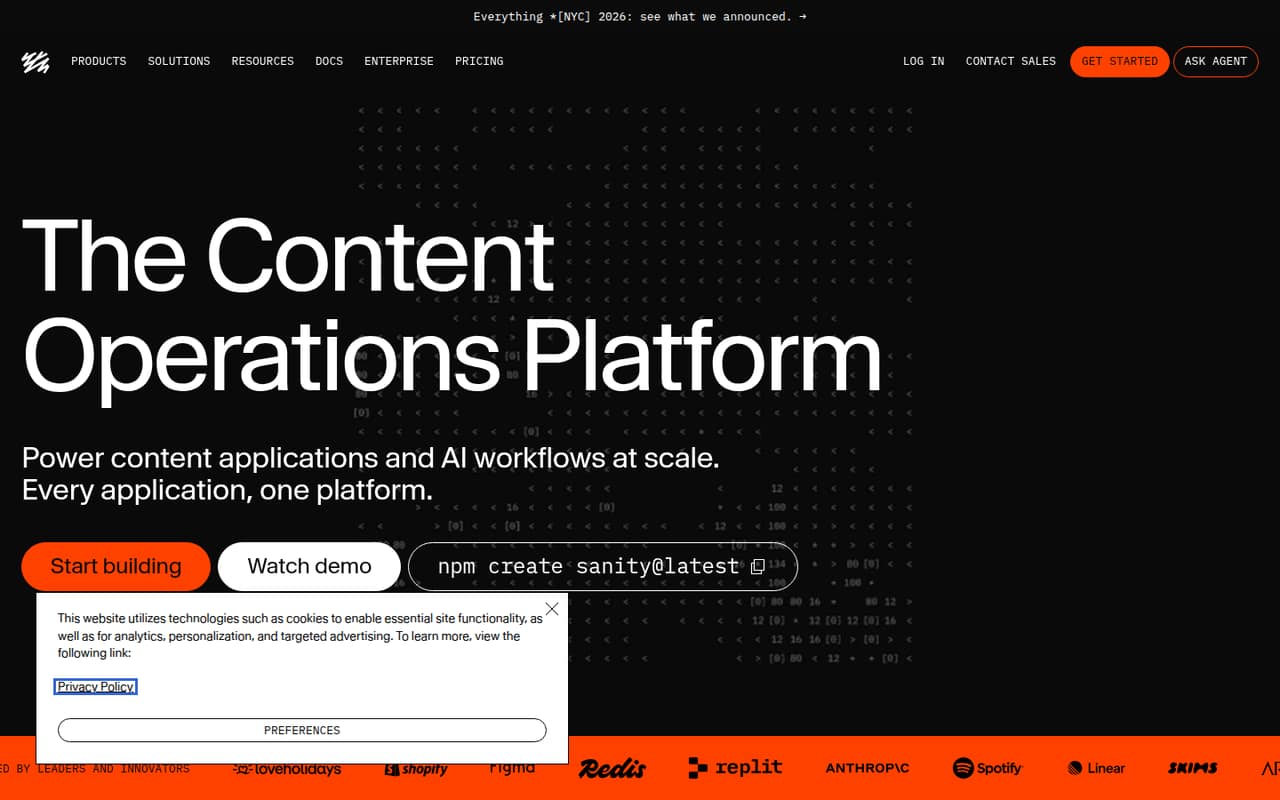
Sanity’s homepage calls the platform “One API” and shows JavaScript examples using sanity, @sanity/client and @sanity/functions. The client example runs a GROQ query through client.fetch, and the function example uses documentEventHandler to react to a document event. The site also gives the CLI command npm create sanity@latest to start a project.
The examples show a JavaScript/TypeScript-style integration surface, but the homepage does not name a complete language or SDK support matrix. Confirm supported SDKs, API versions and integration details in Sanity’s developer documentation before choosing a stack. The product description also names the App SDK for custom content applications and functions for dataset-change automation.
This is a code-first modeling approach: schema definitions live in Studio configuration rather than database constraints. Sanity describes tools for content previews, releases and team editing, but teams still need to design models and connect the content API to their own frontends. Check documentation for authentication, caching, rate limits and deployment guidance relevant to your application.
03Sanity pricing for developers
Sanity’s Free plan costs $0 per month and includes 20 user seats, 2 roles, 2 public datasets, 10,000 documents and 100GB of assets. Growth costs $15 per seat per month and lists 50 user seats, 5 roles, 2 datasets, 25,000 documents and 1 million API CDN requests per month. The pricing page lists Enterprise as custom-priced, with custom seats and datasets, 5,000 AI credits per month, 20 scheduled functions, 365 days of draft review history, dedicated support and an uptime SLA.
The bill can grow with usage. A $299-per-month increased-quota add-on lists 50,000 documents, 5 million API CDN requests, 1 million API requests, 500GB of bandwidth and 500GB of assets. Additional API CDN requests cost $1 per 250,000; API requests cost $1 per 25,000; assets cost $0.50 per GB; and bandwidth costs $0.30 per GB. Other listed charges include $0.05 per AI credit and $1 per million function invocations. Media Library and Content releases pricing is not published. No annual rate is listed.
04Sanity: open source, self-hosting and lock-in
Sanity is presented as a hosted content platform, not as a self-hosted server. Its Studio is configurable, but that does not mean the Content Lake or the complete service can run in your own infrastructure. A Reddit commenter says they moved from Sanity to Payload CMS because of self-hosting; treat that as an individual report, not a product specification.
Sanity’s platform license and data-export procedure should be confirmed with the vendor before you commit. Ask whether exports include documents, assets, schemas and references in formats your team can use, and whether export access or volume is limited by plan. The structured JSON model may help keep content understandable outside the service, but queries, Studio configuration, workflows and integrations can still create migration work. A move to another CMS is not just a database dump: plan to map schemas, rewrite queries and rebuild editorial workflows. Teams that require control over infrastructure should evaluate that requirement early.
05Sanity in production
Sanity’s documented plan quotas make usage planning part of production readiness. Track document counts, assets, bandwidth, API requests and CDN requests against the relevant plan, and estimate add-ons before traffic or content growth pushes the bill up. The pricing page lists an uptime SLA only for Enterprise; teams on other plans should ask what reliability commitments apply.
The product description highlights roles, draft history, previews and releases, but teams should confirm the security controls, compliance terms, data residency and support response commitments they need. Ask Sanity for API rate limits, function invocation and compute limits, retry behavior, and what happens when quotas are exceeded. These details affect both application resilience and editorial operations.
Reddit comments describe Sanity as quick to integrate and praise collaboration and previews, while another notes that configuring Portable Text for blog content took effort. One commenter chose another CMS for self-hosting. These are individual reports, but they point to useful checks: test your content model with editors, establish a migration plan and confirm the operational terms before relying on the service.
From the threadsWhat users say
The Reddit comments lean positive on integration speed, collaboration and editor experience, with reservations about self-hosting and setup work. Sentiment is anecdotal and varies with project needs.
easy to integrate, so fast
Sanity feels smoother out of the box, especially for editors, with real-time collaboration and great preview workflows
the only thing that took me a bit to configure and work with was using portable text for blogs etc
I was a Sanity guy, shifted to Payload CMS because of the self hosting part
Questions people ask
What is Sanity used for?
Sanity stores structured content as JSON documents and provides a configurable Studio for editors. Developers can use its content APIs to power web and mobile applications, custom content tools and AI workflows. Functions can automate operations in response to dataset changes.
Can I use Sanity with Next.js?
Sanity’s Reddit discussions include developers using it with Next.js, and its homepage shows JavaScript examples with the Sanity client. Check Sanity’s documentation for current Next.js integration guidance, supported SDKs, preview setup and caching recommendations before implementation.
Is Sanity free?
Yes. The Free plan costs $0 per month and lists 20 user seats, 2 roles, 2 public datasets, 10,000 documents and 100GB of assets. It has quotas, so estimate API usage and storage needs before using it for a production project.
Can I self-host Sanity?
Sanity is presented as a hosted content platform, not a self-hosted server. Its Studio is configurable, but teams that require their own infrastructure should confirm current hosting options and platform terms with Sanity before adopting it.
Can I export content from Sanity?
Confirm the current export procedure and supported formats with Sanity. Before building a production content model, ask whether exports cover documents, assets, schemas and references, and whether any plan or volume limits apply. Include schema and query migration in your exit plan.