
We may earn a commission if you buy through links on this page. It never changes a score or a ranking. How we make money
The bottom line
A capable open-source automation framework, but confirm deployment details and commercial costs before rollout.
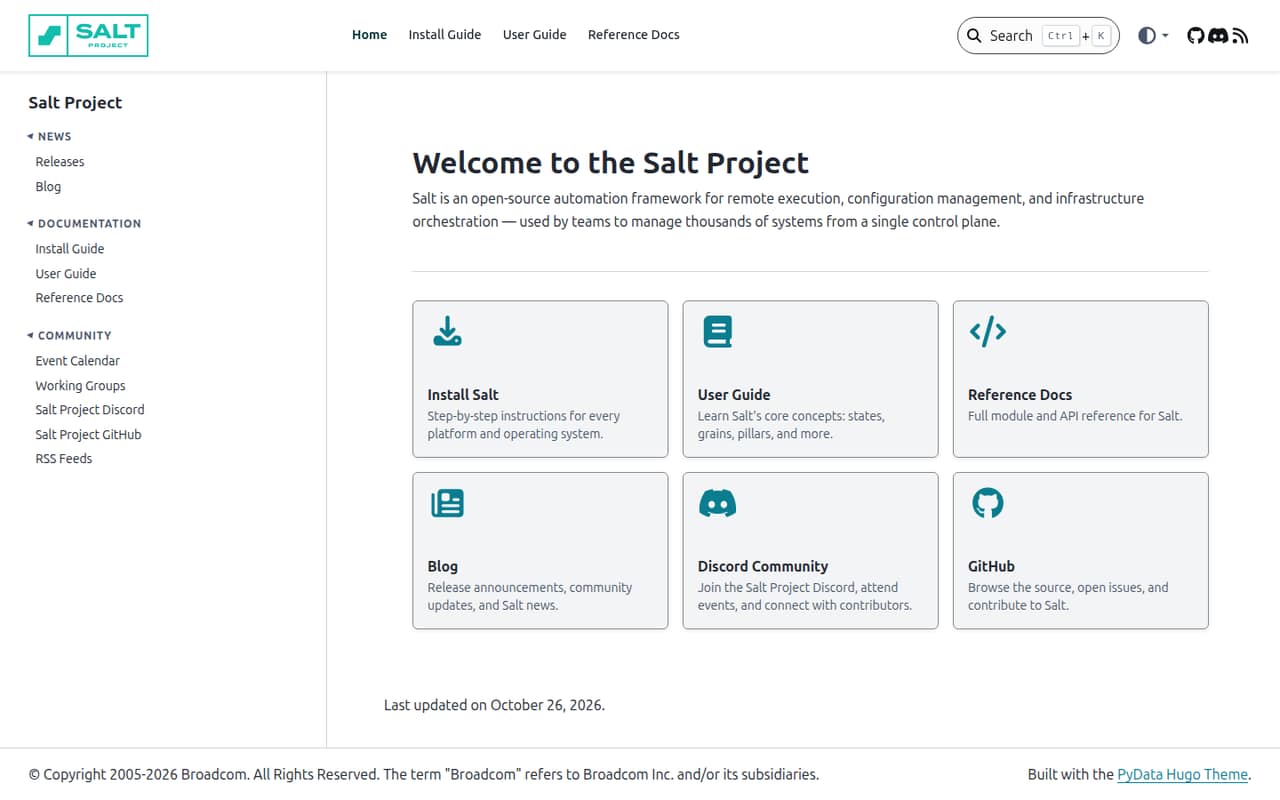
Salt is an open-source framework for remote execution, configuration management, and infrastructure orchestration. Its user guide covers states, grains, and pillars, and the project says teams use it to manage thousands of systems from one control plane.
The open-source option has no listed starting price, but commercial plans, usage costs, and support terms are unclear. Salt publishes install, user, and reference documentation; verify language and SDK fit, deployment topology, and production controls before committing.
Good fit if
- Teams automating remote system management
- Operators using states, grains, and pillars
- Groups seeking open-source infrastructure automation
Skip it if
- Teams requiring published commercial pricing
- Buyers needing confirmed SDK coverage
- Projects requiring documented service-level terms
ScoresHow it rates
What works
- Open-source automation framework
- Combines remote execution and configuration management
- Supports infrastructure orchestration
- User guide covers states, grains, and pillars
- Install guide covers platforms and operating systems
What doesn't
- Commercial plans and starting price are unclear
- No published usage or overage rates
- Language and SDK support require verification
- The license name is not stated on the homepage
- Production limits and service terms need confirmation
01What Salt is, technically
Salt is an open-source automation framework for remote execution, configuration management, and infrastructure orchestration. The project presents it as software teams install and use to manage systems, rather than as a hosted API or SaaS application. Its install guide provides instructions for platforms and operating systems.
In a stack, Salt sits in the infrastructure automation layer: teams use it to run tasks across managed systems, maintain configuration, and coordinate infrastructure. The project describes a single control plane for managing thousands of systems. Its user guide identifies states, grains, and pillars as core concepts, providing the framework's vocabulary for describing and organizing managed environments.
Salt may suit teams looking for a common automation layer across many systems. Before planning a deployment, confirm the control-plane topology, the components required on managed systems, and how Salt fits with existing provisioning and monitoring tools. The project site points users to install instructions, a user guide, reference docs, GitHub, and community channels.
02Salt API, SDKs and docs
Salt's documented developer resources are its install guide, user guide, and reference documentation. The reference docs include a module and API reference; the user guide covers states, grains, and pillars. The homepage does not identify a particular API protocol, SDK, programming language, CLI, webhook interface, or plugin system. Confirm the supported integration surfaces and SDK coverage in the vendor's documentation before designing an integration.
The install guide provides step-by-step instructions for platforms and operating systems, while the user guide introduces Salt's core concepts. The GitHub project is the place to browse source code, open issues, and contribute. Salt also lists a Discord community, events, working groups, and release announcements.
This gives developers documentation and source-code entry points, but teams should check whether the modules and API reference cover their required workflows. Verify language compatibility, authentication, and any supported interfaces against the current reference docs rather than assuming a familiar REST API or SDK.
03Salt pricing for developers
Salt is open source, and the pricing information available for this review lists a free option. It lists no commercial plans, starting price, monthly or annual billing choices, or add-ons. There is therefore no published price to use as a dependable commercial quote, and no basis for estimating a production bill from system count or workload.
The pricing notes also provide no usage rates, request limits, seat charges, compute charges, or overage terms. The open-source option may avoid a software subscription, but it does not establish the total cost of running Salt: infrastructure, operations, and any separately arranged support still need to be budgeted. Do not assume that a free option includes hosted infrastructure or a support plan.
Before a production rollout, ask whether commercial support or services are available, how they are priced, and whether any usage or deployment limits apply. If your project depends on a formal budget, get written terms for the deployment model you intend to use. Until then, Salt's software price may be zero, but its commercial and operating costs are not established.
04Salt: open source, self-hosting and lock-in
Salt is described as open source, and the project links to GitHub to browse its source and contribute. The homepage does not name the software license, so check the repository's license file and its terms before redistributing or embedding Salt. The install guide covers platforms and operating systems, but confirm the supported self-managed deployment model and control-plane requirements for your environment.
The project site does not describe a data-export feature or a hosted service from which to export data. Plan to identify where configuration and operational data live, how they can be backed up, and what formats are usable outside Salt. Migration would also require accounting for Salt-specific concepts such as states, grains, pillars, and modules. That creates some workflow migration work, even with source availability; test how your automation maps to a replacement before relying on an exit plan.
05Salt in production
Salt's homepage says teams use it to manage thousands of systems from a single control plane, but that statement is not a published capacity limit or a reliability guarantee. The vendor does not publish a rate limit, service-level commitment, or usage-based scaling price in the pricing information reviewed here. Validate expected scale and failure behavior against the reference docs and your deployment design.
Before putting Salt in a critical path, check the current guidance for authentication, authorization, transport security, auditability, backup and recovery, and high availability. Confirm how the control plane behaves during network partitions and what happens when a remote execution task fails or times out. These details matter when automation can change system configuration across a fleet.
Also establish how you will monitor Salt itself, manage upgrades, and test states before applying them broadly. The install and user guides provide starting points, but confirm that the documentation covers your operating systems and operational requirements. If you need commercial support or compliance commitments, ask for written terms before rollout.
Questions people ask
Is Salt a hosted service or software you install?
Salt is described as an open-source automation framework, and its site provides an install guide with instructions for platforms and operating systems. The homepage does not present it as a hosted API or SaaS application. Confirm the control-plane topology and self-managed deployment requirements in the current installation documentation.
How much does Salt cost?
Salt has an open-source option, but the pricing information available for this review lists no commercial plans, starting price, billing cadence, or usage rates. That means there is no reliable commercial quote to use for budgeting. Ask the vendor about support, services, and any deployment-specific costs before adopting it.
What are Salt states, grains, and pillars?
Salt's user guide identifies states, grains, and pillars as core concepts. They are part of the framework's documented vocabulary for configuration and system management. Read the user guide and reference docs to understand how these concepts fit your automation model before migrating existing configuration workflows.
Does Salt provide SDKs for my programming language?
The project homepage links to module and API reference documentation but does not name programming languages or SDKs. Check the current reference docs for supported interfaces and language bindings, then verify that they cover your required workflows. Avoid assuming a particular API protocol or SDK is available without confirming it.
Can Salt manage thousands of systems?
The Salt Project says teams use Salt to manage thousands of systems from a single control plane. That is a project statement, not a published capacity limit or service-level guarantee. Test your intended topology and workload, and check the reference documentation for relevant scaling, failure-recovery, and operational guidance.