
We may earn a commission if you buy through links on this page. It never changes a score or a ranking. How we make money
The bottom line
A local-first API client with Git sync and CI collection runs, but limited public pricing and integration details.
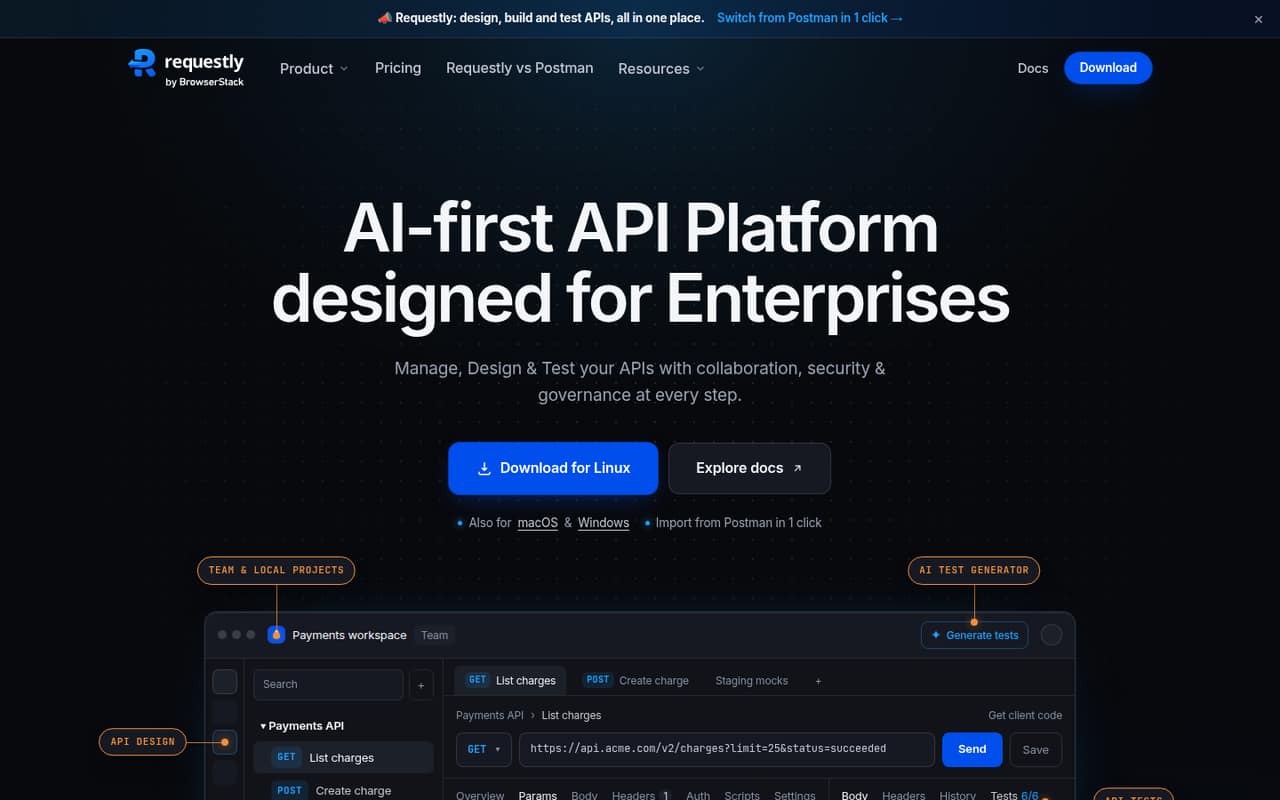
Requestly is a desktop API client for building collections, managing environments, testing responses and running collections in CI. Its Local Projects and Git sync suit teams that want API definitions in files rather than only in a hosted workspace.
The Team plan starts at $10 per user/month with annual billing, and there is a 30-day trial but no free plan. API protocol coverage is broad; confirm SDK or public API support and production limits before making it part of an automated stack.
Good fit if
- Teams versioning API collections in Git
- Developers testing REST and GraphQL APIs
- Teams running collections in CI
Skip it if
- Projects requiring a free ongoing plan
- Teams needing published request-rate limits
- Builders seeking an API SDK
ScoresHow it rates
What works
- Local Projects store collections as files on disk
- GitHub and GitLab sync is included in Team
- Supports REST, GraphQL, SOAP and gRPC
- Collection runner supports CI through the CLI
- Imports Postman, OpenAPI, HAR and cURL
What doesn't
- No free plan; the free option is a 30-day trial
- Monthly billing prices are not published
- Request-rate and other production limits are not published
- Public SDK and API integration details need confirmation
- Enterprise self-hosting requires a custom annual quote
01What Requestly is, technically
Requestly is a desktop API client, not an API server or hosted API runtime. It sends requests to APIs your team operates, organizes them into collections, and provides response inspection, environment variables and assertions. Desktop apps are available for macOS, Windows and Linux.
Its Local Projects model stores collections as files on a developer's machine; teams can sync those projects with Git. Requestly also offers shared team workspaces, and its Enterprise plan includes self-hosting and data residency. That puts it in the development and testing layer alongside API clients, rather than in the application runtime or API gateway layer.
A typical workflow is to maintain request collections and environment values alongside code, run requests during development, then execute collections through Requestly CLI in CI. Requestly's homepage also lists an HTTP Interceptor, File Server and API Explorer, but the core fit is API request authoring and testing.
02Requestly API, SDKs and docs
Requestly's integration surface is its desktop client, JavaScript scripting sandbox, file-based Local Projects and CLI for running collections in CI. Pre-request and post-response scripts can read and set environment variables, chain authentication and assert response data. The homepage also advertises client-code generation in any language.
The client supports REST, GraphQL, SOAP, gRPC, WebSocket, Socket.IO and MQTT. GraphQL features include queries, mutations, introspection and autocomplete; SOAP and gRPC features include WSDL, reflection and streaming. The Team plan lists imports from Postman, OpenAPI, HAR, cURL, WSDL, SoapUI and Bruno.
Requestly provides documentation, but teams building an integration around Requestly itself should confirm SDK support and any public API contract in the vendor's docs. The homepage does not describe a webhook or plugin integration surface. For CI, the named option is Requestly CLI; collection runs are also available through the desktop collection runner.
03Requestly pricing for developers
Requestly has no free plan; the vendor lists a 30-day free trial. With annual billing, Team costs $10 per user/month and Team Pro costs $15 per user/month. Both prices are marked 17% off. Monthly-billing prices are not published.
Team includes unlimited manual and scheduled collection runs, API protocol support, Local Projects with GitHub/GitLab sync, basic API docs with shareable links and imports from several API tools and formats. Team Pro adds unlimited AI credits, AI-generated tests and assertions, advanced reporting and analytics, a secret scanner and external vault integrations. Enterprise is custom annual pricing and adds SAML SSO, SCIM provisioning, attribute-based RBAC, audit logs with SIEM export, data residency, self-hosting and priority support.
The listed plans are priced per user, so the bill grows with seats. The pricing page lists no add-ons, and Team includes unlimited collection runs; it does not publish request-rate or other usage overages. Ask about monthly billing and any CI or service limits before committing.
04Requestly: open source, self-hosting and lock-in
Requestly's vendor pages do not publish an open-source licence or describe the source code as available. Local Projects let teams keep collections as files on disk and sync them with GitHub or GitLab, which gives those API definitions a path outside a hosted workspace.
Self-hosting is an Enterprise feature, alongside data residency; it is not listed as a self-serve deployment option. The vendor does not publish a self-hosting price or deployment requirements, so ask about both before treating it as a way to reduce hosting costs.
Git-backed collections can make migration easier, but they do not establish how to export workspace membership, run history, secrets or reports. Confirm what can be exported and in what format. Keep secrets separate from committed project files: Requestly says environment secrets stay local and are never synced.
05Requestly in production
Requestly can run collections in CI through its CLI, and Team lists unlimited manual and scheduled collection runs. The vendor does not publish request-rate limits, collection-size limits or runner concurrency in the published pricing details. Check those limits, failure behavior and any service-level commitment with the vendor before making CI results a release gate.
Requestly's homepage states SOC 2 compliance, encryption in transit and at rest, SSO, role-based access control and audit logs. The plan breakdown places SAML SSO, SCIM, audit-log SIEM export and self-hosting in Enterprise; confirm which controls apply to the deployment you plan to use. The homepage says environment secrets stay local and are never synced, while Vault secrets are encrypted and never exported. A separate r/firefox thread discusses the browser extension, not the API client.
From the threadsWhat users say
The Reddit signal is too limited to establish overall user sentiment about Requestly's API client. One thread asks for user experiences, while the other concerns Requestly's browser extension rather than the API client.
I also want to hear from the community if they have used Requestly API Client
Looking forward to learning from your experience :)
This is really useful for search engines
But it seems like this addon is following the enshitti
Questions people ask
Is Requestly free to use?
Requestly does not list a free plan. The vendor lists a 30-day trial. After that, Team is $10 per user/month and Team Pro is $15 per user/month with annual billing; monthly-billing prices are not published. Enterprise pricing is custom and annual.
Can Requestly run API collections in CI?
Yes. Requestly CLI runs collections in CI, and the Team plan includes unlimited manual and scheduled collection runs. The vendor does not publish request-rate or runner-concurrency limits in the plan details, so confirm the limits that apply to your CI setup.
Can I self-host Requestly?
Self-hosting and data residency are listed as Enterprise features. Enterprise pricing is custom and annual. The vendor does not publish self-hosting deployment requirements or a separate self-hosting price, so ask about infrastructure, support and licensing before planning a deployment.
Which API protocols does Requestly support?
Requestly supports REST, GraphQL, SOAP, gRPC, WebSocket, Socket.IO and MQTT. Its listed GraphQL capabilities include introspection, and its SOAP and gRPC features include WSDL, reflection and streaming.
Can I import Postman collections into Requestly?
Yes. Requestly lists Postman imports, including collections, folders and environments on its homepage. The Team plan also lists imports from OpenAPI, HAR, cURL, WSDL, SoapUI and Bruno. Local Projects can store collections as files and sync with GitHub or GitLab.