
We may earn a commission if you buy through links on this page. It never changes a score or a ranking. How we make money
The bottom line
Replicated coordinates enterprise software distribution; budget for monthly plans and per-license fees.
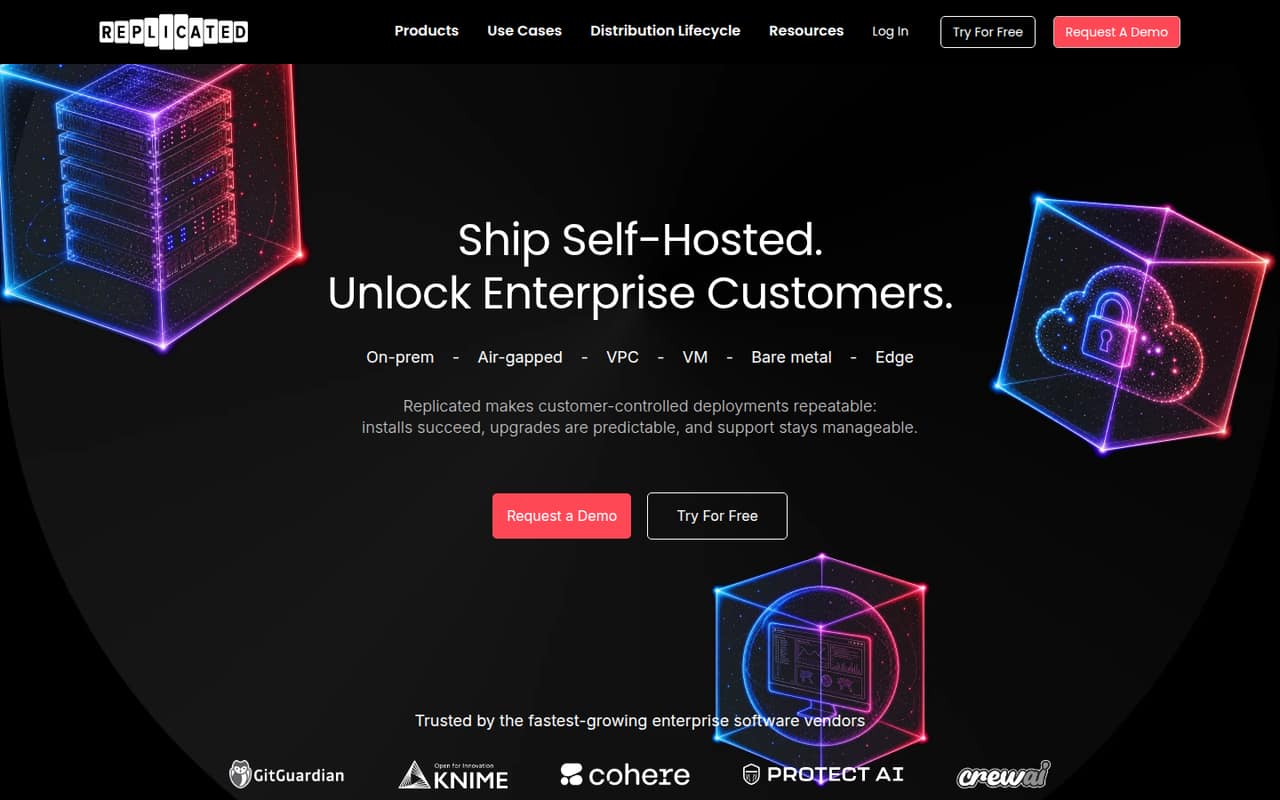
Replicated is a platform for building, testing, licensing, releasing, installing and supporting commercial software in customer-managed environments. It targets deployments across air-gapped servers, bare metal, VMs and VPCs, rather than ordinary SaaS delivery.
The breadth is useful for teams that need a repeatable path from build to customer installation. Plans start at $500 per month, and Builders and Business also charge per license. Check those variable costs, cluster fees and platform details with the vendor before committing.
Good fit if
- Enterprise software shipped on-premises
- Air-gapped customer deployments
- Teams standardizing release operations
Skip it if
- Teams shipping SaaS-only products
- Projects needing published API limits
- Teams requiring clear self-hosting terms
ScoresHow it rates
What works
- Covers testing, licensing, releases, installs and support
- Supports air-gapped customer environments
- Compatibility Matrix integrates with CI
- Provides instance uptime, usage and configuration reporting
- Shared support bundles help investigate customer issues
What doesn't
- Builders and Business add per-license fees
- Compatibility Matrix adds cluster costs
- Annual plan prices are not published
- SDK and language support needs verification
- Platform licensing and data export need clarification
01What Replicated is, technically
Replicated is a software distribution platform that sits between a commercial software team’s build and release process and its customers’ self-managed environments. It is not a library that runs inside an application or a replacement for the customer’s infrastructure. The platform covers development and compatibility testing, licensing, release management, installation, reporting and support.
A team can use SecureBuild images to distribute an application and its OSS components and dependencies, then test compatibility, manage entitlements and deliver releases to customer segments. The resulting software can run in air-gapped environments, on bare metal or VMs, and in IaaS VPCs. Replicated also provides a reporting dashboard and an API for instance information, plus shared support bundles for troubleshooting.
That makes it relevant when enterprise customers control the runtime environment and deployments need to work across different configurations. It is a specialized distribution layer, not a general-purpose CI system or cloud hosting service.
02Replicated API, SDKs and docs
The homepage identifies an API for reporting on customer instances and links to API Reference, CLI Reference and Documentation. Reporting covers uptime, usage and configuration, and teams can subscribe to notifications. The Compatibility Matrix can integrate with CI, giving release workflows a way to test against customer-representative environments before distribution.
The homepage does not name an API style, SDK, programming language or protocol. Confirm SDK support and the API’s authentication, pagination and error-handling patterns in the vendor’s docs before designing an integration. The CLI Reference is a separate integration surface; check its supported commands and automation behavior against your build pipeline. The product also includes release channels, licensing controls, installation workflows and support bundles, so integration work may involve more than calling an API.
For a first evaluation, map your build and CI steps to the Compatibility Matrix, then identify how licensing and release operations fit your existing deployment process.
03Replicated pricing for developers
The pricing page lists a free plan, but does not publish its limits or included features. The homepage also invites teams to start exploring in a Free Trial; confirm whether that trial differs from the free plan and what happens when it ends.
Paid plans are shown monthly. Compatibility Matrix costs $500 per month and includes 65,981+ configuration combinations and 50+ simultaneous clusters; most clusters are available in under three minutes, and additional cluster costs apply. Builders costs $2,000 per month for teams distributing on-prem software. It includes release channels, free trial and dev licenses, preflight checks and air-gap installs, with a per-license fee. Business costs $3,000 per month and adds multi-app support; it also has a per-license fee. Enterprise has custom pricing. Annual pricing and the per-license and extra-cluster rates are not published.
Model the variable charges against expected licenses and cluster use before comparing plans. Ask the vendor for a quote that includes those fees and your expected deployment volume.
04Replicated: open source, self-hosting and lock-in
Replicated’s platform distributes customer-managed software, but that does not establish that Replicated itself can be self-hosted. The vendor doesn’t publish the platform’s open-source license or source availability, whether its management components can run in your infrastructure, or a data export path. Ask the vendor directly if those are procurement or architecture requirements.
There is a practical distinction between running your application on customer infrastructure and self-hosting the distribution tooling. Replicated is built around workflows for releases, licensing, compatibility testing, installation and reporting. Moving away could therefore involve replacing those workflows and migrating release and entitlement processes, not just swapping an API endpoint. The exact effort depends on how much of your delivery process uses the platform.
Before adopting it, establish which data and release artifacts you can retrieve, in what formats, and how customer licenses and installations continue to work if you leave.
05Replicated in production
Replicated targets environments where deployment conditions vary, including air-gapped servers, bare metal, VMs and VPCs. Its Compatibility Matrix is designed to test against 60,000+ customer-representative environments and integrate with CI. The pricing page lists 65,981+ configuration combinations and 50+ simultaneous clusters for Compatibility Matrix, with additional cluster costs. Confirm what counts as a cluster and how usage is billed for your testing workload.
For operations, the platform offers instance uptime, usage and configuration reporting, notifications and shared support bundles. The homepage also describes escalation to a global team of Kubernetes experts for Tier 2 and 3 support. Ask about support coverage, response targets and any plan restrictions before relying on that escalation path.
The vendor doesn’t publish API rate limits or a service-level commitment on the homepage. Validate those with the vendor, along with security and compliance requirements, backup and recovery responsibilities, and the behavior of licensing in disconnected environments.
Questions people ask
What does Replicated do?
Replicated helps software companies build, test, license, release, install, report on and support commercial software deployed in customer-managed environments. Its stated use cases include air-gapped servers, bare metal, VMs and VPCs.
Does Replicated support air-gapped installations?
Yes. Replicated describes air-gap installs and licensing management for air-gapped environments. Its platform also supports customer deployments on bare metal, VMs and IaaS VPCs.
Does Replicated provide an API or CLI?
The homepage links to an API Reference and CLI Reference. It describes an API for reporting on customer-instance uptime, usage and configuration. Confirm API style, SDK availability and language support in the vendor’s documentation.
How much does Replicated cost?
The listed monthly prices are $500 for Compatibility Matrix, $2,000 for Builders and $3,000 for Business. Enterprise pricing is custom. Builders and Business have per-license fees, and Compatibility Matrix has additional cluster costs.
Is Replicated free to use?
The pricing page lists a free plan, and the homepage offers a Free Trial. The free plan’s limits and included features are not published in the listed pricing, so ask the vendor what is included and how the trial converts.