
We may earn a commission if you buy through links on this page. It never changes a score or a ranking. How we make money
The bottom line
A full application platform for teams prepared to operate or pay for enterprise Kubernetes.
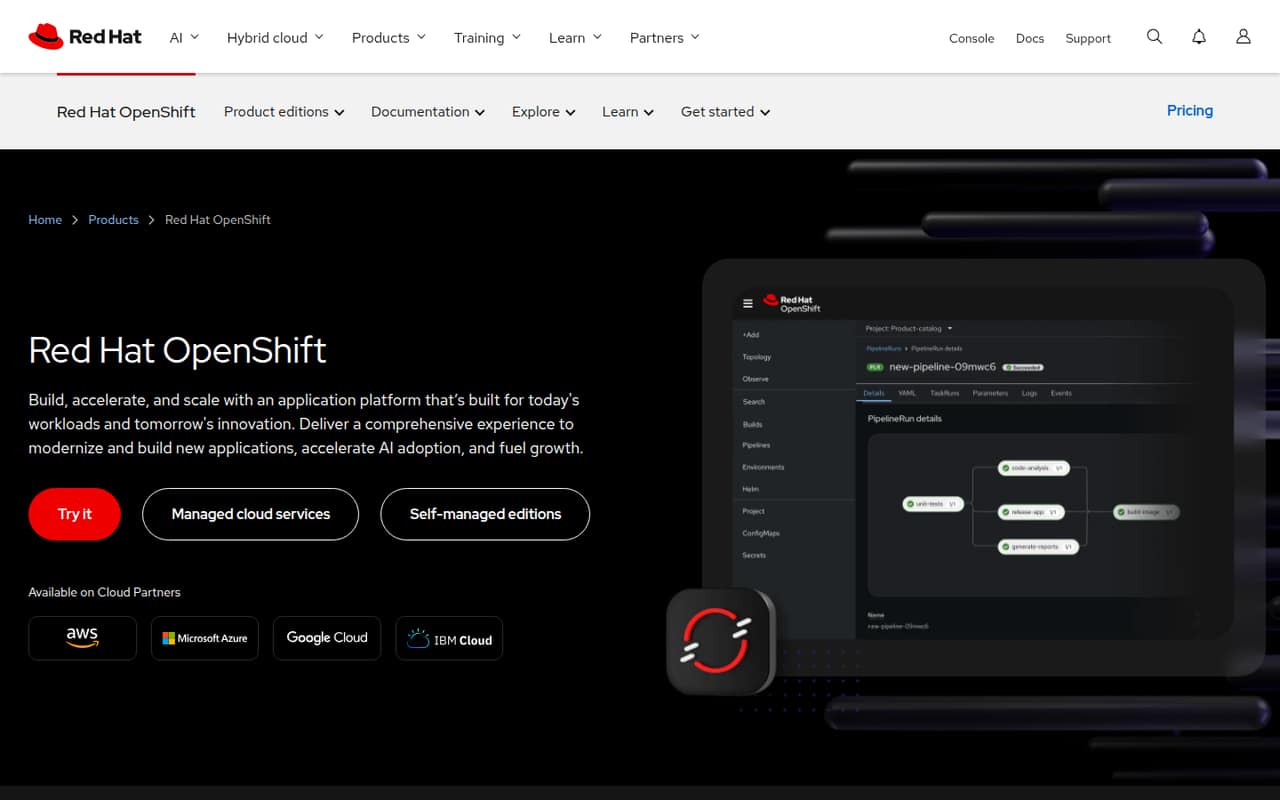
Red Hat OpenShift is an application platform built around enterprise Kubernetes, available as a managed cloud service or as software you run on your own infrastructure. Its editions span developer and operations tools, Kubernetes basics, virtualization and a broader platform bundle.
The trade-off is operational weight and pricing complexity. Managed editions list uptime SLAs and provider-specific billing, while self-managed subscription prices vary. Reddit commenters describe a substantial learning curve and compute demands, so teams new to Kubernetes should account for time as well as subscription costs.
Good fit if
- Teams standardizing on enterprise Kubernetes
- Organizations needing managed OpenShift
- VM teams evaluating OpenShift Virtualization
Skip it if
- Kubernetes beginners seeking a light setup
- Projects needing predictable public pricing
- Teams requiring a named SDK or CLI
ScoresHow it rates
What works
- Managed editions run on AWS, Azure, Google Cloud and IBM Cloud
- Self-managed editions support deployment on your own infrastructure
- Container Platform includes developer and operations tools
- Pipelines and GitOps are included in Container Platform
- Managed editions list uptime SLAs
What doesn't
- Self-managed subscription pricing varies by sizing
- The vendor lists no monthly or annual plan prices
- The homepage does not name SDKs or programming languages
- Reddit users report compute demands and a steep learning curve
- Licence, source availability and data-export details need verification
01What Red Hat OpenShift is, technically
Red Hat OpenShift is an enterprise application platform built around Kubernetes. It sits between your application workloads and the infrastructure that runs them: teams use it to build, modernize and deploy applications, while its platform services cover development and operations. It is not just a hosted SaaS application. Red Hat offers managed cloud editions, as well as self-managed editions for running on your own infrastructure, in the cloud, on a computer or in a datacenter.
The self-managed range has several scopes. Kubernetes Engine provides enterprise Kubernetes basics for container applications; Container Platform adds developer and operations tools; Platform Plus bundles Container Platform with additional management, security, storage and registry products. Virtualization Engine focuses on virtual machine workloads. Managed services are available on AWS, Azure, Google Cloud and IBM Cloud, with different providers managing or billing each offering. That makes OpenShift a platform choice for the application stack, not a drop-in library or a single-purpose deployment tool.
02Red Hat OpenShift API, SDKs and docs
OpenShift is a Kubernetes platform, so the Kubernetes API is the architectural surface to evaluate when connecting deployment automation and workloads. The homepage also identifies a developer console, OpenShift Serverless, Service Mesh, Pipelines and GitOps as Container Platform components. It points developers to documentation, hands-on labs, interactive demos and training resources.
The homepage does not name programming languages, SDKs, a CLI or specific API versions. Before choosing a client library or building automation, confirm SDK support, language compatibility, API versions and command-line workflows in Red Hat's current documentation. CI/CD and GitOps are named use cases, but the homepage does not provide a specific pipeline configuration or integration protocol. The practical integration decision is therefore broader than selecting a library: teams need to validate their Kubernetes workflows, platform services and deployment tooling against the edition they plan to run. Red Hat also directs users to the Hybrid Cloud Console for cloud-product learning resources.
03Red Hat OpenShift pricing for developers
OpenShift has no free plan in the listed pricing, though ROSA has an 8-hour hands-on experience. The pricing page lists no monthly or annual prices for the editions. Self-managed editions use subscriptions, with pricing varying by sizing and subscription. That leaves teams needing a quote based on their deployment rather than a published per-seat or per-request rate.
Managed cloud costs depend on the service. Red Hat OpenShift Service on AWS is pay-as-you-go and billed by AWS; Microsoft Azure Red Hat OpenShift is pay-as-you-go and billed by Azure. OpenShift Dedicated is billed by Red Hat, with Google Cloud infrastructure billed separately. OpenShift on IBM Cloud is billed by IBM. The pricing note lists reserved cloud instances starting at $0.076 per hour on a three-year contract; confirm which configuration that applies to before budgeting. The price list does not give usage thresholds or overage rates, so ask the provider how cluster size, infrastructure and subscription terms affect your bill.
04Red Hat OpenShift: open source, self-hosting and lock-in
Red Hat offers self-managed OpenShift editions, so teams can run the platform on their own infrastructure rather than use a managed cloud service. The product options include Kubernetes Engine, Container Platform, Platform Plus and Virtualization Engine; subscriptions apply, and self-managed pricing varies by sizing and subscription.
The vendor doesn't publish licence or source-availability details on the vendor's site available for this review. Confirm the licence and source terms for the specific components and edition you plan to deploy. Data export and migration procedures also need validation with Red Hat. OpenShift is built around Kubernetes, which gives teams a familiar platform architecture to plan around, but that alone does not guarantee a low-cost exit: platform services, deployment definitions, storage and virtualization workloads can affect migration effort. Before committing, test how your applications and stateful data move to the Kubernetes environment you would use if you left OpenShift.
05Red Hat OpenShift in production
Managed service SLAs vary by provider: the pricing page lists 99.95% uptime for OpenShift Service on AWS, Azure Red Hat OpenShift and OpenShift Dedicated, and 99.99% for OpenShift on IBM Cloud. Check the applicable service terms and how the SLA is measured before using those figures in an availability plan. For self-managed deployments, teams need to assess infrastructure sizing, platform operations and subscription scope for their own environment.
Reddit comments flag practical hurdles. One commenter describes OpenShift as heavy and says it requires significant compute; another says security and SELinux configuration can add to the learning curve for people new to Kubernetes. A separate thread reports challenges using OpenShift Virtualization in hands-on labs and notes the platform is primarily designed for Kubernetes use cases. Treat those as user reports, not universal outcomes. Before production, validate workload fit, resource requirements, security controls, backup and recovery, and support responsibilities—especially for VM workloads.
From the threadsWhat users say
Reddit sentiment is mixed to negative on learning effort and resource demands, with a specific concern about virtualization fit. The comments are anecdotal rather than a broad measure of production outcomes.
OpenShift is primarily designed and developed for K8s use case
it’s heavy and requires significant amount of compute ( storage, memory and cpu )
OpenShift will be likely be very frustrating since not only are you new to the concept, but you also have to navigate the mountain of security/selinux configurations required to get workloads up and running
OpenShift (like many recent projects) evolves too fast
Questions people ask
Does Red Hat OpenShift have a free plan?
The listed pricing says there is no free plan. Red Hat offers an 8-hour hands-on experience for Red Hat OpenShift Service on AWS (ROSA). That experience is time-limited, so confirm its scope and what access it includes before planning a longer evaluation.
Can we run Red Hat OpenShift on our own infrastructure?
Yes. Red Hat offers self-managed editions for running OpenShift on your own infrastructure, in the cloud, on a computer or in a datacenter. The self-managed options include Kubernetes Engine, Container Platform, Platform Plus and Virtualization Engine.
Which cloud providers host managed OpenShift?
Red Hat lists managed offerings on AWS, Azure, Google Cloud and IBM Cloud. AWS and Azure services are billed by their cloud providers; OpenShift Dedicated is billed by Red Hat with Google Cloud infrastructure billed separately; IBM Cloud bills for its offering.
Which OpenShift edition includes developer tools?
Red Hat OpenShift Container Platform is described as including operations and developer services and tools. Its listed components include Kubernetes Engine, Developer Console, OpenShift Serverless, Service Mesh, Pipelines and GitOps.
Is OpenShift suitable for virtual machine workloads?
Red Hat OpenShift Virtualization Engine is the edition focused exclusively on virtual machine workloads. Validate your VM requirements and operating model before choosing it; a Reddit thread reports challenges in hands-on labs and raises questions about the platform's Kubernetes focus.