
We may earn a commission if you buy through links on this page. It never changes a score or a ranking. How we make money
The bottom line
A flexible hosted payments stack, with important production limits and support details to verify first.
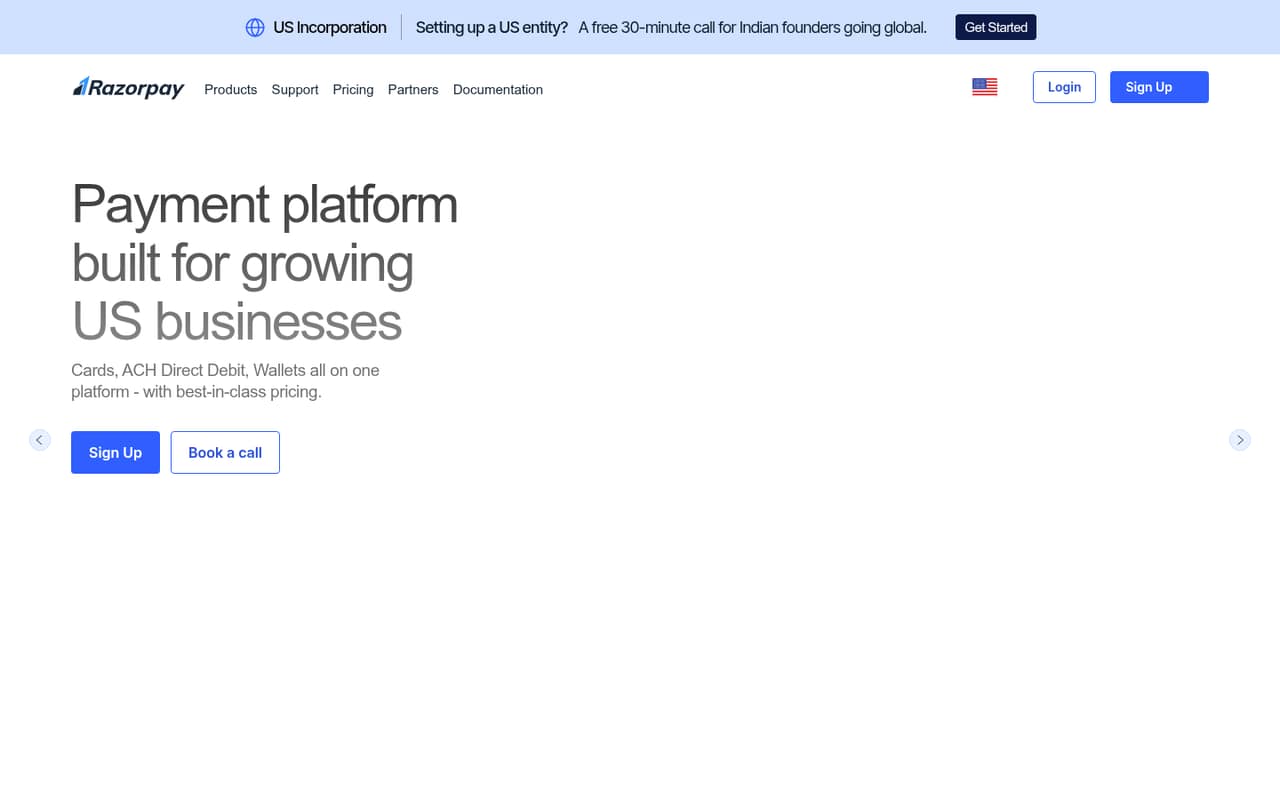
Razorpay is a hosted payment platform for growing US businesses, with cards, ACH, wallets and cross-border methods. Developers can choose REST APIs, SDKs, plugins or a no-code checkout path, alongside payment links and pages.
Standard pricing is transaction-based, with no monthly or annual fee listed. The trade-offs are limited published detail on API limits, SDK languages, data portability and support, plus Reddit reports of payment failures and difficult support in India-focused use cases.
Good fit if
- US businesses adding online payments
- Teams needing ACH and card acceptance
- Businesses combining code and no-code checkout
Skip it if
- Teams requiring a self-hosted payment stack
- Developers needing published rate limits
- Businesses requiring confirmed token portability
ScoresHow it rates
What works
- Accepts cards, ACH, digital wallets and cross-border methods
- Offers REST APIs, SDKs, plugins and a sandbox
- Payment links work through email, text and social channels
- No-code payment pages and buttons are available
- Standard plan has no setup or monthly fee
What doesn't
- No free plan is listed
- Rate limits and uptime commitments are not published
- SDK languages need confirmation in the docs
- Data export and payment-token portability need confirmation
- Reddit users report support and payment reliability problems
01What Razorpay is, technically
Razorpay is a hosted payment platform: it sits between a business’s website or app and the payment methods customers use. It is not presented as a self-hosted server or a payment-processing library. The platform handles online payment acceptance through cards, ACH direct debit, digital wallets and cross-border methods, while its checkout, payment links, pages and buttons provide options for collecting payments.
In a codebase, a team can integrate Razorpay’s REST APIs and SDKs, use a plugin, or send customers to a hosted payment experience. Its product also covers recurring billing and India-specific methods such as UPI, RuPay and Netbanking. That gives teams a path from no-code acceptance to a custom checkout without replacing the payment provider. Razorpay also lists payment insights for volume, success and settlements. The architectural trade-off is that payment processing and some checkout paths depend on Razorpay’s hosted service; confirm what payment data and tokens can move if you later change providers.
02Razorpay API, SDKs and docs
The integration surface includes a REST API, SDKs, plugins and a sandbox, alongside hosted checkout, payment links, payment pages and buttons. The homepage describes checkout for websites and apps, and a custom checkout that can be started by adding a key without front-end work. Payment links can be shared by email, text or social channels; connected invoicing and subscription tools can trigger payments automatically.
The homepage does not name SDK languages or document API conventions such as authentication, pagination or error formats. Confirm supported SDKs and languages in Razorpay’s documentation before choosing an implementation path. The same applies to API versioning, webhook support and retry behavior: verify the details in the docs and ask Razorpay about any production requirements that are not covered there. A sandbox is listed for development, but teams should establish how its behavior and test credentials differ from live processing. Plugins offer an alternative when a supported platform integration fits the codebase.
03Razorpay pricing for developers
Standard is pay-as-you-go, with no setup fee or monthly fee listed. The pricing page lists 2.70% + $0.30 per card transaction, an additional 1.2% for international or non-US cards, and ACH debit at 0.5%, capped at $5. The pricing note says fees apply to successful transactions. Razorpay lists no free plan or free trial.
The bill therefore grows with successful payment volume and payment mix. International card charges combine the Standard card rate with the extra 1.2%; ACH has a percentage fee with a transaction cap. The listed add-ons are a $5 ACH return fee and a $10 dispute fee. Invoicing has no extra cost. There is no monthly or annual billing listed for Standard.
Custom pricing offers volume-based discounts and tailored rates, with pricing available from sales. Enterprise is for businesses processing $12M+ annually and includes custom volume-based pricing and dedicated support. Ask sales to clarify how rates vary by method, volume and dispute or return handling before forecasting costs.
04Razorpay: open source, self-hosting and lock-in
Razorpay is presented as a hosted payment service, not as a self-hostable payment server or an open-source library. The vendor does not publish a software licence or source-availability terms in its product description. It also does not publish data-export or payment-token portability terms there, so ask Razorpay what you can export and whether stored payment credentials can transfer to another processor.
Leaving would mean changing the payment integration and any checkout, payment-link or recurring-billing flows that depend on Razorpay. How much customer and transaction data can move is a separate question; confirm export formats, retention periods and any migration support with the vendor before launch. Keep your own order records and payment identifiers in your application where appropriate, and avoid making Razorpay the only source for business-critical reconciliation data.
05Razorpay in production
Razorpay lists tokenization and 3-D Secure for cards, but teams should confirm which payment methods and transaction paths use each protection. The vendor does not publish API rate limits or an uptime commitment in its homepage description. Ask for current limits, service-level terms, incident communication procedures and the behavior of payment attempts during outages before making it a critical dependency. Confirm applicable compliance responsibilities with Razorpay for your business and payment flows.
Reddit reports are mixed and include complaints that need context: an r/indianstartups founder described failed international payments, and commenters in that thread reported problems with recurring auto-charges. Other users in Indian payment-gateway discussions describe slow support and settlement concerns, while some report successful integrations and support. These accounts are not a measure of Razorpay’s performance for every merchant, but they make payment recovery, escalation paths and settlement timing worth checking. Test declines, retries and reconciliation in the sandbox, then monitor success rates and settlements after launch.
From the threadsWhat users say
Reddit sentiment leans negative on support, failed international payments and settlement concerns, particularly in India-focused discussions. Some users report that Razorpay integrates easily and works reliably for them, so the complaints are not universal.
Checked my dashboard today: 25 failed payments in the last 30 days
Using razorpay at the moment. Won't recommend it. Has bugs, their customer support is not good
I have had a great experience with Razorpay. Extremely easy to integrate, great customer support
Questions people ask
Can I accept international payments with Razorpay?
Razorpay lists international and non-US cards, cross-border payment methods, and region-specific India methods including UPI, RuPay and Netbanking. Its Standard pricing adds 1.2% for international or non-US cards on top of the card rate. Confirm which methods are enabled for your account and target markets.
How secure is Razorpay?
Razorpay says its card acceptance includes tokenization and 3-D Secure. Those features do not remove your need to confirm security and compliance responsibilities for your own checkout, account and payment flows. Ask the vendor which protections apply to each payment method and what controls your integration must implement.
How much commission does Razorpay charge?
The Standard plan lists 2.70% + $0.30 per card transaction, plus 1.2% for international or non-US cards. ACH debit is 0.5%, capped at $5. Razorpay also lists a $5 ACH return fee and a $10 dispute fee. Custom and Enterprise pricing is available from sales.
Can I delete my Razorpay account?
Razorpay does not publish account-deletion steps in its product description. Contact the vendor to ask how to close the account, export transaction records and handle any pending settlements or recurring payments. Confirm what data Razorpay retains after closure and for how long.
Does Razorpay refund money?
The homepage does not describe refund workflows or whether processing fees are returned when a payment is refunded. Check Razorpay’s documentation and ask support about refund timing, eligible payment methods, fee treatment and how refunds appear in settlement and reconciliation records before relying on refunds in your customer-support process.