
We may earn a commission if you buy through links on this page. It never changes a score or a ranking. How we make money
The bottom line
Radar bundles maps, geofencing and location risk tools, with usage-based pricing and annual commitments.
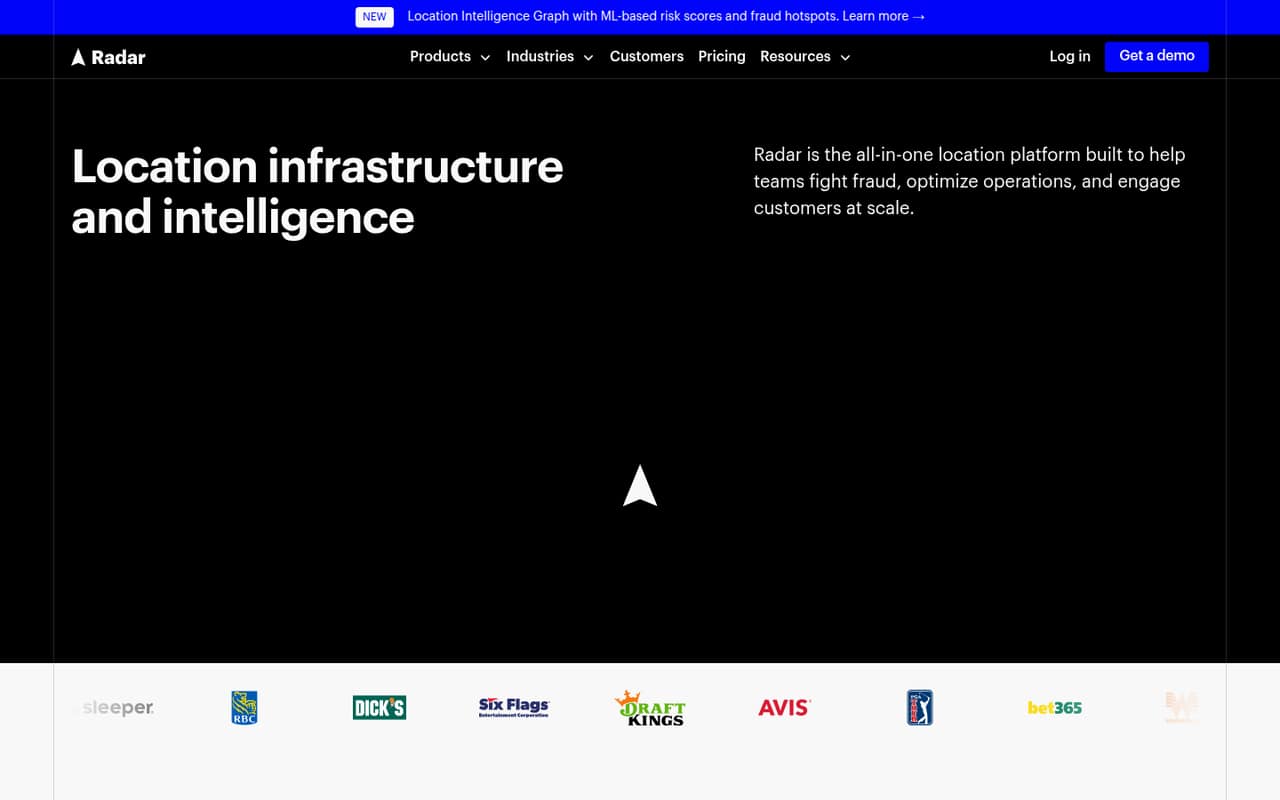
Radar is a hosted location platform accessed through SDKs and APIs. It combines geofencing, maps, geocoding, search and routing with tools for fraud prevention, operations tracking and location-based engagement.
Its feature range suits teams that need several location capabilities in one stack. Before adopting it, confirm SDK and language support, monthly usage quotas, rate limits and data-export options. Pricing starts at $0.02 per monthly tracked user or $0.50 per 1,000 API calls, depending on the product, and agreements are annual.
Good fit if
- Teams combining maps and geofencing
- Fraud teams checking location signals
- Operations teams tracking field work
Skip it if
- Projects requiring a free tier
- Teams requiring self-hosted maps
- Buyers needing published rate limits
ScoresHow it rates
What works
- Combines maps, geofencing and location products
- Offers geocoding, autocomplete, search and routing
- Reveal scores sessions without location permission
- Protect supports precise location verification
- Vendor states it handles one billion API calls daily
What doesn't
- No free plan or free trial is listed
- Agreements require annual commitments
- SDK languages and API protocols are not named
- Rate limits and quota sizes are not published
- Source availability and data export terms need confirmation
01What Radar is, technically
Radar is a hosted location platform that developers integrate through SDKs and APIs. It is infrastructure for apps and services that need location signals, rather than a standalone mapping application or a self-hosted server. Its platform covers geofencing and location tracking, maps, geocoding, autocomplete, search and routing. Product-specific services add fraud scoring, precise location verification, field operations tracking and location-based engagement.
In a typical stack, Radar sits between a client app or backend and location-dependent product features. SDKs and APIs collect or process location, device and sensor data; application code can then use the resulting capabilities for tasks such as detecting arrivals, checking a location or building a map feature. Reveal uses device and network signals to score web and mobile sessions without requiring location permission. Protect, Optimize and Engage add workflows for compliance, operations and marketing. The homepage describes enterprise infrastructure and SDKs, but does not name deployment options beyond the hosted platform.
02Radar API, SDKs and docs
Radar describes its integration surface as SDKs and APIs, with documentation and an integrations section linked from its site. The APIs cover maps, geocoding, autocomplete, search and routing, while the platform also provides geofencing and location tracking. The vendor says its SDKs and APIs collect location, device and sensor data across GPS, Wi-Fi and IP. The homepage does not name an API protocol, programming languages, SDK packages, CLI or webhook support. Confirm those details in Radar’s documentation before choosing an implementation path.
The product surface is broader than mapping alone: Protect verifies location, Reveal scores risky web and mobile sessions, Optimize supports arrival detection and job management, and Engage handles location-based audiences and messaging. Radar also links to integrations, but the homepage does not enumerate integration targets. Check the docs for platform-specific setup, authentication, event handling and migration guidance. Radar says teams can integrate with an existing stack, but published integration time depends on the codebase, SDK support and product scope.
03Radar pricing for developers
Radar lists no free plan or free trial. Protect and Optimize start at $0.04 per monthly tracked user; Engage starts at $0.02 per monthly tracked user. Reveal starts at $2 per 1,000 API calls, Core Maps at $0.50 per 1,000 API calls, and Premium Maps at $2 per 1,000 API calls. These are starting rates, not a single platform-wide price.
The bill scales with tracked users for Protect, Optimize and Engage, and with API calls for Reveal and the maps products. Radar says agreements are annual commitments with monthly usage quotas. Volume discounts are set by sales, and the pricing page does not list quota sizes or overage rates. No add-ons are listed. For a production estimate, ask sales how tracked users are counted, what happens when a monthly quota is exceeded, and whether separate products share quotas. The prices are usage-based, so forecast each API or user metric against expected traffic before signing an annual agreement.
04Radar: open source, self-hosting and lock-in
Radar describes its location infrastructure as proprietary, but its homepage does not publish an open-source licence or state whether source code is available. It presents Radar as a platform accessed through SDKs and APIs; a self-hosted deployment option is not listed. Ask the vendor directly about source access, deployment choices and any requirements for customer-managed infrastructure.
The homepage also does not describe data export formats or a migration process. Treat those as procurement questions, especially if Radar will hold location history, geofences or operational data. Moving away may require replacing API calls and SDK integrations, then rebuilding product behavior such as geofence events, location verification or routing. The difficulty depends on how much application logic relies on Radar-specific services. Before committing, confirm export scope, retention, deletion, and whether your data can be retrieved in a usable format at contract end.
05Radar in production
Radar says its infrastructure handles one billion API calls per day and is installed on hundreds of millions of devices. It also states that the platform is SOC 2 and GDPR compliant. Those vendor claims are relevant to scale and compliance, but they do not replace reviewing the applicable security reports, data-processing terms or service commitments for your deployment.
The pricing terms include monthly usage quotas under annual agreements. The pricing page does not publish quota sizes, API rate limits, overage rates or service-level targets, so ask for them before routing production traffic through the platform. Check how clients behave when requests are throttled or a quota is reached, and how location updates recover after connectivity loss. Confirm data retention and export, plus the SDK platforms and versions your app needs. The vendor says its team provides location expertise and support, but support response targets are not stated on the homepage.
Questions people ask
What is Radar used for?
Radar provides location infrastructure through SDKs and APIs. Teams can use it for geofencing, maps, geocoding, autocomplete, search and routing, as well as fraud scoring, location verification, operations tracking and location-based marketing.
Does Radar offer a free plan or trial?
Radar lists no free plan or free trial. Its published starting rates are $0.02 per monthly tracked user for Engage, $0.04 for Protect and Optimize, and usage-based API prices for Reveal and maps.
Which programming languages does Radar support?
Radar’s homepage describes SDKs and APIs but does not name supported languages or SDK packages. Check the vendor’s documentation for the platforms and versions your application uses before planning an integration.
Can Radar score fraud without location permission?
Yes. Radar says Reveal provides fraud risk scores for web and mobile sessions using device and network signals, and does not require location permission.
Can Radar be self-hosted?
Radar presents its product as a platform accessed through SDKs and APIs, and does not list a self-hosted deployment option. Ask the vendor about deployment choices, source availability and data export if those are requirements.