
We may earn a commission if you buy through links on this page. It never changes a score or a ranking. How we make money
The bottom line
Useful for persistent configuration enforcement; check the learning curve, deployment model, and custom pricing first.
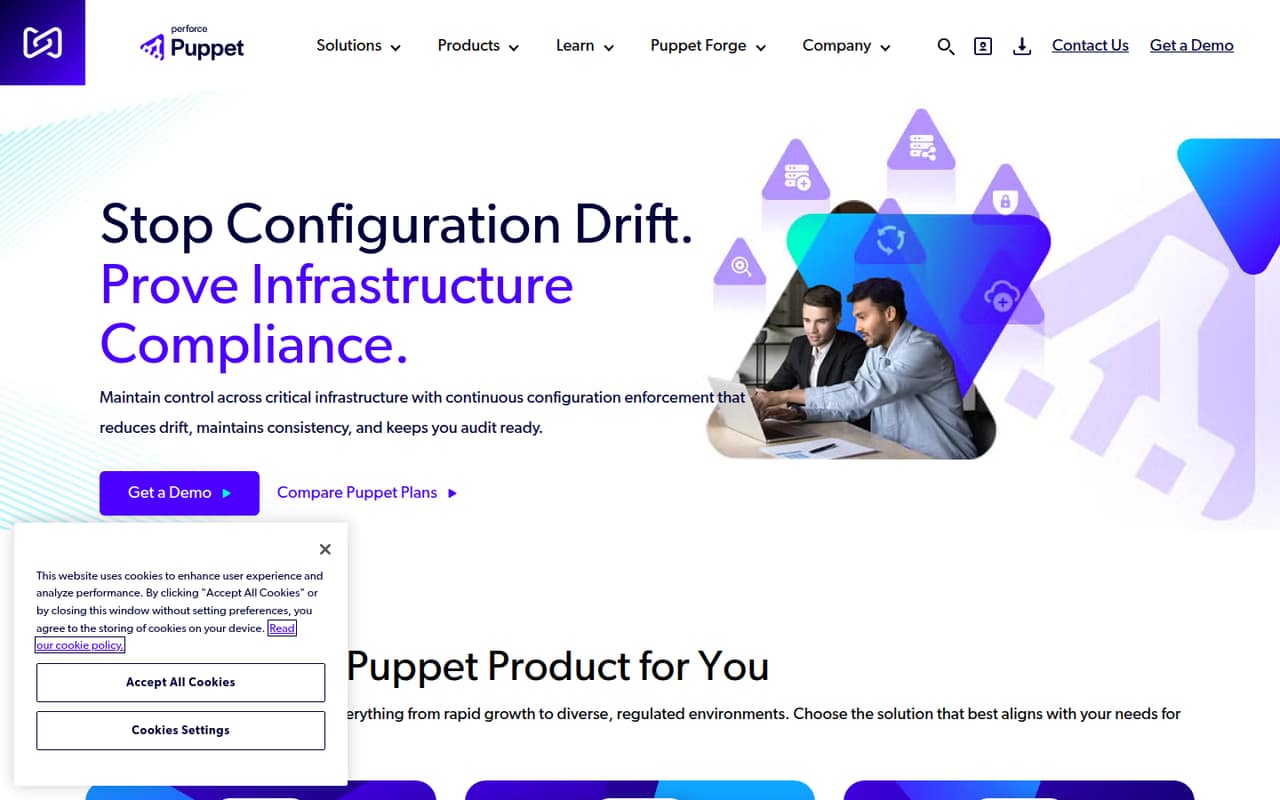
Puppet is configuration management software that checks infrastructure nodes, corrects configuration drift, and reports what it changed. That makes it a fit for teams that need repeatable enforcement and evidence for audits, including alignment with CIS Benchmarks and DISA STIGs.
The trade-off is that public pricing and technical integration details are sparse. Reddit users disagree about Puppet’s learning curve and fit, and one thread cautions against using configuration management as the Kubernetes infrastructure layer. Evaluate it against your environment and operating model before standardizing.
Good fit if
- Teams enforcing node configuration
- Infrastructure with audit requirements
- Organizations correcting configuration drift
Skip it if
- Teams seeking a quick-start tool
- Kubernetes infrastructure management alone
- Buyers requiring published usage rates
ScoresHow it rates
What works
- Automatically restores nodes to desired configuration
- Distinguishes planned changes from configuration drift
- Run reports show detected changes and actions
- Provides multiple views for filtering infrastructure nodes
- Supports policies aligned with CIS Benchmarks and DISA STIGs
What doesn't
- Custom pricing applies at 25 or more nodes
- Monthly prices are not published
- Public API, SDK, and CLI details are sparse
- Reddit users report a steep learning curve
- Fit for Kubernetes infrastructure is disputed
01What Puppet is, technically
Puppet is configuration management and automation software for enforcing a desired state across infrastructure nodes. It sits in the infrastructure operations layer: teams define security and configuration policies, Puppet checks nodes, and the system can correct detected drift by restoring the expected configuration. Its run reports show detected changes and actions taken, giving operators a record they can use to support audits.
This is not positioned as a general-purpose hosted API or a standalone infrastructure provisioning service. The product range includes Puppet Core, Puppet Enterprise, and Puppet Enterprise Advanced, with the latter two aimed at teams that need configuration management at scale or secure, scalable control. The homepage describes products and capabilities, but not where the components run. Confirm the deployment model and responsibilities with Puppet before designing around it. For a stack that already has infrastructure provisioning, Puppet’s stated role is configuration enforcement after resources exist, rather than replacing every layer of infrastructure automation.
02Puppet API, SDKs and docs
The documented workflow centers on managed nodes, configuration checks, security policies, filtering views, and Puppet run reports. Operators can filter nodes to find failures, inspect planned changes or drift, and review the latest report to see what Puppet detected and did. That gives teams a defined operations surface, but the vendor doesn't publish API, SDK, language, CLI, or protocol details on its homepage.
Before integrating Puppet into a build or deployment pipeline, confirm API access, supported SDKs and languages, command-line tooling, and available integrations in the vendor’s technical documentation. Also check how policy and configuration changes are represented, reviewed, and promoted between environments; those details affect whether Puppet fits your existing source-control and release workflow. The homepage describes custom security policies and automated reporting, but does not name specific CI systems, plugins, or other integration targets. Treat those as procurement and architecture questions rather than assuming compatibility from the product’s configuration-management role.
03Puppet pricing for developers
The pricing page lists Puppet Core (Developer) as free for teams managing fewer than 25 nodes. Its pricing notes say the Developer plan is free on annual billing; the page does not provide a monthly price. The plan includes hardened Puppet builds and is positioned as offering more reliability and control than community-supported open source.
At 25 or more nodes, Puppet Core (Commercial) moves to custom pricing. Puppet Enterprise and Puppet Enterprise Advanced are also custom-priced, with no published starting price. The published model is based on node bands and plan choice, not a disclosed per-request, per-seat, or compute rate, so teams cannot estimate a usage bill from a public unit price. The pricing page doesn't publish overage rules or paid-plan monthly prices. A dedicated Technical Account Manager and 24×7 premium support are optional add-ons with prices not published. Get a quote that spells out node counting, support costs, and how changes in managed-node count affect your contract.
04Puppet: open source, self-hosting and lock-in
Puppet distinguishes community-supported open source from its hardened Puppet Core builds. The Developer plan is described as providing more reliability and control than community-supported open source, but the homepage does not name a software license. It also does not establish whether each commercial product is self-hosted, hosted, or available in both forms. Confirm the license and deployment options with Puppet before deciding how the software fits your infrastructure policies.
The vendor doesn't publish data-export or migration details on its homepage. Puppet’s core value is configuration enforcement and its associated run reports, so moving away means replacing the rules that maintain desired state and recreating any reporting workflow your audits depend on. Ask what configuration data and reports can be exported, in which formats, and whether they remain accessible after a contract ends. The more operational policy and audit evidence depends on Puppet-specific workflows, the more migration planning matters.
05Puppet in production
Puppet’s stated production case is continuous configuration enforcement: it detects node changes, identifies drift, and can restore protected locations and nodes to the desired state. Its run reports record detected changes and actions, and its security policies can support compliance work around CIS Benchmarks and DISA STIGs. Before relying on it, verify node-count pricing, deployment responsibilities, failure handling, and how teams review corrective changes. The homepage does not publish operational limits or service reliability figures.
Reddit responses are divided. One commenter says Puppet restores changes on its next automated run, while other users describe it as harder to learn than Ansible or argue that it has a larger footprint. A separate r/devops thread questions using configuration management for Kubernetes infrastructure; a commenter says none of the configuration-management tools are a good fit for managing Kubernetes infrastructure itself. Treat those as individual opinions, but validate the target workload and operating model rather than assuming Puppet is the right layer for every cluster.
From the threadsWhat users say
Reddit sentiment is mixed: commenters value Puppet’s state enforcement, while others raise learning-curve, footprint, and workload-fit concerns. Several emphasize choosing based on the task and environment.
Puppet will automatically change that back on it's next automated run
Choose the right tool for the job
you need to spend months learning how to operate it before you can be productive
none of the CM tools are good for managing k8s infra
Questions people ask
What is Puppet used for?
Puppet automates configuration enforcement across infrastructure nodes. It checks for changes, identifies configuration drift, and can restore nodes to a desired state. Its run reports show what it detected and the actions taken, which can help teams maintain consistency and support audits.
Does Puppet correct configuration drift automatically?
Yes. Puppet's website says it identifies nodes where drift occurred and automatically corrects it to restore the desired state. Teams can review the latest Puppet run report to see what was detected and what actions were taken.
Can Puppet support compliance work?
Puppet says teams can set custom security and compliance policies and enforce them around the clock. Its homepage specifically names CIS Benchmarks and DISA STIGs, and describes run reports that record detected changes and actions taken for audit support.
Is Puppet free for small teams?
Puppet Core (Developer) is listed as free for teams managing fewer than 25 nodes. The pricing notes say the plan is free on annual billing. At 25 or more nodes, Puppet Core (Commercial) has custom pricing.
Does Puppet offer a hosted service?
The homepage describes Puppet products and configuration-management features but does not establish their deployment model. Ask Puppet whether the plan you are considering is hosted, self-managed, or offered in both forms, and clarify who operates the components in production.