
We may earn a commission if you buy through links on this page. It never changes a score or a ranking. How we make money
The bottom line
Pulumi suits software-minded infrastructure teams; price usage and set language standards before adopting it.
Pulumi is an infrastructure-as-code platform with a CLI and programming-language interfaces for defining cloud resources. It stands out when teams want reusable abstractions, policy controls and infrastructure workflows written in languages they already use.
The trade-off is that code flexibility needs standards, review and dependency security practices. Free covers individual use, while production teams should model resource, secret, workflow and discovery usage against Essentials or Pro pricing.
Good fit if
- Teams with software engineering skills
- Reusable, programmatic infrastructure
- Organizations needing policy governance
Skip it if
- Teams seeking only declarative configuration
- Organizations without IaC code standards
- Projects requiring predictable flat pricing
ScoresHow it rates
What works
- Supports TypeScript, Python, Go, .NET, Java, YAML and HCL
- Reusable components can be shared through package managers
- Governance includes policy as code and audit trails
- Free plan includes unlimited projects, stacks and environments
- Enterprise offers self-hosting and SCIM synchronization
What doesn't
- Programming-language flexibility can invite over-engineering
- Code dependencies add supply-chain review work
- Usage charges can extend beyond plan prices
- Exact licence and data-export terms need confirmation
- Reddit users report mixed views on docs and maturity
01What Pulumi is, technically
Pulumi is an infrastructure-as-code platform: teams define cloud resources in programming languages or YAML, then use Pulumi’s CLI and platform to manage infrastructure. It sits between application code and cloud-provider APIs, turning resource definitions into infrastructure workflows. The platform also covers secrets and configuration, governance, self-service infrastructure, resource discovery and AI assistance.
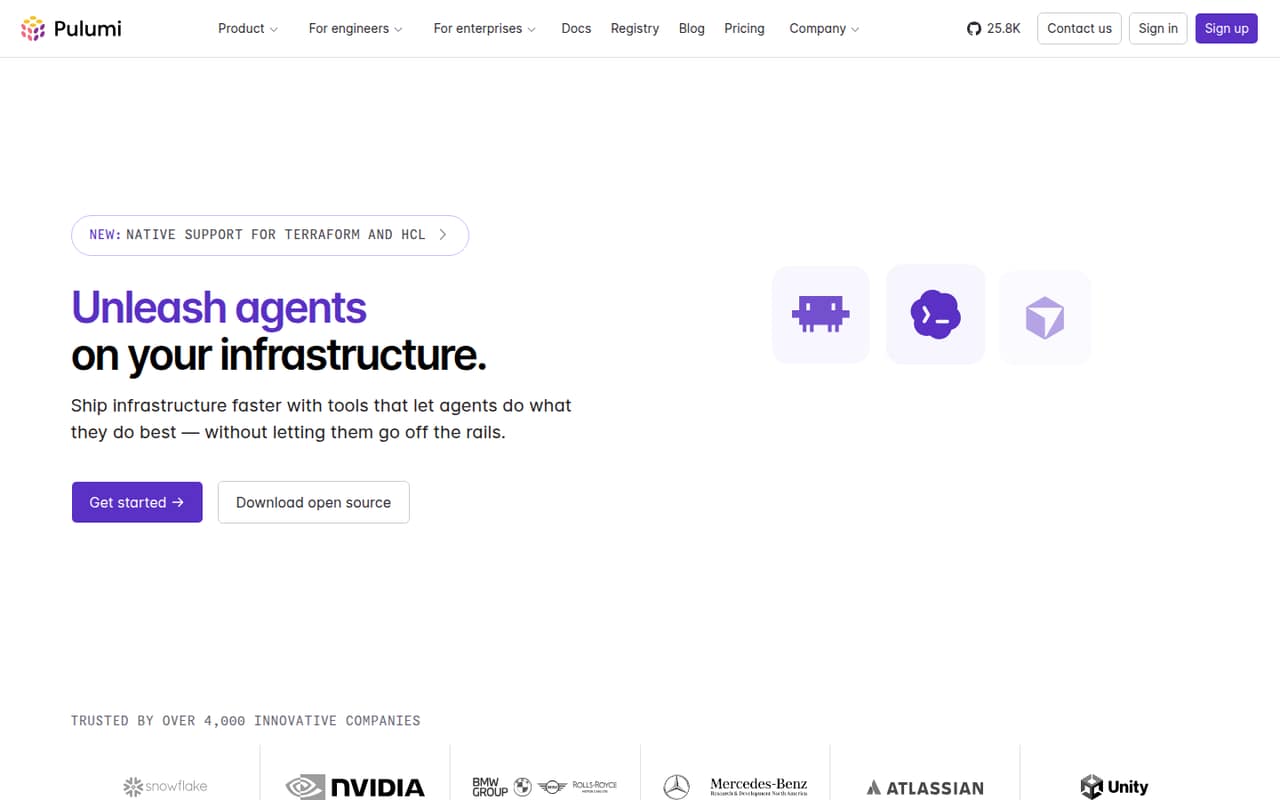
This is not just a library embedded in an application. Pulumi pairs language support with a platform for managing infrastructure, and its product features include policy controls, audit trails and compliance tracking. The homepage offers a CLI download and instructions to install Pulumi and deploy a first project. Enterprise includes a self-hosting option; the plan details do not say that self-hosting is available on lower tiers.
The core architectural choice is how much infrastructure logic to express as code. That can help when teams need abstractions or dynamic configuration. It also makes code ownership, review and language standards part of infrastructure operations.
02Pulumi API, SDKs and docs
Pulumi lets teams define infrastructure with TypeScript, Python, Go, .NET, Java, YAML or HCL. Its language interfaces let developers use familiar programming constructs to describe infrastructure; reusable components can be packaged and shared through npm, PyPI and NuGet. The product also has a CLI: Pulumi’s homepage directs engineers to install it, create a project and deploy.
For integrations, Pulumi’s Registry lists hundreds of cloud providers and packages. The documentation includes guides and API references, while the Dev Center offers tutorials, templates and examples. The homepage also identifies native support for Terraform and HCL. Check the vendor’s documentation for the precise API and package surface for each provider and language before standardizing on one.
This approach fits teams that want infrastructure code alongside application code. It asks more of code review and dependency management than a configuration-only workflow. A commenter on r/devops praised Pulumi’s programming-language experience, while another reported finding gaps in provider documentation and examples.
03Pulumi pricing for developers
Pulumi Free costs $0 per month for one user, with up to 500 workflow minutes, 25 secrets and 10,000 API calls per month. Projects, stacks and environments are unlimited. Essentials starts at $40 per month and includes 40 Pulumi Credits, up to 500 managed resources, unlimited users, five concurrent stack updates and one primary cloud account. Pro is $400 per month, with 400 credits, up to 2,000 managed resources, unlimited concurrent updates, 10 primary cloud accounts and up to 10 custom policy packs.
Usage beyond plan allowances draws from credits; one credit costs $1, and excess usage is billed in arrears. Essentials and Pro list workflow minutes at $0.01 each. Managed resources, secrets and discovered resources also carry hourly charges. Pulumi Neo costs $3 per million tokens on those plans. Standard support is $625 monthly; higher tiers cost more or require contacting sales. Essentials and Pro bill monthly in advance. Annual commitments are available only for Pro and Enterprise, with contract pricing.
04Pulumi: open source, self-hosting and lock-in
Pulumi describes its infrastructure tooling as open source and offers an open-source download. The vendor's site does not identify the specific licence, so confirm the licence and any usage conditions before adopting it. Enterprise lists self-hosting as available; the other plans do not list that option.
Pulumi code can use mainstream languages and package ecosystems, and components can be shared through npm, PyPI and NuGet. That makes code and package choices part of the migration decision: a team moving away may need to replace its Pulumi-specific resource definitions and component interfaces. The vendor's site does not describe a data-export procedure. Ask Pulumi how to export state, configuration and audit records, and test that process before you depend on the hosted platform.
05Pulumi in production
The Free plan caps API calls at 10,000 per month and workflow minutes at 500; Essentials and Pro pricing adds resource, secrets and workflow usage charges. The vendor does not publish per-minute API rate limits in the plan details, so confirm limits and expected behavior during throttling with Pulumi before designing automation around frequent calls.
Pulumi’s policy-as-code, audit trails, compliance tracking, OIDC short-lived credentials and external secret-store connections address governance and credential management. Teams still need to review their own code, packages and deployment processes. In Reddit discussions, developers describe both productivity gains and concerns about over-engineering, code dependencies and consistency when engineers leave. One commenter also reported finding provider documentation examples missing or incomplete. Treat those reports as individual experiences, and verify the provider coverage and operational workflow your services require.
From the threadsWhat users say
Reddit sentiment is mixed. Supporters value programming-language flexibility and productivity, while critics point to code complexity, team continuity and dependency security.
go with Pulumi
Every time its enabled a huge improvement in productivity
Way more footguns, a code dependency tree that now needs to be security scanned
Having IaC written in whatever feels most comfortable to the engineer who happens to be there that year is not a good business continuity strategy
Questions people ask
What languages does Pulumi support?
Pulumi supports TypeScript, Python, Go, .NET, Java, YAML and HCL for defining infrastructure. Teams can also create reusable components and share them through package managers such as npm, PyPI and NuGet.
Does Pulumi have a free plan?
Yes. Free costs $0 per month and includes one user, up to 500 workflow minutes, 25 secrets, 10,000 API calls per month, and unlimited projects, stacks and environments. Check whether your expected usage fits those limits before relying on it for production.
Can Pulumi be self-hosted?
Pulumi lists self-hosting as an Enterprise feature. The plan details do not list self-hosting for Free, Essentials or Pro. Ask Pulumi about deployment requirements, licensing and which platform capabilities are available in a self-hosted setup.
Is Pulumi open source?
Pulumi describes its infrastructure tooling as open source and offers an open-source download. Confirm the exact licence and its terms with Pulumi before adopting it; the vendor's site does not identify the licence.
What is Pulumi Neo?
Pulumi Neo is an AI infrastructure agent that uses code and organizational context to carry out infrastructure workflows. On Essentials and Pro, the listed price is $3 per million tokens. Teams should include that usage in their cost model if they plan to use Neo.