
We may earn a commission if you buy through links on this page. It never changes a score or a ranking. How we make money
The bottom line
Hosted wallets, key controls and financial flows; paid plans start at $299 per month.
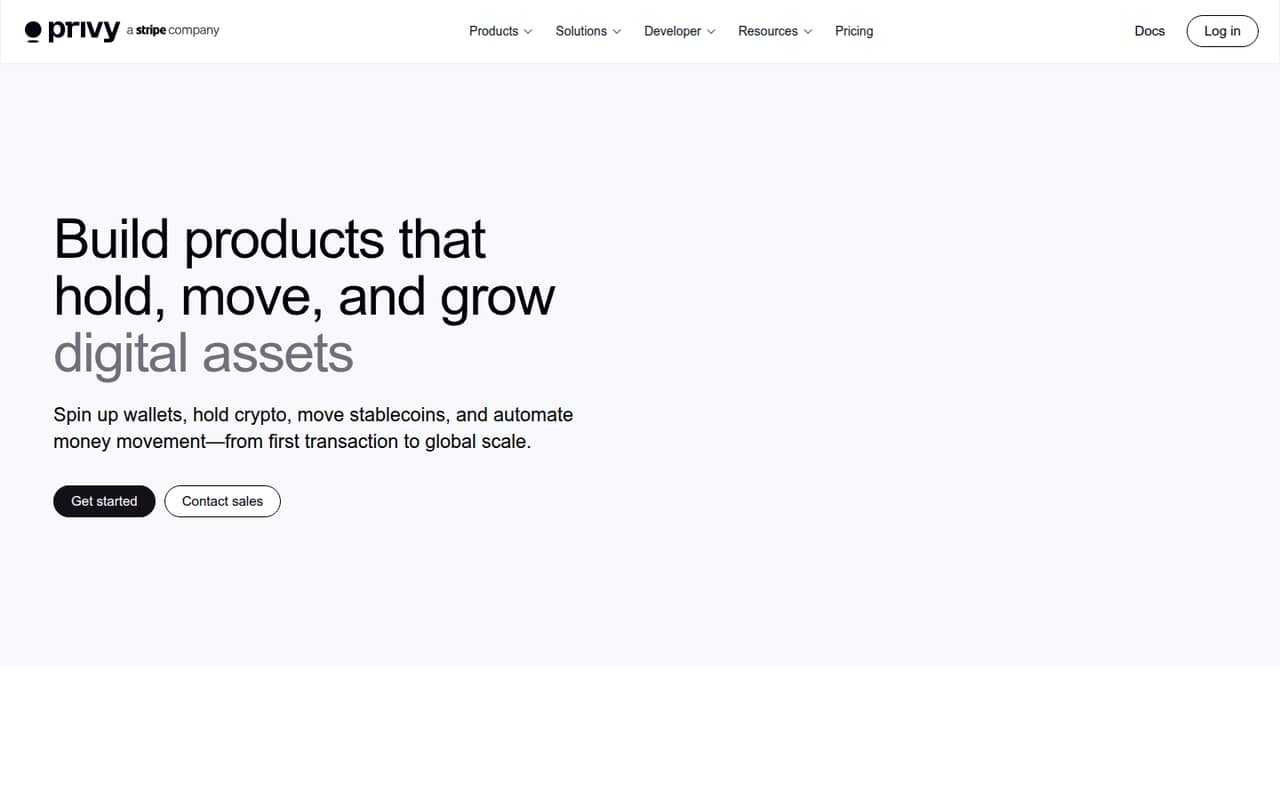
Privy is hosted wallet and financial infrastructure for products that hold crypto, move stablecoins and automate money movement. Its features include embedded and agent wallets, key management, programmable policies, funding and card programs.
A free plan covers up to 500 MAU, 50,000 signatures and $1 million in monthly transaction volume. Core starts at $299 per month; confirm usage charges, security requirements and migration options before committing.
Good fit if
- Products embedding crypto wallets
- Teams building stablecoin payment flows
- Apps with agent-controlled transactions
Skip it if
- Teams requiring self-hosted wallet infrastructure
- Projects needing published SDK language guarantees
- Products with unpredictable usage and strict budgets
ScoresHow it rates
What works
- Embedded and agent wallet options
- Programmable key management and transfer controls
- Funding, cards and spend features
- Free tier includes 500 MAU
- CLI, docs and GitHub resources
What doesn't
- Core starts at $299 per month
- Usage overages can add a $2,000 base fee
- SDK languages and API protocol need verification
- Self-hosting and data export terms need confirmation
- Rate limits and reliability commitments are not published here
01What Privy is, technically
Privy is hosted wallet and financial infrastructure that sits between an application and the digital-asset operations its users or agents need to perform. Rather than providing only a wallet library, its product lineup covers embedded wallets, key management, programmable controls, funding, cards and other financial flows. Products can use it to create wallet experiences and manage transactions without building all of that infrastructure themselves.
The platform is aimed at applications that hold crypto, move stablecoins or automate money movement. Its policy engine supports programmable rules, approvals and transfer controls; agent wallets are intended for autonomous systems that hold funds and transact. Privy also presents funding infrastructure for fiat and digital assets, plus card programs connected to wallet balances. The available product material presents Privy as a managed service, not a self-hosted server. Teams should treat it as a dependency in their wallet and transaction stack and verify how its controls, custody model and operational responsibilities fit their architecture before launch.
02Privy API, SDKs and docs
Privy provides developer documentation, a demo for customizing auth, wallets and user flows, and a GitHub area for SDKs, examples and open-source tools. Its Agent CLI is described as a way to create, fund and manage agent wallets from the command line. The homepage does not name programming languages or an API protocol, so confirm SDK support and the integration surface in Privy’s docs before choosing it for a specific stack.
The broader integration path is to use Privy’s wallet and key infrastructure in an application, then configure programmable rules and financial flows for the product’s needs. The site also points developers to guides, troubleshooting and support, plus a Security Handbook and Trust Center for technical specifications and audits. Those resources are useful starting points, but teams should verify the exact API operations, supported chains, SDK release status, versioning policy and test environment in the docs. The CLI is specifically positioned for agent wallets; do not assume it replaces application SDKs or API integrations.
03Privy pricing for developers
Privy’s Free plan costs $0 per month and includes up to 500 MAU, 50,000 signatures per month, $1 million in monthly transaction volume and core features. Core is $299 per month and lists 500–2,499 MAU, up to 2,500 MAU, the same 50,000 free signatures and $1 million volume. Scale is $499 per month for 2,500–9,999 MAU, with the same listed signature and volume allowances. The pricing page does not publish annual rates.
The pricing FAQ lists pay-as-you-go when usage exceeds 10,000 MAU, 50,000 monthly signatures or $1 million in monthly transaction volume. It gives a $2,000 base fee, $0.05 per MAU above 10,000 and $0.01 per signature above 50,000. Check how those triggers apply alongside a paid plan before estimating production costs. Enterprise pricing is custom, with pricing per transaction or transacting wallet, premium SLAs and dedicated support. The page says signature pricing can be as low as $0.001. Advanced SSO is an add-on.
04Privy: open source, self-hosting and lock-in
Privy’s developer site points to GitHub repositories containing SDKs, examples and open-source tools. That does not establish that the hosted wallet infrastructure itself is open source. The vendor's site does not state a licence for the platform, describe a self-hosting option or explain whether customers can run the service in their own environment. Ask Privy which components are open source, what licences apply and whether any production infrastructure can be self-hosted.
The vendor also does not publish data export or migration terms in the information available here. That matters because wallet operations and key management can make migration more involved than replacing an application library. Before adopting Privy, ask what wallet, transaction and user records can be exported, how key portability works, and what happens to active wallets if service ends. Treat the hosted service as a potential point of lock-in until those answers are documented.
05Privy in production
Privy’s published plan thresholds make MAU, monthly signatures and transaction volume the first capacity checks. Free includes up to 500 MAU, 50,000 signatures and $1 million in monthly volume; Core and Scale list higher MAU bands but retain those signature and volume allowances. The pricing FAQ describes additional charges beyond specified usage thresholds, so model a high-usage month before rollout and confirm how fees interact with your plan.
For a production review, check the Trust Center’s technical specifications and audits and read the Security Handbook. Privy advertises key management, policy controls, roles and permissions, but your team still needs to validate the controls against its threat model and approval requirements. Enterprise lists premium SLAs and dedicated support; the other plans’ service commitments, rate limits and availability targets are not published in the pricing details here. Ask about those limits, incident response, supported recovery procedures and export options before making Privy a critical transaction dependency.
Questions people ask
What is Privy used for?
Privy provides wallet and financial infrastructure for products that hold crypto, move stablecoins or automate money movement. Its offerings include embedded and agent wallets, key management, programmable policies, funding and card programs connected to wallet balances.
Is Privy free to use?
Yes. The Free plan costs $0 per month and includes up to 500 MAU, 50,000 signatures per month, $1 million in monthly transaction volume and core features. Usage above the listed thresholds may trigger additional charges, so check the pricing terms against your expected activity.
Is Privy safe to use?
Privy describes key management, programmable policies, approvals, roles and permissions as part of its security offering. Its site links to a Security Handbook and Trust Center with technical specifications and audits. Review those materials and confirm recovery, incident response and compliance requirements with the vendor before production use.
Can I self-host Privy?
The vendor's site presents Privy as hosted infrastructure and does not describe a self-hosted deployment option. Its GitHub area includes SDKs, examples and open-source tools, but that does not mean the wallet service can run in your environment. Ask Privy about deployment and licence options.
What does Privy cost after the free tier?
Core is listed at $299 per month and Scale at $499 per month. The pricing FAQ also lists a $2,000 base fee for pay-as-you-go usage, plus charges above specified MAU and signature thresholds. Enterprise pricing is custom; confirm how your plan and usage interact.