
We may earn a commission if you buy through links on this page. It never changes a score or a ranking. How we make money
The bottom line
PPRO handles local payment operations, but integration specifics and pricing require a sales conversation.
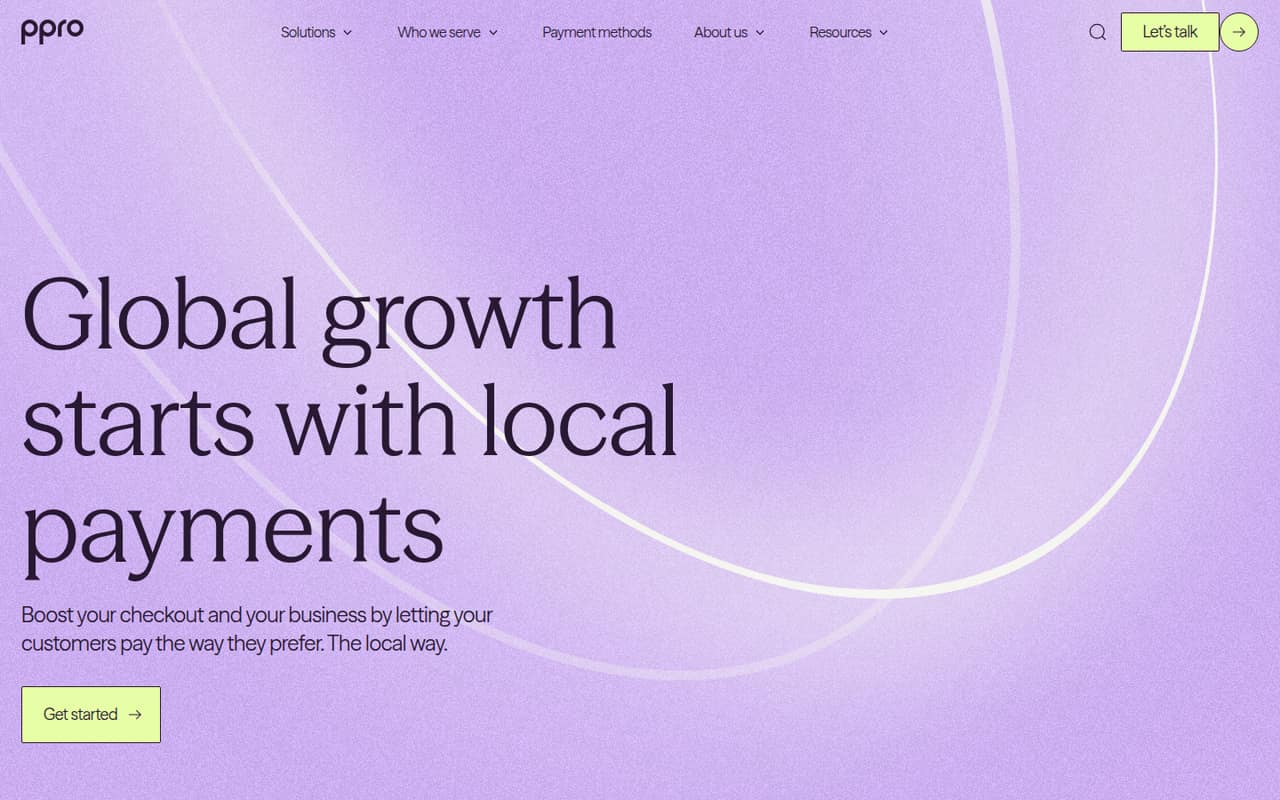
PPRO is a commercial local-payments platform for activating and accepting local payment methods, managing money flows and supporting market entry. It says it serves 3m+ merchants across 85+ markets, but its public homepage gives little detail about the developer interface.
Pricing is custom, with no published starting price, free tier or usage rates. Treat PPRO as a vendor-led payments integration: ask for the API and SDK documentation, supported methods by market, and production limits before estimating engineering effort or cost.
Good fit if
- Businesses expanding into new markets
- Teams seeking local payment operations
- Merchants needing market-specific payment methods
Skip it if
- Developers seeking a public SDK
- Teams requiring published, self-serve pricing
- Projects that must self-host payment infrastructure
ScoresHow it rates
What works
- Covers activation, acceptance and payment operations
- Reports service across 85+ markets
- Provides local market intelligence
- Offers integrations designed for checkout
- Supports a vendor-led market expansion model
What doesn't
- Pricing is custom and not published
- No free tier or trial is listed
- Public API and SDK details are unclear
- Rate limits and usage fees are not published
- Self-hosting and data export terms need confirmation
01What PPRO is, technically
PPRO is a commercial local-payments platform that sits between a business’s checkout and payment operations and the local payment methods it wants to offer. It is presented as a managed platform, not as a client library, command-line tool or self-hosted server. PPRO describes three functions: activate local methods, accept and connect them, and manage money flows.
That makes it relevant when a business is entering markets where customers expect different ways to pay, or when it wants a provider to handle local payment operations. The platform also offers local insights on consumer behavior, regulation and market dynamics. PPRO says it serves more than 3 million merchants across 85+ markets and reports €20bn in transaction volume. Those figures describe the company’s stated reach; they do not establish which methods, countries or transaction volumes are available under a particular contract. Confirm market coverage and method availability for your use case.
02PPRO API, SDKs and docs
PPRO describes integrations for connecting local payment methods and says they are designed to optimize checkout. Its homepage frames the workflow as activating methods, accepting and connecting them, then managing money flows. It does not name a protocol or a developer interface such as REST, webhooks, a CLI or plugins, and it names no SDKs or programming languages.
That leaves important implementation questions open. Before choosing PPRO, ask the vendor for its API reference, supported SDKs and languages, authentication model, webhook behavior, sandbox access and checkout integration options. Confirm whether your team can control the payment flow directly or must use a vendor-managed integration. The homepage’s general integration claims are not enough to estimate implementation effort, error handling or ongoing maintenance. Ask for an integration walkthrough using the payment methods and markets your product actually needs.
03PPRO pricing for developers
Available pricing information lists an Enterprise plan with a custom contract for businesses needing local payment services. There is no published starting price, free tier or free trial, and monthly or annual billing terms are not published. A sales quote is therefore necessary before you can compare PPRO’s cost with an implementation using other payment providers.
The available information does not give transaction rates, request-based charges, minimum commitments, overage rates or add-on prices. It also does not say how the bill changes with payment volume, markets, payment methods or support needs. Do not assume that pricing is purely usage-based or that a particular method is included in the contract. Ask for a written fee schedule covering processing, settlement, currency conversion, refunds, chargebacks, integrations and any minimums. For a production estimate, request sample costs at expected volumes and clarify how contract terms change as you add markets.
04PPRO: open source, self-hosting and lock-in
PPRO is presented as a commercial platform, but its public homepage does not state a software licence or offer source code. It also does not describe a self-hosted deployment. Treat self-hosting as unavailable unless PPRO confirms otherwise in writing; do not assume you can run the payment stack in your own environment.
Data export and migration terms are not published in the available material. Before signing, ask which payment, customer and reconciliation data you can export, in what formats, and for how long after a contract ends. Also confirm whether payment method connections, stored credentials or recurring payment arrangements can move to another provider. The practical migration effort depends on PPRO’s integration model and your contract, so get these terms before building checkout and operations around the service.
05PPRO in production
PPRO positions itself as a provider for payment acceptance and local payment operations, but production readiness depends on details your team should get from the vendor. Its public material does not provide rate limits, request quotas, uptime commitments, incident history, latency targets or service-level terms. Ask for those limits and the escalation process before routing critical checkout traffic through the platform.
Confirm security and compliance responsibilities, including which party handles payment data, what certifications apply to your deployment, and how credentials and payment events are managed. Ask how retries, duplicate requests, refunds, settlement reporting and reconciliation work for each payment method. PPRO highlights local expertise and operations, but the contract and technical documentation should define responsibilities and support coverage. Test the expected failure paths in a sandbox or vendor-led integration environment before launch, and agree on monitoring and incident procedures.
Questions people ask
What does PPRO do?
PPRO is a local-payments platform for businesses expanding into markets with different payment preferences. It offers local payment method activation, acceptance and connection, payment operations, and market intelligence. PPRO says it serves more than 3 million merchants across 85+ markets. Confirm specific market and payment method coverage with the vendor.
How do developers integrate PPRO?
PPRO describes integrations for connecting local payment methods, but its homepage does not name an API protocol, SDK, programming language, CLI or plugin. Ask PPRO for its current API reference, supported SDKs, sandbox access, authentication details and webhook behavior. Those materials will determine how the service fits your checkout and backend.
How much does PPRO cost?
Available pricing information lists an Enterprise plan with a custom contract. PPRO has no published starting price, free tier or free trial in that information, and monthly or annual terms are not published. Ask for a written quote that itemizes transaction fees, minimums, market coverage, payment methods and any additional charges.
Can I self-host PPRO?
PPRO is presented as a commercial platform, and its public homepage does not describe a self-hosted deployment or publish a software licence. Do not plan on running it in your own environment without written confirmation. Ask the vendor about deployment options, source availability, data export and what happens to your data when a contract ends.
Which payment methods and markets does PPRO support?
PPRO says it operates across 85+ markets and promotes local payment methods, but that headline does not confirm availability for a particular country or business. Its case studies mention Alipay+ and Bancontact. Ask PPRO for a current market-by-market list, supported methods, settlement currencies and eligibility requirements for your business.