
We may earn a commission if you buy through links on this page. It never changes a score or a ranking. How we make money
The bottom line
A developer-friendly hosted email API, with predictable integration and costs that rise with volume.
Postmark is a hosted email API and SMTP service for transactional and promotional email. Its separate message streams, inbound processing, templates and delivery analytics cover common application email workflows without requiring you to operate mail infrastructure.
The API and language libraries should fit many stacks, and the Free plan is useful for small tests. Production teams should model overages and add-ons, and confirm rate limits, security requirements and export options with Postmark before depending on it.
Good fit if
- Apps sending transactional email
- Teams needing inbound email webhooks
- Developers using API or SMTP
Skip it if
- Teams requiring self-hosted email infrastructure
- Senders needing a large free allowance
- Projects requiring published rate limits
ScoresHow it rates
What works
- Email API and SMTP sending
- Separate transactional and promotional streams
- Inbound email converts to JSON for webhooks
- Official libraries cover several languages and frameworks
- Free plan does not expire
What doesn't
- Free plan stops at 100 emails monthly
- Paid plans start at $15 monthly
- Paid usage overages add to the bill
- Dedicated IPs cost extra and have eligibility requirements
- Self-hosting and data export options are unclear
01What Postmark is, technically
Postmark is a hosted email delivery service: your application sends messages through its email API or SMTP service, and Postmark handles delivery. It is not a mail server you install in your codebase, nor a library that sends mail independently. The service sits between application logic—such as account registration, password resets or receipts—and recipients' inboxes.
Postmark supports transactional and promotional email through separate message streams on parallel sending infrastructure. That separation helps keep the two message types distinct in your sending setup. The service also processes inbound email into JSON and sends it to a webhook URL, so an application can handle replies or other incoming messages. Templates, delivery statistics, analytics and link tracking cover common operational needs. For a typical integration, your application calls the API or connects over SMTP; Postmark manages the sending service and related email workflows.
02Postmark API, SDKs and docs
The API uses HTTP requests with JSON payloads. The vendor's example sends a POST to https://api.postmarkapp.com/email with an X-Postmark-Server-Token header; SMTP is the alternative integration surface. The homepage documents a Node.js library installed as postmark, a Python SDK installed from PyPI as postmark-python (Python 3.10+), the postmark-rails gem and the Ruby postmark gem. It also provides a curl example that can be run in a terminal.
Postmark links to API documentation and official-library documentation, and says it has API libraries for many programming languages. The homepage also promotes Postmark Skills for AI coding agents. Email templates, inbound processing and webhooks extend the API beyond outbound messages. Migration guides cover switching from several email providers. Confirm the specific SDK, framework integration and supported API operations in Postmark's developer documentation before choosing an implementation; the service also accepts SMTP if you prefer an established mail transport interface.
03Postmark pricing for developers
The Free plan costs $0 and includes 100 emails per month, with no overages allowed; it does not expire. Paid plans start at $15 per month for Basic, which includes 10,000 emails, five custom sending domains, 45-day data retention and unlimited emails per day. Extra email costs $1.80 per 1,000.
Pro costs $16.50 monthly and Platform costs $18 monthly. Both include 10,000 emails, inbound email processing and retention up to 365 days, with 45 days as the default. Pro includes 10 custom sending domains and charges $1.30 per 1,000 extra emails; Platform includes unlimited custom sending domains and charges $1.20 per 1,000. Paid-plan overages are charged with the upcoming month's bill. Plans are billed monthly; annual plans are not offered.
Dedicated IPs start at $50 per month per IP and require Pro or higher plus at least 300,000 emails per month. Custom activity retention starts at $5 monthly, and DMARC monitoring starts at $14 per domain monthly. High-volume custom pricing requires contacting sales.
04Postmark: open source, self-hosting and lock-in
Postmark is a hosted service, not a self-hosted email server or an open-source library. The vendor does not publish an open-source licence, self-hosting option or data-export process for the service; ask Postmark how to retrieve account data and templates before building workflows that depend on them.
The sending integration is less tightly coupled if your application keeps email composition behind its own adapter: Postmark supports both an HTTP API and SMTP, so changing providers need not require rewriting every calling feature. Provider-specific templates, inbound processing and webhook handling can still create migration work. Keep message content and delivery logic in your codebase where practical, document stream configuration and DNS changes, and check how your team can move templates and historical data if you leave.
05Postmark in production
Postmark lists unlimited emails per day on Basic, but that is not the same as a published API request rate limit. The vendor does not publish a rate-limit figure here; ask about request throttling, burst behavior, retry guidance and account sending limits before sizing a production integration. Also confirm security and compliance requirements for the data your messages contain.
The pricing page's overage rates make volume growth predictable, but dedicated IPs add cost and are available only on Pro or higher for customers sending at least 300,000 emails monthly. That makes plan and IP eligibility worth checking before a traffic ramp. Developers on Reddit report positive experiences with Postmark's API and deliverability, including one commenter who said they had used it for client sites for years without deliverability issues. Another commenter described an incident in which the dashboard showed emails sent while they were not delivered. Treat those as individual reports, not service guarantees, and monitor delivery events in your own application.
From the threadsWhat users say
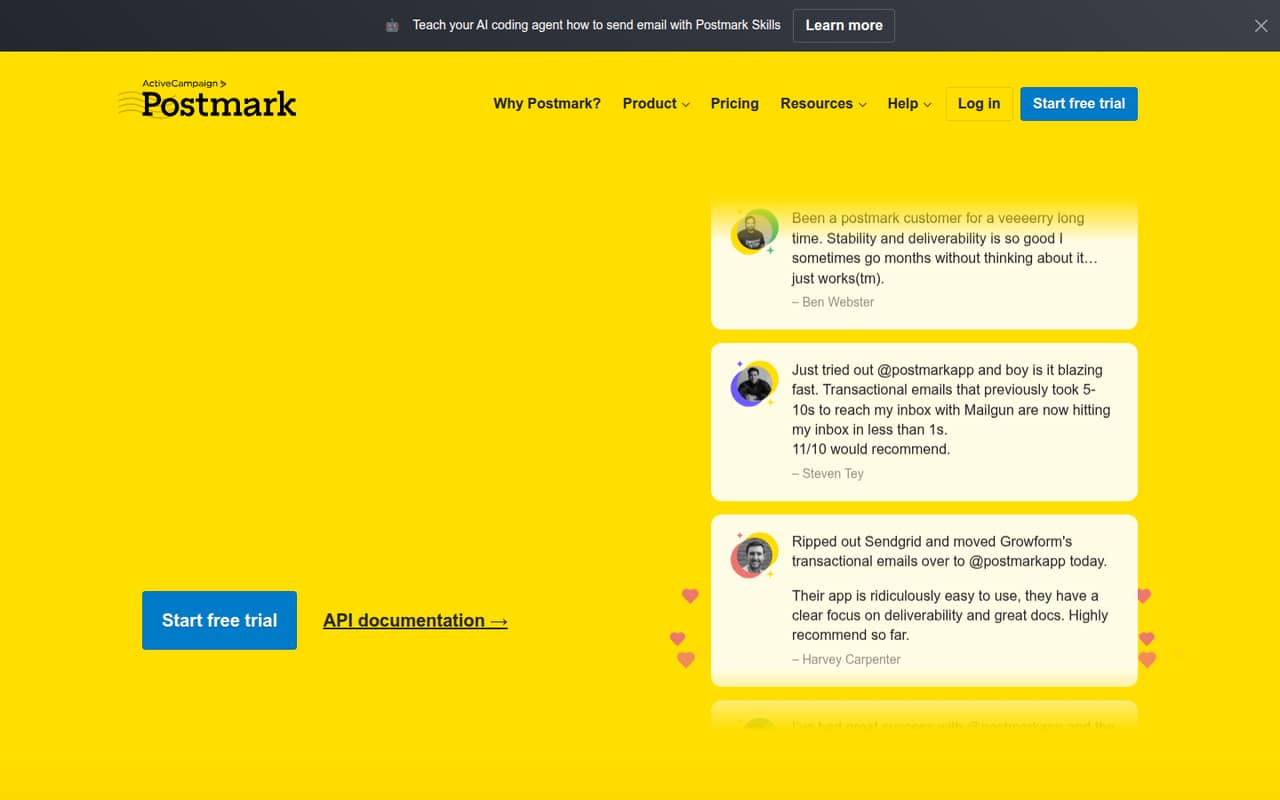
Reddit comments lean positive on ease of integration and deliverability, including reports of long-term use without issues. There are also isolated complaints about delivery visibility and account approval, so the sentiment is favorable but not uniform.
Did a lot of research on this topic. Eventually went with Postmark for all our client websites. Been using them for a few years no issues on deliverability. Easy to use API
No issues with AWS SES so far
I tried them from appsumo. I had a day no emails sent and in they're dashboard, it said all emails are sent. Refunded
I tried but they declined my account
Questions people ask
Is Postmark free?
Yes. Postmark's Free plan includes 100 emails per month, has no overages and does not expire. It is suited to testing or low-volume projects, but a production workload above that allowance needs a paid plan. The listed paid plans start at $15 per month for Basic.
Can I send email through SMTP instead of the API?
Yes. Postmark offers both an email API and an SMTP service. The API example uses an HTTP POST with a JSON body and a server-token header. Choose the interface that fits your existing mailer, then confirm the required configuration in Postmark's developer documentation.
Can Postmark handle promotional email?
Yes. Postmark supports transactional and promotional messages and keeps them on separate message streams with parallel sending infrastructure. That separation is useful when one application sends both account-related messages and promotional campaigns; check the vendor's guidance for setting up the streams.
Does Postmark support inbound email?
Yes. Postmark can process inbound email, convert it to JSON and send it to a webhook URL. Inbound email processing is included with Pro and Platform plans. Check the developer documentation for webhook setup and the application logic needed to handle incoming message data.
Is Postmark a legitimate email service?
Postmark is an email delivery service offering an API and SMTP sending, along with inbound processing, templates and delivery analytics. Reddit users report both positive long-term use and isolated problems. For a production decision, review its documentation, pricing and account requirements, then verify that its security terms fit your application.