
We may earn a commission if you buy through links on this page. It never changes a score or a ranking. How we make money
The bottom line
Flexible market-data access, but verify coverage and data quality before depending on it.
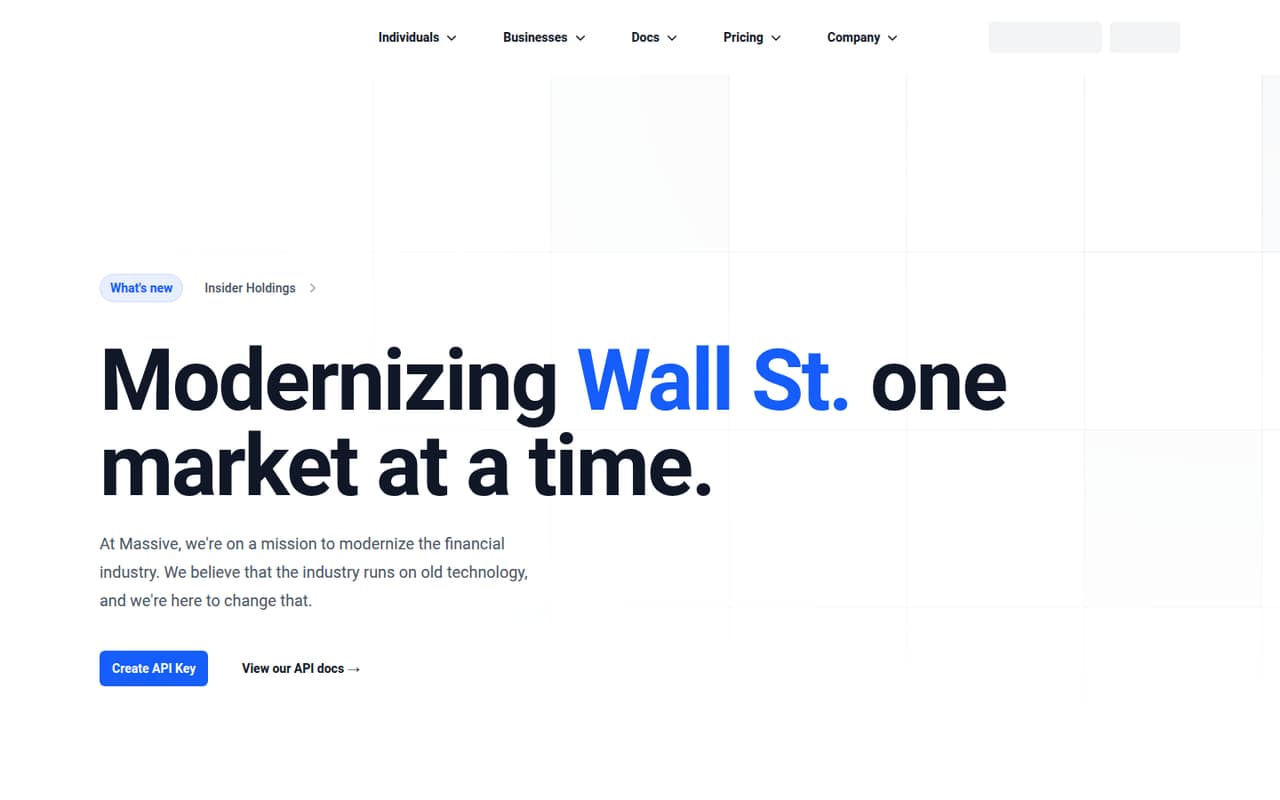
Polygon.io is a hosted financial market-data service offering REST and WebSocket APIs, S3 flat files and SQL access. It covers stocks, options, indices, currencies and futures, with JSON and CSV formats and client libraries for several languages.
The integration surface is broad, but pricing is plan-specific and the listed individual subscriptions restrict use to individuals. Reddit reports raise concerns about reference-data accuracy and historical options data, so validate the exact symbols, intervals and entitlements your application needs.
Good fit if
- Applications using REST or WebSockets
- Researchers needing historical market data
- Developers who want flat-file access
Skip it if
- Teams needing published rate limits
- Commercial users on individual subscriptions
- Projects without time for data validation
ScoresHow it rates
What works
- REST and WebSocket access for real-time and historical data
- S3 interface for flat-file datasets
- SQL queries are available by request
- JSON and CSV data formats
- Client libraries named for Python, JavaScript, Go and Java
What doesn't
- Listed subscription plans are for individual use only
- No free plan is listed in the pricing snapshot
- Rate limits and overage costs are not published
- Reddit users report reference-data errors
- Some users report issues with older historical data
01What Polygon.io is, technically
Polygon.io is a hosted market-data service, not a database you install in your own environment. It supplies financial data to applications, research workflows and trading tools through REST and WebSocket APIs, flat files accessed through an S3 interface, and SQL queries. The vendor says SQL access is available by request.
In an application stack, Polygon sits upstream of your data-processing and presentation layers: your service requests market data, then uses it in dashboards, research jobs or trading systems. The stated coverage includes stocks, options, indices, currencies and futures, with real-time and historical data. The homepage says stock data spans US exchanges, dark pools and OTC markets, and describes datasets in JSON and CSV. Flat files give batch-oriented workflows another route beyond API calls. Before building around a feed, verify that the specific asset, exchange, history and data type you need are included in your subscription.
02Polygon.io API, SDKs and docs
The main integration surfaces are RESTful and WebSocket APIs for real-time or historical data, an S3 interface for flat files, and SQL queries. Polygon says its data is available in JSON and CSV. The homepage names client libraries and provides a Python example using from massive import RESTClient; the displayed library import uses the Massive name.
The homepage lists Python, JavaScript, Go and Java alongside the client-library information. It also points developers to tutorials, examples and API documentation. The vendor describes the APIs as language-agnostic, but that does not establish identical SDK coverage or feature parity across languages. Confirm the current SDK package names, supported endpoints and authentication details in the vendor docs before choosing a client library. SQL access requires a request, while the S3 interface is aimed at accessing flat-file datasets. The homepage also describes setup prompts for AI tools, but REST, WebSocket, SQL and S3 remain the named data access methods.
03Polygon.io pricing for developers
The pricing snapshot lists no free plan and no free trial. A Polygon staff response in a Reddit thread said Reference API data was free with an account, but that is not a general free market-data subscription. The lowest listed subscription is Financials & Ratios at $29 per month, or $23.20 per month equivalent with annual billing. It includes company financials and key ratios and is marked for individual use only.
Stocks Advanced costs $199 monthly or $159.20 per month equivalent annually. It lists real-time stock data, 20+ years of history, WebSockets, financials and ratios, also for individual use. NYSE Order Imbalances costs $49 monthly or $39.20 annually equivalent; European Consumer Spending by Merchant costs $99 monthly or $79.20 annually equivalent. The page says annual billing saves 20%. Benzinga, TMX and ETF Global add-ons are each listed at $99 per month per dataset. The pricing page does not publish API rate limits, overage charges or usage-based billing, so ask about those and commercial entitlements before estimating a production bill.
04Polygon.io: open source, self-hosting and lock-in
Polygon.io is presented as a hosted data service. The vendor describes access through APIs, SQL and an S3 interface; it does not present a self-hosted server or a downloadable software package for running the service in your own infrastructure. The vendor does not publish an open-source licence for the market-data service, so confirm licensing and redistribution rights directly before embedding data in a product.
Flat files provide a way to retrieve datasets rather than relying only on live API responses, which may help with portability for workflows built around those files. The available facts do not establish a general data-export facility or the formats and rights that apply to every dataset. Applications coupled to Polygon-specific endpoints, symbols, response schemas or subscription entitlements will need an adapter and data-mapping work to migrate. Keep your own normalized storage where practical, and verify export and retention terms for the plan you choose.
05Polygon.io in production
Before relying on Polygon.io, check endpoint rate limits, WebSocket connection and message limits, historical-data coverage, symbol mapping, adjustment conventions and plan entitlements. The vendor homepage describes redundancy and horizontal scalability, but the reviewed pricing facts do not publish numeric API limits, uptime commitments or overage rules. Ask for those details, plus security and compliance documentation, before connecting a production trading or research workflow.
Reddit reports are mixed. One r/algotrading thread describes incorrect or missing reference data, including symbol mismatches; the original poster said they had not tested the WebSocket service. Other commenters reported difficulties getting issues resolved. In a separate options-data discussion, users reported concerns about historical minute data and older observations, while another commenter said their errors were few and praised the platform's speeds. These are user reports, not a measured reliability record. Build validation around the instruments and date ranges you use, and monitor for missing bars and unexpected symbol changes.
From the threadsWhat users say
Reddit sentiment is mixed but leans cautious: users describe reference-data and historical-data problems, while others report good speeds and some positive experiences. One thread also includes a Polygon staff response acknowledging reported issues.
To me it's unusable because the data is incorrect, buggy, and outdated
A friend of mine is working on a big project and emailed them last summer about some key missing data and got a similar email, but then nothing came of it
I tried Polygon, but it has many errors for data older than 5 years
For the rest you have a great platform and good speeds
Questions people ask
What data does Polygon.io provide?
Polygon.io lists real-time and historical data for stocks, options, indices, currencies and futures. Its homepage describes US stock coverage across exchanges, dark pools and OTC markets, and lists forex pairs and cryptocurrency markets under currencies. Confirm that the specific instruments, history and data types your application needs are covered by your plan.
How can I access Polygon.io data?
The vendor offers REST and WebSocket APIs, flat files through an S3 interface, and SQL queries by request. It says data is available in JSON and CSV. The homepage lists client-library support alongside Python, JavaScript, Go and Java; verify the current packages and endpoint support in the vendor documentation.
Does Polygon.io have a free plan?
The pricing snapshot lists no free plan or free trial. A Polygon staff response in a Reddit thread said Reference API data was free with an account, but that does not mean the broader market-data subscriptions are free. Check the current pricing page for eligibility and the data covered.
Can I use Polygon.io for a commercial application?
The listed subscriptions described here are marked for individual use only. That is not enough to establish commercial rights for a product or trading service. Ask Polygon about business plans, redistribution rights, exchange licensing and permitted use before integrating market data into a commercial application.
Does Polygon.io support SQL?
Yes. Polygon's homepage describes a SQL Query option for querying its data, but says to request access. The page does not establish which datasets, SQL engine, query limits or plan entitlements apply. Confirm those details with the vendor before designing a production data pipeline around SQL.