
We may earn a commission if you buy through links on this page. It never changes a score or a ranking. How we make money
The bottom line
A strong fit for AI billing, with transaction and payout fees to model before launch.
Polar is a hosted billing platform for companies selling subscriptions, credits and usage-based products. It meters events such as tokens and GPU seconds, adds usage to invoices, and can act as merchant of record in more than 100 markets.
The free Starter plan makes it accessible for early projects, but fees apply per transaction and to payouts. Before relying on it in production, confirm API details, usage limits, data export and the self-hosting position with Polar.
Good fit if
- AI products billing by token or usage
- Teams combining credits and subscriptions
- Companies seeking merchant-of-record services
Skip it if
- Teams requiring self-hosted billing
- Products needing published rate limits
- Businesses avoiding per-transaction fees
ScoresHow it rates
What works
- Meters calls, tokens and GPU seconds as events arrive
- Combines plans, prepaid credits and metered usage
- Shows inference costs and margin by customer
- Merchant-of-record service covers more than 100 markets
- Starter plan has no monthly subscription price
What doesn't
- Transaction fees apply even on the free plan
- Payout and dispute fees add to processing costs
- Rate limits and uptime commitments aren't published
- Self-hosting and the core service licence aren't clear
- Data export and migration details need vendor confirmation
01What Polar is, technically
Polar is a hosted billing platform and merchant-of-record service, not a billing library or a self-hosted server. It sits between a product and its customers: the product sends usage events, Polar aggregates them into meters, then combines metered charges with subscriptions or prepaid credits on invoices.
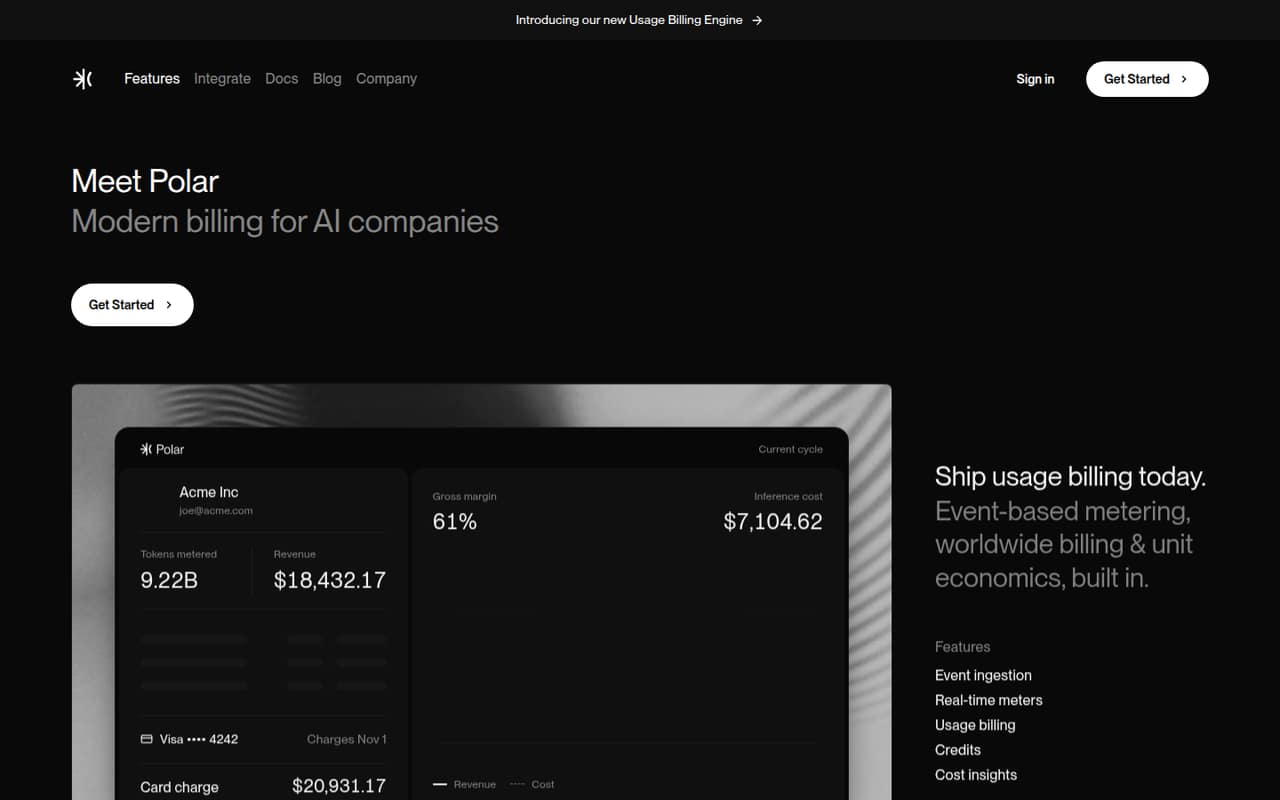
That makes it relevant to AI and other usage-based products where a seat-based subscription alone does not reflect customer consumption. Polar's event metering covers calls, tokens and GPU seconds; usage can be settled at the end of a billing cycle. Teams can attach inference costs to events and view revenue, cost and gross margin by customer.
As merchant of record, Polar says it handles payments, sales tax, fraud, refunds and chargebacks in more than 100 markets. The platform therefore reaches beyond invoice generation into payment and tax operations. It is a vendor-operated service: confirm its API, data handling and export options before making it a central dependency.
02Polar API, SDKs and docs
The homepage names a Python SDK and webhook infrastructure, and describes integrations with a Polar MCP server. Its HTTP MCP endpoint is https://mcp.polar.sh/mcp/polar-mcp; Claude Code, Cursor, ChatGPT and Claude Desktop are named clients. The MCP flow uses OAuth, with a browser sign-in rather than an API key pasted into an agent. Agents can query customer, usage and revenue data, and create products, discounts and refunds.
The homepage does not publish API protocol details or endpoint patterns. Confirm the API surface, supported SDK languages and webhook event coverage in Polar's docs before choosing an integration. The Python SDK is the only language-specific SDK named on the homepage. A code sample shows attaching an _cost amount and currency to events for margin reporting.
Polar describes a flow from event ingestion to live meters and automatic invoice settlement. That reduces the need to build usage aggregation and billing-cycle reconciliation yourself, but you still need to instrument events and validate how retries, duplicate events and failed webhooks are handled.
03Polar pricing for developers
Starter costs $0 per month and charges 5% + $0.50 per transaction. Pro is $20 per month at 3.8% + $0.40; Growth is $100 per month at 3.6% + $0.35; Scale is $400 per month at 3.4% + $0.30. The Startup Program offers Scale free for 12 months to early-stage AI startups. Early Member is a grandfathered plan for organizations created before May 27, 2026, with a 4% + $0.40 transaction fee and a 0.5% fee on subscription payments.
The monthly plans list a 0% subscription fee, except Early Member. All plans add 1.5% for international cards. Active payouts cost $2 per month, plus 0.25% + $0.25 per payout; cross-border currency conversion adds 0.25% to 1%. Disputes cost $15 each. These charges can matter more than the monthly fee as transaction volume grows. The vendor doesn't publish annual prices or a free-tier transaction ceiling, so model your mix of payments and ask about limits before launch.
04Polar: open source, self-hosting and lock-in
Polar's homepage has an Open Source link, but the vendor doesn't publish the billing service's licence or a self-hosting path there. The product described is a hosted service; do not assume you can run its billing infrastructure in your own environment. Ask Polar which components are open source, what licence applies and whether those components include the production billing service.
The vendor doesn't publish a data export process on its homepage. Before adopting Polar, confirm whether you can export customers, products, subscriptions, usage events, invoices and payment records in usable formats, and how long exports remain available after cancellation.
Migration effort will depend on how much billing state and product logic you place in Polar. Metered events and pricing configuration may need mapping to a replacement service, while payment and tax operations may need a separate provider. Keep your own copy of source usage events and document pricing rules to reduce that dependency.
05Polar in production
Polar's live metering and end-of-cycle settlement are designed for products that need usage to flow into billing without manual reconciliation. Its customer-level cost insights can also help teams spot accounts whose inference costs exceed revenue. Those features make event correctness important: verify duplicate handling, retries, late events, corrections and invoice previews before connecting meters to customer charges.
The vendor doesn't publish rate limits, uptime commitments or detailed reliability targets on its homepage. Ask for those limits, incident procedures and support response terms for the plan you expect to use. The listed plans range from standard support on Starter to prioritized support on Pro and Growth, and P1 support plus a shared Slack channel on Scale.
Polar says it handles sales tax, fraud, refunds and chargebacks as merchant of record in more than 100 markets. Confirm eligible countries, product restrictions, payout timing and the responsibilities that remain with your company. The homepage says MCP access uses OAuth, but teams should also review access controls and data permissions before enabling billing actions for agents.
Questions people ask
What does Polar do?
Polar provides hosted billing and payment infrastructure for products that sell subscriptions, credits or usage-based plans. It records usage events, aggregates them into meters, adds charges to invoices and can serve as merchant of record, handling payments and sales tax in more than 100 markets.
Is Polar a merchant of record?
Yes. Polar says it acts as the reseller of a product in more than 100 markets and takes responsibility for payments, sales tax, fraud, refunds and chargebacks. Confirm which markets and product types are eligible before relying on that coverage.
How much does Polar cost?
Starter is free monthly, with a 5% + $0.50 transaction fee. Paid plans range from Pro at $20 per month to Scale at $400 per month, with lower transaction fees. International-card, payout, currency-conversion and dispute fees may also apply.
Does Polar support usage-based billing?
Yes. Polar meters events such as calls, tokens and GPU seconds, aggregates them by customer and adds usage charges to invoices. It also supports combining a base plan, prepaid credits and metered usage on one product.
Which SDKs and integrations does Polar offer?
The homepage names a Python SDK and webhook infrastructure, plus an MCP server that connects with Claude Code, Cursor, ChatGPT and Claude Desktop. The MCP server uses OAuth. Confirm supported SDK languages and API details in Polar's documentation.