
We may earn a commission if you buy through links on this page. It never changes a score or a ranking. How we make money
The bottom line
Pingdom covers uptime, transactions and real users, but check API limits and costs before scaling.
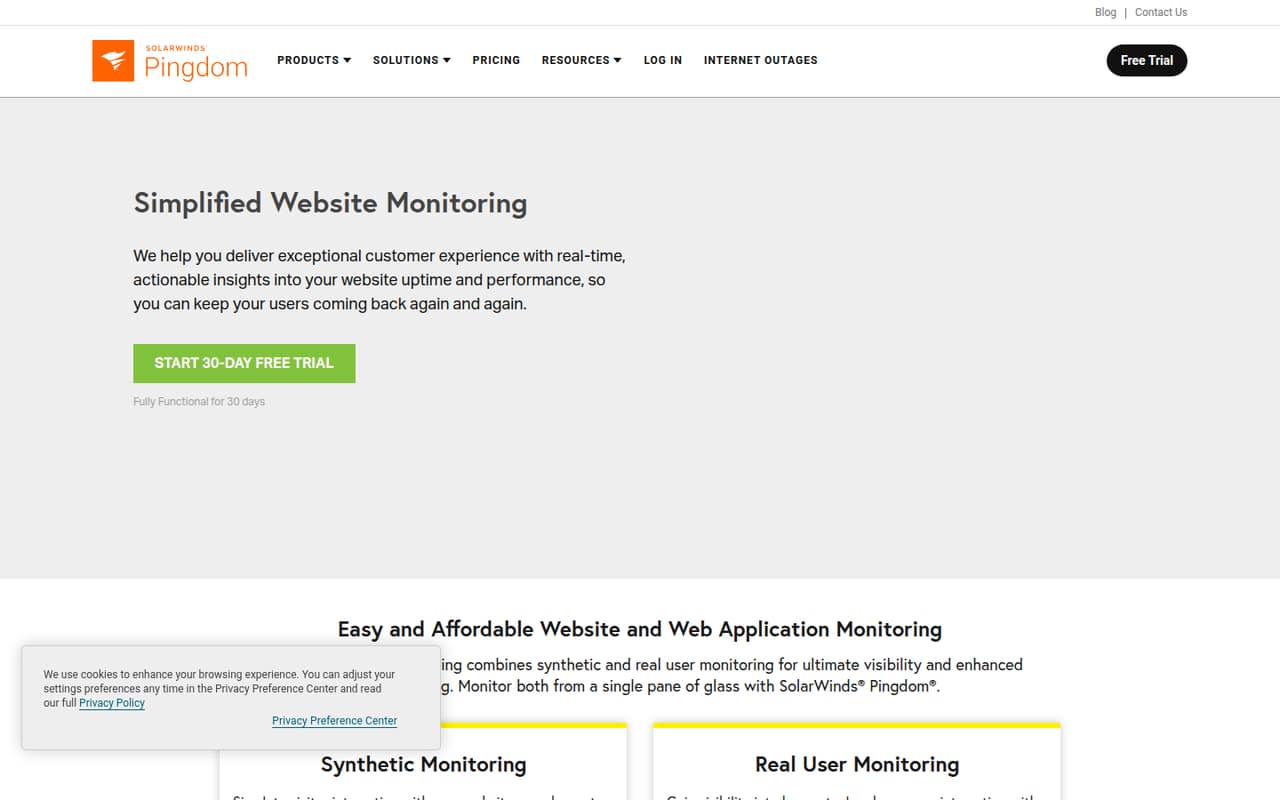
Pingdom is a hosted website and web-application monitoring service. Synthetic checks cover uptime, page speed and transactions; real user monitoring adds browser, device and location views. Its linked API, webhooks and plugins offer integration paths, though teams should confirm SDK support and operating limits in the docs.
The 30-day trial is followed by paid plans, with annual-billed starting prices of €14.33 per month for Synthetic Monitoring and Real User Monitoring. There is no free plan, and published prices do not show the monthly-billed rates or how prices change as usage grows.
Good fit if
- Teams monitoring web-app uptime
- Sites testing key user journeys
- Teams tracking real visitor experience
Skip it if
- Teams requiring self-hosted monitoring
- Projects needing a free ongoing tier
- Teams needing published API limits
ScoresHow it rates
What works
- Checks availability from over 100 locations
- Tests transactions such as logins and checkouts
- Combines synthetic checks with real user monitoring
- RUM plan includes 13-month data retention
- Offers a 30-day fully functional trial
What doesn't
- No free plan is listed
- Monthly-billed rates are not published
- SDKs and supported languages are not named
- API rate limits are not published on the homepage
- No self-hosted deployment route is listed
01What Pingdom is, technically
Pingdom is a hosted monitoring service for websites and web applications, not a library, CLI or self-hosted server. It sits outside the application stack and checks availability and performance from monitoring locations. Synthetic checks simulate visitor interactions, including uptime, page speed and transactions such as registrations, logins and checkouts. Real user monitoring (RUM) collects experience data from actual visitors, with views by browser, device and geographic location.
That puts Pingdom alongside an application in production: use it to detect outages or slow pages and to observe how visitors experience the service. The homepage says uptime monitoring checks from over 100 locations worldwide. It also describes alerts by email and SMS and public status pages for communicating service status. Pingdom is part of the broader SolarWinds Observability offering, which also includes infrastructure monitoring, application performance monitoring and log management. Those offerings are presented as separate capabilities, so teams should check which products and plans cover their required stack.
02Pingdom API, SDKs and docs
The homepage links to a Pingdom API, technical documentation, a datasheet, Getting Started, FAQs and a knowledge base. It also names webhooks and a collection of plugins, apps and add-ons as integration surfaces. That gives teams places to start for automation and event handling, but the homepage does not name an API protocol, SDK, programming language or CLI. Confirm supported SDKs and API behavior in Pingdom’s technical documentation before choosing an integration approach.
For an application stack, the likely fit is to connect monitoring configuration or events to existing operational workflows, then use alerts to notify the people or systems responsible for response. The homepage describes email and SMS alerts, but does not give implementation examples or name specific third-party integrations. It also links to support tickets and training resources. Treat the API and webhook documentation as the source of truth for authentication, payload formats, retry behavior and limits; do not assume a particular client library or language is supported.
03Pingdom pricing for developers
Pingdom has no free plan; its pricing page lists a 30-day fully functional trial. Synthetic Monitoring starts at €14.33 per month when billed annually. That starting quantity includes 10 uptime checks, 1 advanced check, 50 SMS alerts and unlimited users, with uptime, page-speed and transaction monitoring. Real User Monitoring also starts at €14.33 per month on annual billing and includes 100,000 pageviews, unlimited sites and users, shareable reports and 13-month data retention.
The pricing page offers annual and monthly billing but lists only the annual-billed monthly equivalent, so monthly rates are not published. Higher usage means checking the plan’s quantities: RUM has a 100,000-pageview starting quantity, while Enterprise covers 500,000 to over 5 million monthly pageviews and requires a quote. The vendor does not publish the price for additional quantities or overages on this pricing information. No add-ons are listed. Get current pricing for your expected check, pageview and alert volumes before budgeting.
04Pingdom: open source, self-hosting and lock-in
Pingdom is presented as a hosted monitoring service. The homepage does not list a self-hosted edition or source release, so teams should treat it as a proprietary hosted dependency and confirm licensing terms with the vendor. Its API and webhooks may help connect Pingdom to internal tooling, but that is not the same as being able to move the monitoring service itself.
Before adopting it, ask whether monitoring configuration, reports and historical data can be exported in a usable format, and whether the API covers that workflow. The homepage does not describe a data-export path. Migration would mean recreating checks, transaction flows, alerts and any status-page setup in another service; the effort depends on how much configuration the team builds around Pingdom. Keep check definitions and response procedures in your own documentation where possible, rather than relying on a monitoring dashboard as the only record.
05Pingdom in production
Pingdom’s synthetic checks and RUM cover different failure signals: synthetic monitoring tests whether selected pages and transactions work, while RUM reports how actual visitors experience the site. That combination can help teams separate a broken journey from a broader performance problem. Before depending on it for incident response, confirm check frequency, alert delivery behavior and how the service handles failed checks.
The vendor does not publish API rate limits, an availability SLA or security and compliance details on the homepage; ask for those terms before integrating Pingdom into a production control plane. RUM data also calls for a review of privacy, consent and retention requirements. The RUM plan lists 13-month data retention. In Reddit discussions, users raise concerns about losing basic free accounts and the cost of paying for monitoring; these are individual reports, not evidence of a general reliability pattern. One self-hosting thread also illustrates that running an alternative monitor brings its own operational burden.
From the threadsWhat users say
The Reddit discussion is mixed and centers on the loss of basic free accounts, reluctance to pay, and interest in alternatives. The comments discuss other monitoring tools rather than providing a broad assessment of Pingdom’s current reliability.
Anyone know selfhosted pingdom alternative?
I'm using Gatus for this
Pingdom are no longer supporting basic free accounts
I don't really want to pay £10/mo for that
Questions people ask
Does Pingdom have a free plan?
No free plan is listed. Pingdom offers a 30-day fully functional free trial. After the trial, the listed plans are Synthetic Monitoring, Real User Monitoring and Enterprise. The pricing page does not list an ongoing free tier.
What does Pingdom monitor?
Pingdom monitors website and web-application availability and performance. Synthetic monitoring covers uptime, page speed and transactions, while real user monitoring reports on actual visitor experience by browser, device and geographic location. The broader SolarWinds Observability offering also describes infrastructure monitoring, application performance monitoring and log management.
How much does Pingdom cost?
Synthetic Monitoring and Real User Monitoring each start at €14.33 per month when billed annually. The pricing page offers monthly billing but does not list its rates. Enterprise pricing is custom, with pageview volumes from 500,000 to over 5 million per month. Prices can depend on the quantity selected.
Can I self-host Pingdom?
Pingdom is presented as a hosted monitoring service, and the homepage does not list a self-hosted edition. Teams that require self-hosting should confirm with the vendor whether another deployment option exists. The Reddit discussions include people seeking self-hosted alternatives, not instructions for running Pingdom themselves.
Does Pingdom have an API?
Yes. Pingdom’s homepage links to a Pingdom API, technical documentation and webhooks, as well as plugins, apps and add-ons. It does not name SDKs or supported programming languages on the homepage. Check the technical documentation for API details and confirm SDK support before planning an integration.