
We may earn a commission if you buy through links on this page. It never changes a score or a ranking. How we make money
The bottom line
Phyllo offers broad social data coverage through hosted APIs, but custom pricing makes value hard to assess.
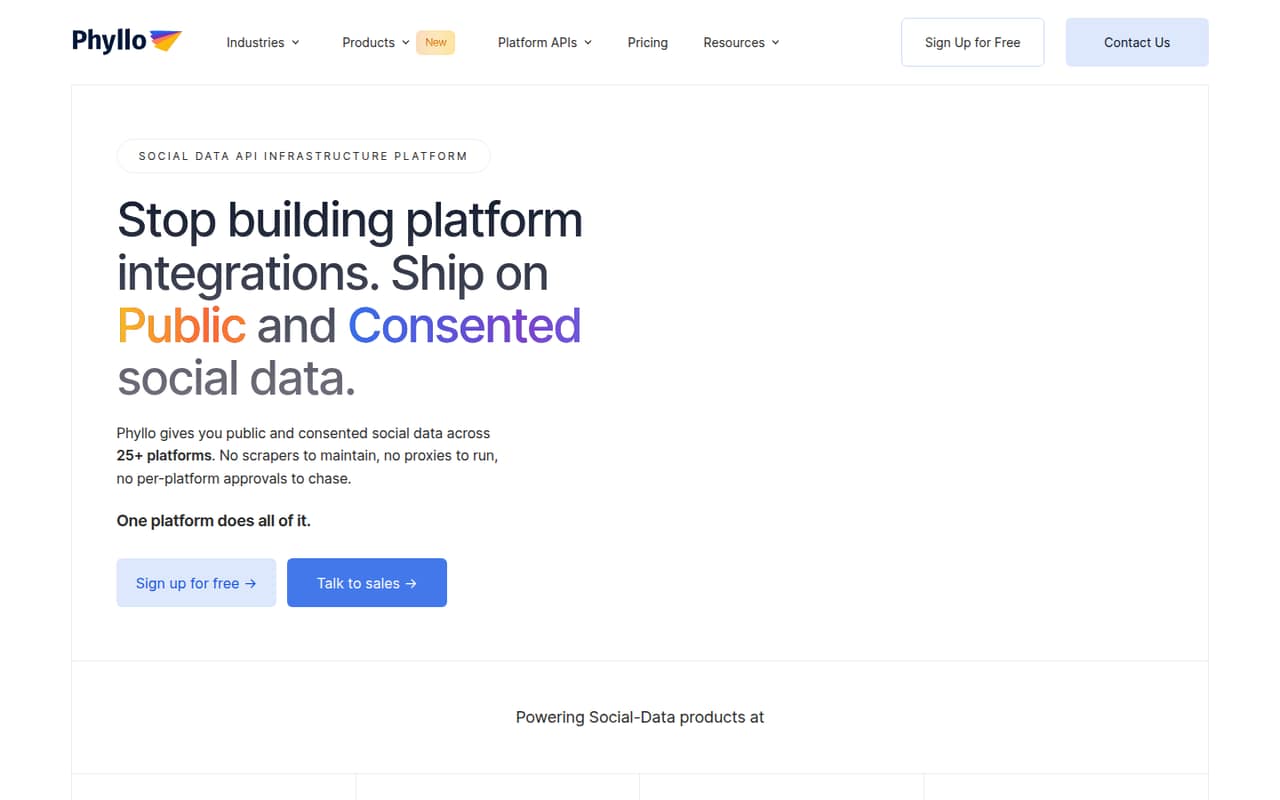
Phyllo is a hosted social data API platform with public and creator-consented data across 25+ platforms. Its advertised surfaces include creator search, profile analytics, content, social listening, verified income and private performance metrics, returned on a shared data standard.
It could replace a collection of platform-specific integrations, but the vendor’s pricing is quote-based, with no public production free plan or usage limits listed. Treat it as a sales-led dependency: confirm coverage, quotas, security terms and export options before building around it.
Good fit if
- Creator analytics product teams
- Influencer marketing platforms
- Apps needing consented creator data
Skip it if
- Teams requiring self-hosted infrastructure
- Projects needing predictable public pricing
- Developers seeking a published SDK matrix
ScoresHow it rates
What works
- Public and consented data share a standard
- Creator search covers 470M+ profiles
- Social data spans 25+ platforms
- Consent enables private performance and income data
- Free sandbox for API testing and development
What doesn't
- Production pricing requires a custom quote
- Usage limits are not published
- No production free plan is listed
- SDK languages and CLI support are not named
- License, self-hosting and export terms need confirmation
01What Phyllo is, technically
Phyllo is a hosted social data API platform, not a library or self-hosted server. It sits between your application and social platforms, returning public profile, content and listening data alongside creator-approved account data. The vendor says both data layers use the same standard, so an application can work across them without changing its parser.
The public layer covers creator search, profile analytics, content and social listening; public data does not require an account connection. The consented layer requires creator permission and can provide verified income, audience details and private performance metrics. Phyllo also markets social screening, identity verification and a Linkage SDK for connecting social profiles to an app.
The architectural tradeoff is straightforward: you can avoid maintaining integrations and platform access processes yourself, but your product depends on Phyllo’s coverage and service. The homepage describes 25+ platforms and search across 470M+ profiles. Validate the specific platforms and fields your product needs before treating that breadth as guaranteed coverage.
02Phyllo API, SDKs and docs
The integration surface is Phyllo’s APIs, with a separate Linkage SDK described as a way to connect a user’s social profiles to your app. The homepage also links to developer documentation and refers to public and authenticated APIs. It does not name an API protocol, SDK language matrix, CLI, webhook support or code examples, so confirm those details in the vendor’s docs before choosing an implementation path.
A typical architecture would keep Phyllo calls behind your own service boundary, normalize the returned data into your internal model, and keep creator consent and account-linking flows explicit in the product. Phyllo says public data can be retrieved without an account connection; access to consented metrics depends on creator approval. That split affects both onboarding and what your application can show.
The shared data standard may reduce per-platform parsing work, but it does not remove the need to validate field coverage and behavior by platform. Ask for current API references, SDK support for your languages, authentication requirements, error handling guidance and versioning policy. The vendor’s homepage links to Dev docs; confirm SDK support there.
03Phyllo pricing for developers
Phyllo lists customized Startup, Growth and Enterprise plans, priced by quote. The pricing information also lists a free sandbox for API testing and development, but no production free plan. A public starting price, monthly or annual rate, and add-on prices are not listed, so a team cannot estimate a production bill from published rates.
Usage limits, billable units and overage terms are also not listed. The vendor does not give a public formula showing whether costs grow with profiles searched, API requests, connected accounts, data types or seats. Ask sales to define those units and provide sample costs for your expected traffic, including any costs for consented data, additional platforms, or production environments.
The sandbox is useful for development, but it does not establish what a live workload will cost or what production quota it includes. Treat the custom quote as a procurement dependency: get written limits, overage handling, rate limits and renewal terms before committing. With no public production price, value depends on the quote and the engineering work Phyllo replaces.
04Phyllo: open source, self-hosting and lock-in
Phyllo is presented as a hosted API platform, not as software to deploy in your own infrastructure. The vendor does not publish an open-source license, a self-hosting option or a data export process on the homepage, so ask directly before treating any of those as available. The integration therefore creates a dependency on Phyllo for data access and platform coverage.
Migration effort depends on how tightly your application adopts Phyllo’s schema and consent flows. The vendor says its public and consented layers share a standard, which can simplify your own code across those layers, but that is not the same as portability to another provider. Keep an internal data model, isolate API calls behind an adapter, and store only data you are allowed to retain. Confirm retention, deletion, export formats and what happens to connected accounts when a contract ends.
05Phyllo in production
The key production questions are quotas, rate limits, platform coverage and failure behavior. Phyllo’s pricing information gives no public usage limits, and the homepage does not state rate limits or service-level commitments. Ask for those terms, plus retry guidance, pagination behavior, freshness guarantees and how the API reports platform outages or unavailable fields. Test your own fallback behavior against the vendor’s documented responses before tying customer-facing features to live data.
Consent is another operational boundary. Public data is described as available without account connection; private performance and verified income require creator approval. Build authorization state into your data model, and ask how revocation, deletion and expired connections are surfaced. For screening and identity-related use cases, establish what the returned results mean and how your team should review them.
The homepage says Phyllo avoids maintaining scrapers, proxies and per-platform approvals. That can reduce integration work, but makes coverage and uptime a vendor dependency. Review security, privacy and compliance terms with the vendor before sending account or user data.
Questions people ask
What does Phyllo provide to developers?
Phyllo provides hosted APIs for public and creator-consented social data across 25+ platforms. Its public data surfaces include creator search, profile analytics, content and social listening. With creator permission, its consented APIs can provide verified income, audience details and private performance metrics.
Does Phyllo have a free plan?
The pricing information lists a free sandbox for API testing and development, but no production free plan. Production plans are listed as customized Startup, Growth and Enterprise plans with quote-based pricing. Confirm sandbox quotas and any production requirements with Phyllo before planning a launch.
Does Phyllo provide private creator analytics?
Yes, Phyllo describes a consented data layer for metrics that public sources do not expose. Examples include verified income, real audience demographics, engagement rate, stories, reach and saves. Access depends on the creator approving the connection and the requested fields.
Which SDKs and programming languages does Phyllo support?
The homepage names a Linkage SDK for connecting a user’s social profiles to an app, and links to developer documentation. It does not list supported SDK languages or a CLI. Check the current docs or ask Phyllo which SDKs, API protocols and examples are available for your stack.
Can we self-host Phyllo or export data if we leave?
Phyllo is presented as a hosted API platform. Its homepage does not publish a self-hosting option or a data export process. Before adopting it, ask about export formats, data retention and deletion, connected-account handling, and how your contract defines access at termination.